

By R. Luke Sturgill, MD · Double Board-Certified Facial Plastic Surgeon · Carmel, Indiana
Eyelid Surgery
Look Rested. Not “Done.”
The eyes are the first thing people notice—across the room, in conversation, and in every photo. They communicate energy, health, and emotion before a single word is spoken. When the eyelids look heavy or puffy, they can unintentionally project fatigue, stress, or sadness that doesn’t match how a person actually feels.
Here’s the problem: the traditional way of thinking about eyelid surgery is reduction. It’s not. It’s about restoration.
When the upper lids feel heavy or the under-eyes look puffy, tired, or hollow, the goal is to restore clean contours and a natural lid–cheek transition—so patients look like themselves again… just refreshed.
Dr. Sturgill’s approach is straightforward: identify what’s actually driving the tired look—skin, fat, volume loss, lid support, brow position, or true eyelid droop—then choose the least disruptive plan that reliably delivers the best result.
Most “bad bleph” results come from the same mistakes:
- Too much skin removed
- Too much fat removed
- Changing eyelid shape when it was fine to begin with
- Treating the eyelid when the brow is the real issue
- Missing ptosis (true eyelid droop)
That’s how eyes end up looking hollow, pulled, round, or simply “different.”
This is the opposite approach:
- Brighter eyes without changing identity
- Smoother under-eyes without a round “operated” lower lid
- Natural fullness preserved—no skeletonized look
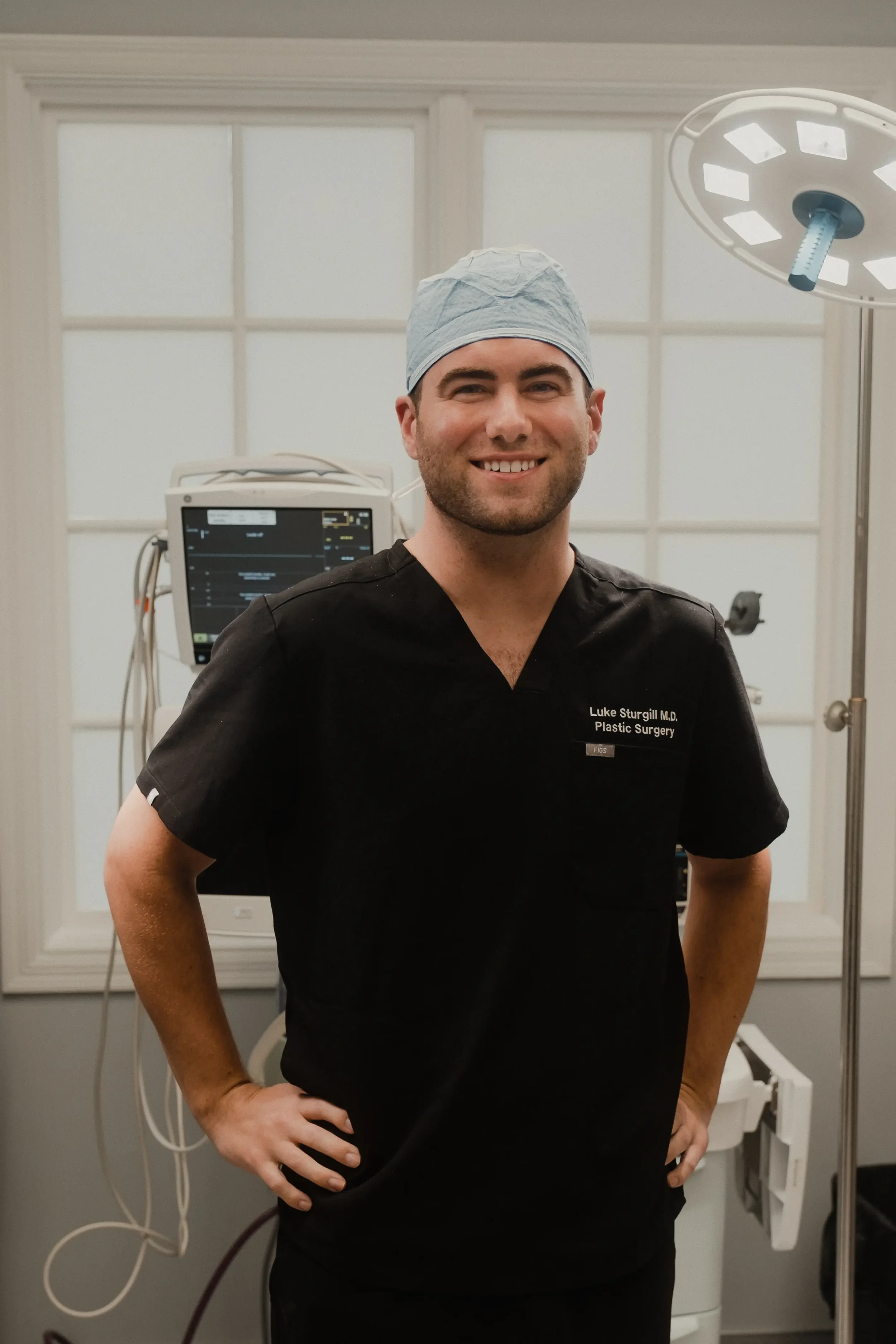
R. Luke Sturgill, MD ◆ Facial Plastic Surgeon
The Consultation
What Dr. Sturgill Is Actually Evaluating
Eyelid surgery isn’t one-size-fits-all. During a consultation, Dr. Sturgill evaluates the entire periorbital unit—not just the eyelids:
- Brow position — and how the forehead contributes to upper lid heaviness
- Upper lid skin — how much lid platform shows and where the crease sits
- Crease position & eyelid shape — whether surgery would alter it
- Under-eye “bags” — fat prominence versus hollowing and volume loss
- Skin quality — crepey texture, sun damage, and pigment changes
- Lower lid support — tone, laxity, and risk of malposition
That analysis determines the plan. No cookie-cutter blepharoplasties. No forcing a technique. Just the right moves for each patient’s anatomy.
Book Your Consultation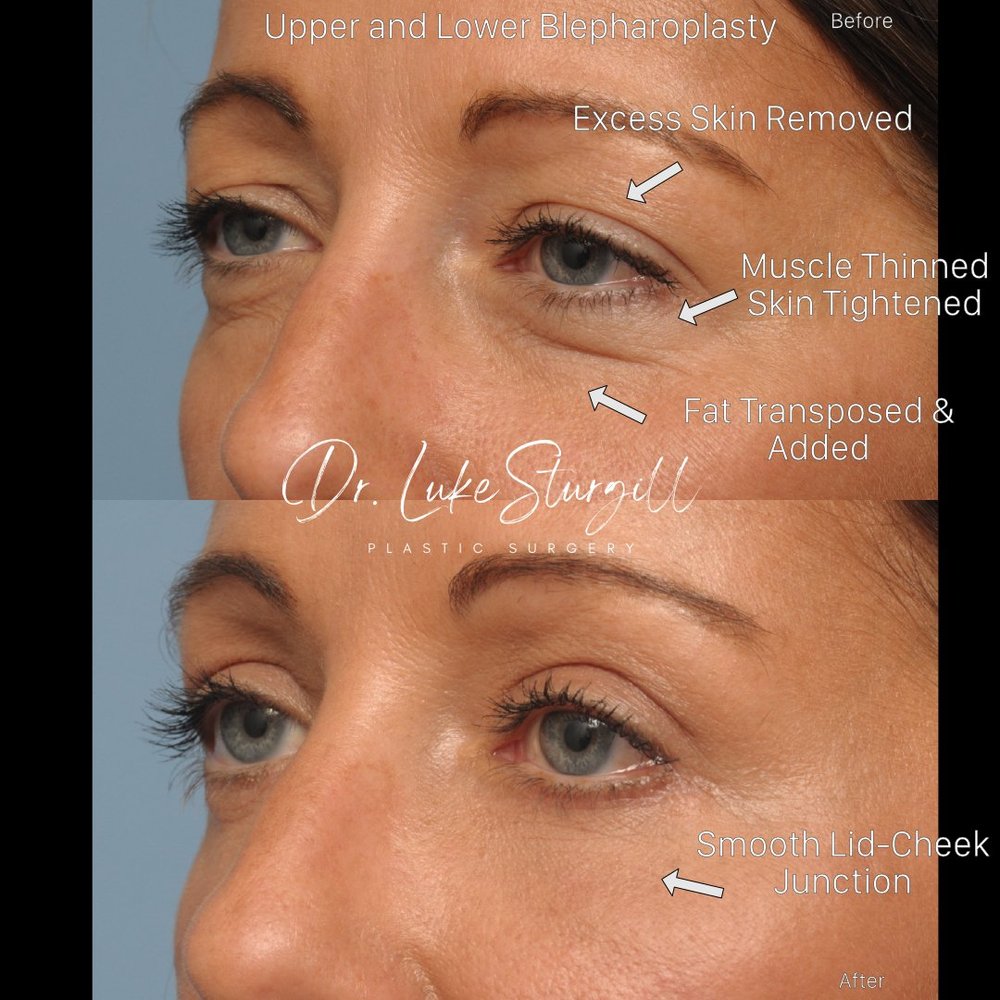
Upper & Lower Blepharoplasty ◆ Before & After
Real Patient Results
Before & After
The goal of eyelid surgery is never to look “done” — it’s to look like yourself again, only more rested and refreshed. What patients notice first in these results isn’t any single change. It’s that the eyes finally match how they feel — brighter, more open, and naturally full. No two patients receive the same operation because no two sets of eyelids age the same way.
Our Photography Standards
100mm macro lens. Dual-light setup. Standardized positioning. No angles, no tricks. Learn why this matters and how to evaluate any surgeon’s before & after photos.
What to Look For
Here’s what separates a thoughtful blepharoplasty from a “just remove skin” approach:
A note on photos: All images are unretouched and show real patients of Dr. Sturgill photographed under standardized clinical lighting with a 100mm macro lens. Results vary by individual anatomy, skin quality, and healing response. These photos represent typical outcomes — not best-case-only marketing.
Upper Eyelid Surgery
Upper BlepharoplastyUpper blepharoplasty removes excess skin from the upper eyelids through an incision hidden within the natural eyelid crease. Once healed, the incision is essentially invisible. The procedure restores definition to the eyelid crease, makes the eyes look larger and more open, and eliminates the heavy, hooded appearance that accumulates with age or genetics.
Not all upper eyelid heaviness is the same. Some patients have true skin excess where the skin alone has stretched and hangs over the crease. Others have a component of fat prolapse where the orbital fat has shifted forward. And in many cases, the apparent heaviness is actually caused by brow descent pushing tissue onto the eyelid from above.
What Dr. Sturgill Evaluates
- Brow position — is the brow contributing to the lid heaviness?
- Crease position — how much of the natural crease is visible?
- True skin excess versus pseudo-excess from brow descent
- Fat distribution — medial and lateral compartments
- Ptosis — is the eyelid margin itself drooping?
- Eyelid symmetry and natural anatomy worth preserving
Approximately 40% of patients who think they need an upper blepharoplasty also benefit from addressing brow position — either with an endoscopic brow lift or a conservative internal browpexy performed through the same incision. The mirror test above can give you a preview, but precise evaluation requires an in-person examination.
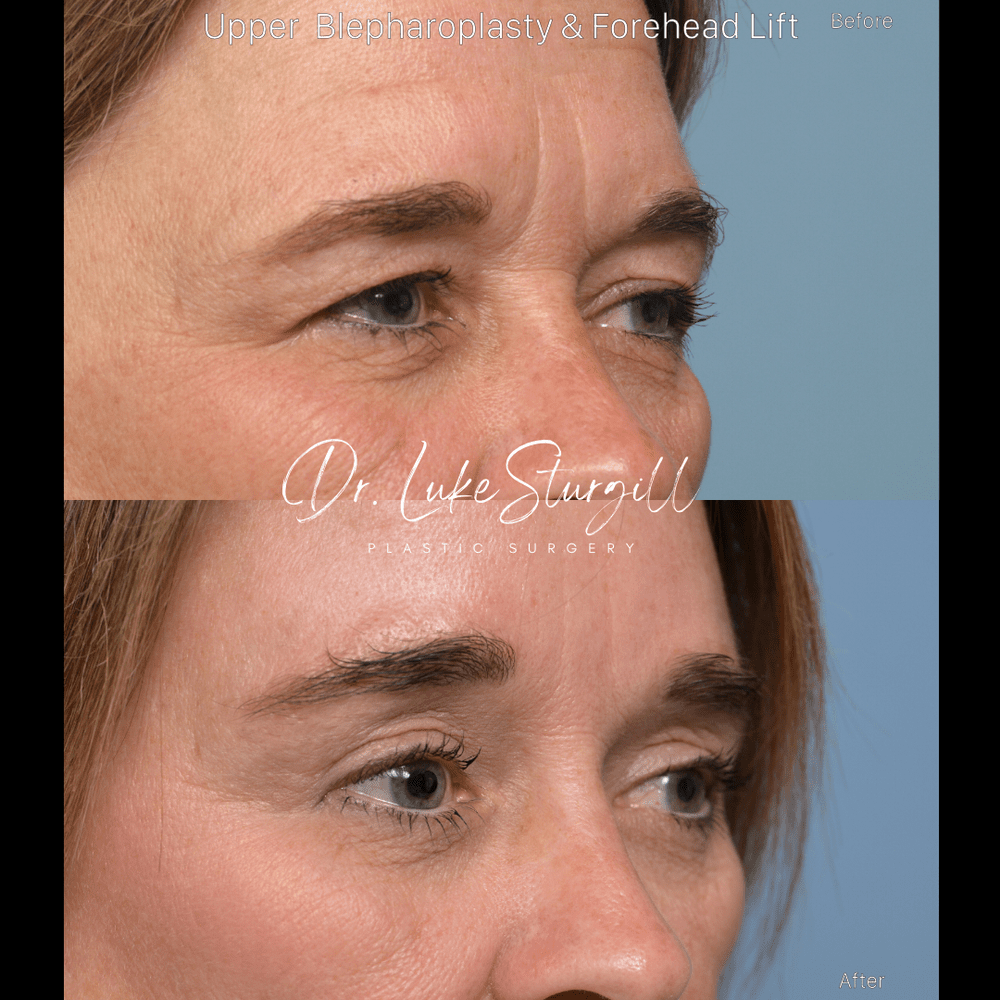
Upper blepharoplasty & endoscopic brow lift
Hidden within the natural eyelid crease. Essentially invisible once healed — even with eyes closed.
IV sedation or general anesthesia at Meridian Plastic Surgery Center. Complete precision, zero discomfort.
Light activities within 7–10 days. Sutures out in one week. Socially comfortable by 10–14 days.
Long-lasting — typically 10 to 15 years or more. Many patients never need a second procedure.
Endoscopic Brow Lift • Lower Blepharoplasty • Laser Resurfacing
Lower Eyelid Surgery
Lower BlepharoplastyLower blepharoplasty addresses puffiness, bags, and hollowing under the eyes. These changes make people look tired, older, or unwell — even when they feel fine. The goal is a smooth, natural transition from the lower eyelid to the cheek with no visible bags, no hollow shadows, and no sign of surgery.
The anatomy under each eye is different, and so is the surgical plan. Some patients have fat that has pushed forward through a weakened septum, creating visible bags. Others have lost volume in the tear trough and lid–cheek junction, creating a hollow, shadowed appearance. Many have both. The surgical approach depends on which problem is dominant.
Two Approaches, Chosen by Anatomy
Transconjunctival blepharoplasty — The incision is made inside the lower lid, leaving absolutely no visible scar. This approach is ideal when the primary issue is fat prominence without significant skin excess. It allows precise fat repositioning or removal from within.
Subciliary (transcutaneous) blepharoplasty — The incision is placed just below the lash line. This approach is used when excess skin needs to be addressed in addition to fat. It allows both fat management and conservative skin tightening through a single incision that heals nearly invisibly.
Your anatomy decides the approach. Dr. Sturgill evaluates skin quality, true skin excess, lid support and laxity, fat distribution, and midface position before recommending one approach over the other.
Fat Repositioning vs. Fat Removal
The traditional approach to lower blepharoplasty was straightforward: remove the fat pads that create bags. While this eliminates puffiness, it can leave the under-eye area hollow and gaunt — trading one aged appearance for another.
Think of it like rearranging furniture in a room rather than throwing it away. The fat that creates a bag in one area is the exact volume you need to fill the hollow next to it. Repositioning uses your own tissue to solve two problems at once — eliminating the bag and filling the tear trough in a single step.
Fat transposition takes the prolapsed orbital fat and drapes it over the orbital rim into the tear trough and lid–cheek junction. The result is a smooth, youthful contour that looks natural because it is natural — your own tissue in a better position. When additional volume is needed beyond what repositioning can provide, fat grafting can fill remaining hollows with exceptional precision.
The Midface Matters
Imagine hemming a pair of pants without checking how they fit at the waist. The lower eyelid does not exist in isolation — it sits on top of the cheek. If the cheek has descended, treating the lid alone produces a result that looks disconnected from the rest of the face.
When cheek descent has created a visible lid–cheek junction, addressing the midface as part of the plan produces a dramatically better result. This may involve fat grafting to restore cheek volume, an endoscopic mid facelift, or in some cases, an extended deep plane facelift to reposition the descended tissue. Dr. Sturgill evaluates the entire lower eyelid–cheek unit to ensure the surgical plan addresses the actual problem, not just the most obvious symptom.
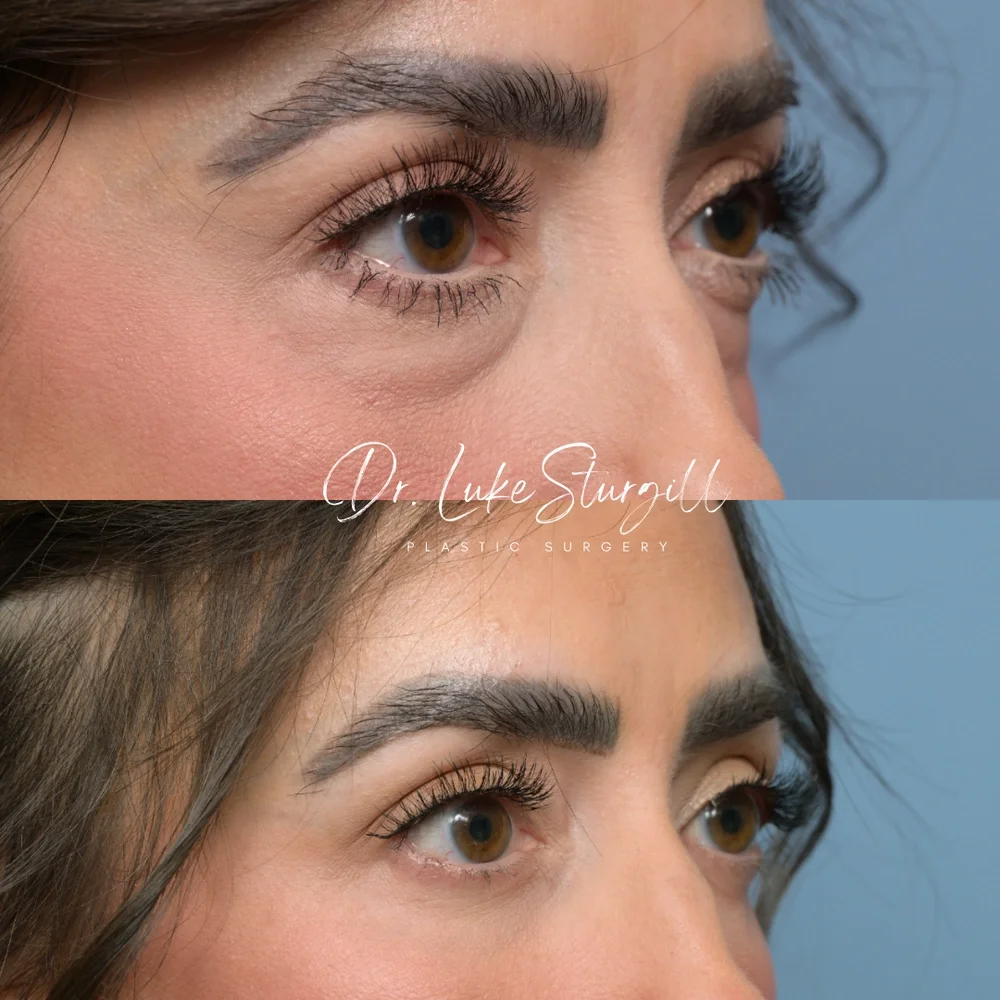
Lower blepharoplasty & fat grafting
Transconjunctival: Inside the lid — no visible scar.
Subciliary: Below the lash line — heals nearly invisibly.
General anesthesia at Meridian Plastic Surgery Center. Precise fat repositioning and meticulous hemostasis.
Bruising peaks days 2–3, improves by week 2. Light activities within 7–10 days. Socially comfortable by 10–14 days (transconjunctival) or 10–21 days (subciliary).
Durable and long-lasting. Fat repositioning produces stable results — your own tissue in a better position.
Ptosis Repair
Eyelid Droop CorrectionPtosis is a true drooping of the upper eyelid margin itself — not excess skin, not a heavy brow, but the actual lid sitting too low over the iris. It is caused by a weakened or stretched levator muscle, the muscle responsible for opening the eye. Ptosis makes the eyes look asymmetric, sleepy, or partially closed, and in advanced cases it can obstruct the upper visual field.
This is a fundamentally different problem from the skin excess that blepharoplasty treats. Performing a blepharoplasty on a patient with undiagnosed ptosis removes skin but leaves the lid margin in the wrong position — the eye still looks droopy, and the patient is left wondering why surgery didn’t work.
Why Ptosis Gets Missed
- The drooping lid is mistaken for excess skin or brow heaviness
- Ptosis is often asymmetric, affecting one eye more than the other — easy to overlook if not specifically measured
- Many surgeons evaluate skin excess without measuring the lid margin position (MRD1) or levator function
- Mild ptosis is subtle and can be masked by the patient unconsciously raising their brow to compensate
The Repair
Ptosis repair involves advancing or reattaching the levator aponeurosis — the tendon-like tissue that connects the levator muscle to the eyelid. The incision is hidden in the eyelid crease, the same location used for upper blepharoplasty, and the two procedures can be combined when both ptosis and skin excess are present.
The key to a good ptosis repair is precision in setting the lid height and contour. Even a millimeter of difference between the two eyes is noticeable. Dr. Sturgill measures the margin reflex distance, levator excursion, and eyelid crease position before surgery and adjusts the repair intraoperatively to achieve symmetry.
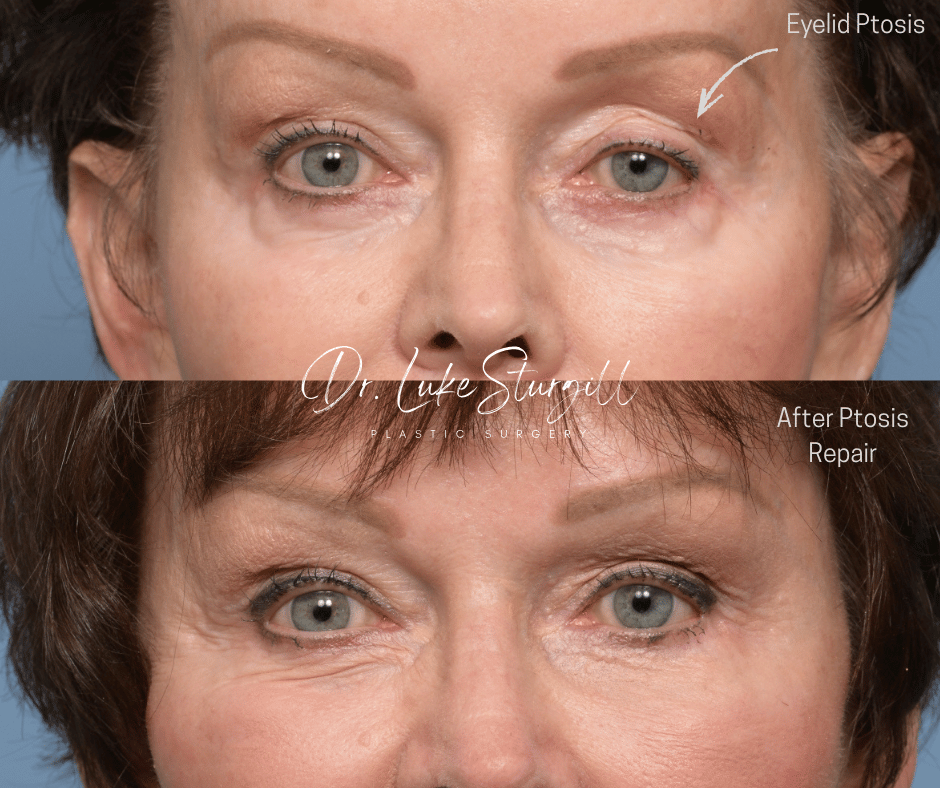
Left eye ptosis repair & fat grafting
Hidden in the eyelid crease — same as upper blepharoplasty. Both can share a single incision.
IV sedation or general anesthesia at Meridian Plastic Surgery Center.
Similar to upper blepharoplasty. Sutures out within one week. Final lid height settles over 4–6 weeks.
Often covered when the drooping lid obstructs the visual field. Functional impairment assessed during consultation.
Commonly Combined Procedures
Eyelid surgery is frequently performed alongside other facial procedures. Combining procedures means one anesthesia, one recovery, and a more comprehensive result.
Facial Fat Grafting
Fat transfer restores volume that has been lost in the tear trough, temple, and upper cheek. When combined with lower blepharoplasty, it creates a seamless lid–cheek transition and corrects the hollow, skeletal appearance that fat repositioning alone cannot fully address.
Explore Facial Fat Grafting →Endoscopic Brow Lift
When brow descent is pushing tissue onto the upper eyelid, an upper blepharoplasty alone may not fully solve the problem. An endoscopic brow lift restores brow position, opens the orbital area, and prevents the flattened appearance that occurs when too much skin is removed to compensate for a low brow.
Explore Endoscopic Brow Lift →Canthoplasty
Some patients have inherent lower lid laxity — the lid pulls away from the eye too easily or shows excessive white below the iris (scleral show). Others develop laxity with age or after previous surgery. Performing lower blepharoplasty on a lax lid risks pulling it down further, creating a rounded or sad appearance. Canthoplasty tightens the lower lid at its outer attachment, providing the structural support needed for a safe lower blepharoplasty and a more defined eye shape.
Endoscopic Midface Lift
The lower eyelid doesn’t exist in isolation — it’s the top border of your cheek. When the midface descends with age, it pulls the lower lid down, creates a longer lid–cheek junction, and deepens the tear trough. Removing lower lid skin and fat without addressing the descended cheek is like hemming pants without acknowledging the waist has dropped. A midface lift restores cheek volume to its youthful position, supporting the lower lid from below and creating a smoother transition from eye to cheek.
Skin Resurfacing
Surgery corrects structural problems — descent and deflation. But it does not address crepey skin, fine lines, or pigmentation changes. Laser resurfacing and TCA chemical peels target the “damage” component of periorbital aging and are frequently performed at the same time as eyelid surgery for a complete rejuvenation.
Explore Skin Resurfacing →Extended Deep Plane Facelift
For patients whose aging extends beyond the eyes — jowling, neck laxity, midface descent — combining eyelid surgery with a deep plane facelift addresses the entire face in a single operation. This is the most comprehensive approach and produces the most dramatic, natural transformation.
Explore Deep Plane Facelift →Your Surgeon Matters
Why Patients Choose Dr. Sturgill
Eyelid surgery demands a surgeon who understands the full anatomy of the orbital region — not just the skin, but the fat, the muscle, the brow, and the cheek beneath it. Millimeters matter here more than anywhere else on the face.
Complete Eyelid Expertise
Dr. Sturgill is a double board-certified facial plastic surgeon who performs upper blepharoplasty, lower blepharoplasty, ptosis repair, canthoplasty, and endoscopic midface lifts — all under one roof. Most plastic surgeons refer ptosis and lid support cases to oculoplastic specialists. Dr. Sturgill diagnoses and treats the full spectrum, which means one surgeon, one plan, and no gaps.
Truth & Transparency
Not every patient who thinks they need eyelid surgery actually needs eyelid surgery. A drooping brow, undiagnosed ptosis, or midface descent can mimic — or compound — what looks like a lid problem. Dr. Sturgill identifies the real cause and recommends only what will genuinely make a difference.
The “Unoperated” Look
The goal is eyes that look rested and open — not hollow, rounded, or obviously surgical. Dr. Sturgill preserves fat where it belongs, repositions what has shifted, and resects conservatively. The result is a natural eye shape that looks like you on a good day, not like someone who had work done.
What Patients Are Saying About Dr. Sturgill
Real reviews from real patients—because the best referral is an honest one.
Ready to take the next step?
Your consultation is a planning session — not a sales pitch.
Dr. Sturgill will evaluate your facial anatomy, discuss your goals, and give you an honest assessment of what surgery can — and cannot — achieve. You will leave with a clear understanding of whether this procedure is right for you.
What to expect
- Review your concerns and goals in detail
- Receive a facial analysis with a personalized surgical plan
- See before-and-after photos of what YOU will look like after surgery
- Have all your questions answered directly
Consultations typically last around 45 minutes.
Book Your Consultation
Common Questions
Frequently Asked Questions
Honest, detailed answers about eyelid surgery — from the procedures themselves to recovery, results, and what to expect during your consultation.
About Eyelid Surgery
Will I still look like myself?
Yes — that is the entire point. The best eyelid result is invisible as surgery. People just think you look rested. Dr. Sturgill preserves fat where it belongs, repositions what has shifted, and resects conservatively to maintain your natural eye shape. The goal is brighter, more open eyes — not a different face.
At what age should I consider eyelid surgery?
There’s no ideal age — it depends on your anatomy and genetics. Dr. Sturgill sees patients in their 20s with hereditary under-eye bags and patients in their 60s just beginning to notice upper lid hooding. The right time is when the changes bother you enough to want them corrected.
That said, he’d rather operate on healthy tissue with good elasticity than wait until the changes are severe — so don’t feel you need to “earn” the surgery by suffering with it for years.
Where are the incisions and will I have visible scars?
For upper eyelid surgery, the incision hides within the natural eyelid crease — once healed, it’s essentially invisible even with eyes closed. For lower eyelid surgery, the approach depends on your anatomy. When a transconjunctival approach is used, the incision is made inside the lower eyelid with no external scar at all. When skin removal is necessary, the incision is placed just beneath the lash line where it heals imperceptibly in the vast majority of patients.
What type of anesthesia is used?
Upper blepharoplasty and ptosis repair can be performed under IV sedation or general anesthesia. Lower blepharoplasty is performed exclusively under general anesthesia — precise fat repositioning and meticulous hemostasis require it.
All procedures are performed at Meridian Plastic Surgery Center, our private accredited surgical facility with a board-certified MD anesthesiologist. This allows complete precision without any patient discomfort or anxiety.
Is eyelid surgery painful?
Eyelid surgery is one of the least painful cosmetic procedures. During surgery, you feel nothing. Afterward, most patients describe the sensation as mild discomfort, tightness, or a gritty feeling in the eyes rather than actual pain. Significant pain is uncommon.
Dr. Sturgill prescribes pain medication to have on hand, but many patients find they only need over-the-counter Tylenol after the first day or two. Cold compresses and keeping your head elevated also go a long way toward minimizing discomfort.
Upper Eyelid Surgery
How do I know if I need an upper blepharoplasty or a brow lift?
This is one of the most common diagnostic questions in eyelid surgery. Approximately 40% of patients who think they need an upper blepharoplasty also benefit from addressing brow position. When the brow has descended, it pushes tissue onto the upper lid — creating the appearance of excess skin when the real problem is above the lid, not on it.
Removing upper lid skin without correcting a low brow can produce a flattened, tight appearance — or simply fail to fully solve the problem. Dr. Sturgill evaluates brow position specifically during every upper eyelid consultation and recommends an endoscopic brow lift or internal browpexy when indicated.
How long do upper blepharoplasty results last?
Upper blepharoplasty results typically last 10 to 15 years or more. Many patients never need a second procedure. Aging continues, but from a younger, cleaner baseline.
Lower Eyelid Surgery
What’s the difference between lower blepharoplasty and under-eye filler?
Blepharoplasty addresses the structural causes of puffiness and contour problems — fat prominence, septal weakness, and volume malposition. Filler can camouflage certain hollows temporarily, but it cannot remove bags. Trying to “fill over bags” often makes the under-eye area look puffier.
When bags are present, surgery is the definitive correction. When hollowing is the only issue and the anatomy is favorable, filler can be a reasonable option — but that distinction requires an in-person evaluation.
How does Dr. Sturgill decide between transconjunctival and subciliary approach?
Skin quality, true skin excess, lid support and laxity, fat distribution, and what’s causing the contour issue. Your anatomy determines the approach, then technique follows.
When the primary issue is fat prominence without meaningful skin excess, a transconjunctival approach — through the inside of the lid — allows precise fat management with no external scar. When true skin excess needs to be addressed, a subciliary incision just below the lash line allows both fat repositioning and conservative skin tightening.
What’s the difference between removing fat and repositioning fat?
The traditional approach was to simply remove the fat pads that create under-eye bags. While this eliminates the bags, it can lead to a hollow, skeletonized appearance over time — particularly as the face continues to lose volume with age.
Dr. Sturgill prefers fat repositioning in almost every case. This technique moves the “bag” fat downward to fill the hollow tear trough, creating a smooth transition from lower eyelid to cheek. He also frequently adds facial fat grafting when repositioned fat alone isn’t sufficient to fully correct the hollowing.
Do I need fat grafting with lower blepharoplasty?
If hollowing is a meaningful part of the tired look, fat grafting can be the difference between better and complete. Not everyone needs it, but the right candidate benefits significantly. Fat grafting is combined in approximately 70% of Dr. Sturgill’s lower eyelid cases.
The decision is always anatomy-based. When the volume deficit is limited, fat repositioning alone may be sufficient. When the tear trough, upper cheek, or temple also show deflation, grafting produces a more natural, fully restored result.
Ptosis & Lid Support
What is ptosis and how is it different from excess eyelid skin?
Ptosis is a true drooping of the upper eyelid margin itself — not excess skin hanging over the crease, but the actual lid sitting too low over the iris. It’s caused by a weakened or stretched levator muscle. The distinction matters because performing a blepharoplasty on a patient with undiagnosed ptosis removes skin but leaves the lid margin in the wrong position — the eye still looks droopy.
Dr. Sturgill measures ptosis specifically during every upper eyelid consultation. Most plastic surgeons refer ptosis cases to oculoplastic specialists — or miss the diagnosis entirely. Dr. Sturgill diagnoses and repairs ptosis as part of his eyelid surgery practice.
Is ptosis repair covered by insurance?
Ptosis repair is often covered by insurance when the drooping lid obstructs the visual field. This requires documentation of functional impairment, which Dr. Sturgill can assess during your consultation. When ptosis is purely cosmetic — bothersome but not obstructing vision — the repair is typically an out-of-pocket procedure.
What is a canthoplasty and do I need one?
Canthoplasty tightens the lower lid at its outer attachment point. It’s needed when lower lid laxity is present — when the lid pulls away from the eye too easily or shows excessive white below the iris (scleral show). Performing lower blepharoplasty on a lax lid without addressing support risks pulling the lid down further, creating a rounded or sad appearance.
Not every patient needs one, but Dr. Sturgill evaluates lid laxity during every lower eyelid consultation to determine whether canthoplasty should be part of the plan.
Recovery & Results
What is recovery like after eyelid surgery?
Most patients return to light activities within 7–10 days. Bruising and swelling peak at days 2–3 and improve significantly by week 2. Sutures are removed within one week.
For upper blepharoplasty, most patients are comfortable being seen socially by 10–14 days. For lower blepharoplasty, the timeline depends on approach: 10–14 days for transconjunctival and 10–21 days for subciliary. Cold compresses, head elevation, and following post-operative instructions closely make a significant difference.
When will I see my final results?
Meaningful improvement is visible early — most patients feel encouraged by the end of week two. Residual swelling, particularly in the lower lids, can take 2–3 months to fully resolve. For ptosis repair, the final lid height settles over 4–6 weeks. Most patients feel they look very good by 6–8 weeks, with subtle refinement continuing through 3 months.
Combining Procedures
Can eyelid surgery be combined with other procedures?
Yes — and often it should be. The eyes don’t age in isolation, and addressing only one dimension can leave the overall result feeling incomplete. Common combinations include:
Facial Fat Grafting to restore volume in the tear trough, temple, and upper cheek. Endoscopic Brow Lift for patients whose brow descent contributes to upper lid heaviness. Skin Resurfacing for fine lines, crepey skin, and pigmentation. Extended Deep Plane Facelift for comprehensive facial rejuvenation when aging extends beyond the eyes.
Combining procedures means one anesthesia, one recovery, and a more comprehensive result. Dr. Sturgill builds the operative plan around each patient’s anatomy rather than applying a default combination.
Your eyes. Your anatomy.
Your plan.
Dr. Sturgill evaluates each patient’s eyelid anatomy, brow position, and midface structure to build a surgical plan around their specific goals — not a one-size-fits-all approach.
Book Your ConsultationCarmel, Indiana ◆ In-Person & Virtual Available