

By R. Luke Sturgill, MD · Double Board-Certified Facial Plastic Surgeon · Carmel, Indiana
Reduction, Not Removal. On Purpose.
Most people search “buccal fat removal.” Dr. Sturgill calls it something else — on purpose.
If you found this page by searching “buccal fat removal,” you’re in the right place — but you’ll notice Dr. Sturgill uses a different word. He calls it buccal fat reduction. That’s not branding. It’s a philosophy.
He never removes all of the buccal fat. Ever.
The buccal fat pad is normal anatomy. It supports your facial structure — especially as you age and naturally lose volume everywhere else. Facial volume is not the enemy. Over-resection is how people end up looking hollow, harsh, or unmistakably “operated.” A measured reduction — when it’s genuinely indicated — creates proportion without altering who you are.
You don’t want to look “different.” You want to look like you — just more balanced.
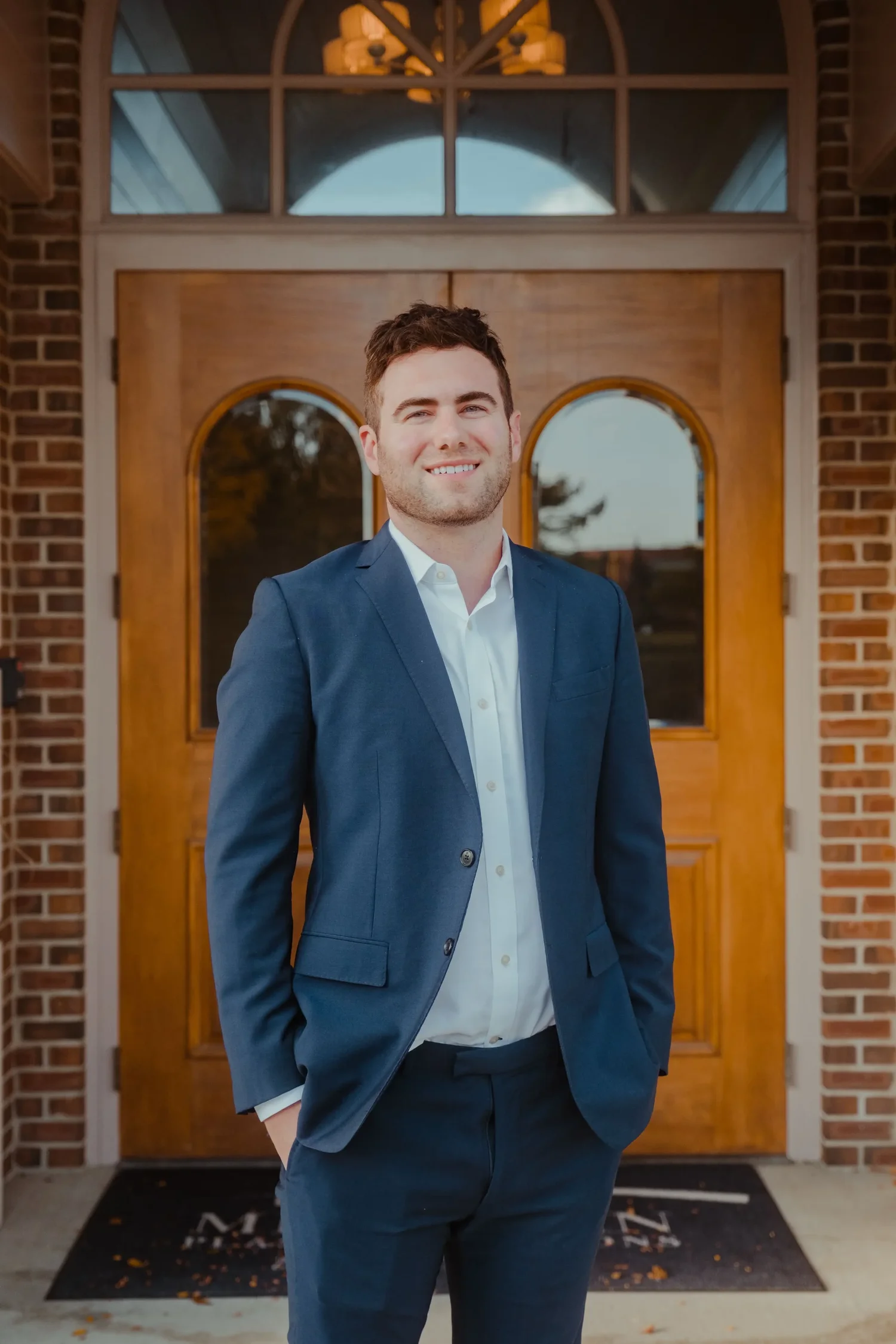
Dr. R. Luke Sturgill is a double board-certified facial plastic surgeon in Carmel, Indiana — serving greater Indianapolis and destination patients from across the country. He operates exclusively on the face and neck. That exclusivity matters here because buccal fat doesn’t exist in isolation. It relates to your cheekbones, your jawline, your temples, your midface volume, your skin quality, your aging trajectory. Evaluating buccal fat without evaluating the whole face is how patients end up with results they regret.
Book a Consultation
Two Types of Candidates
Who actually benefits — and who doesn’t.
Not everyone who wants buccal fat reduction should have it. But for two specific groups of patients, it makes a genuine, lasting difference.
Hereditary Fullness
Some patients are simply born with naturally large buccal fat pads. Their face appears round, full, or overly “cheeky” — and it has nothing to do with their weight.
- They’ve been fit and healthy for years
- The lower-cheek fullness doesn’t change with diet or exercise
- Buccal fat is a distinct anatomical structure — it behaves differently than subcutaneous fat
For these patients, a conservative reduction creates better facial balance — de-emphasizing lower-cheek fullness and improving the relationship between cheek and jawline, while preserving natural softness.
The key word is conservative — refining what’s there, not chasing a look that doesn’t suit your structure.
Mature Patients Undergoing Facelift Surgery
This is the group most people — and many surgeons — overlook. And it’s arguably where buccal fat reduction has its most impactful role.
In aging patients, the buccal fat pad can become ptotic — it drops. That descent contributes directly to jowling and lower-face heaviness. You can perform a technically excellent facelift, but if you leave a ptotic buccal fat pad untouched, the result is compromised:
- Releasing ligaments, repositioning tissues, tightening the neck
- Yet visible fullness persists in the lower cheek and jowl area
- An otherwise well-executed lift looks incomplete
In approximately 50% of his facelift patients, Dr. Sturgill reduces some of the ptotic buccal fat. Not because it’s routine — because their anatomy calls for it.
This is the opposite of “lift everything and hope for the best” — evaluate what’s actually creating the heaviness, then treat it with precision.
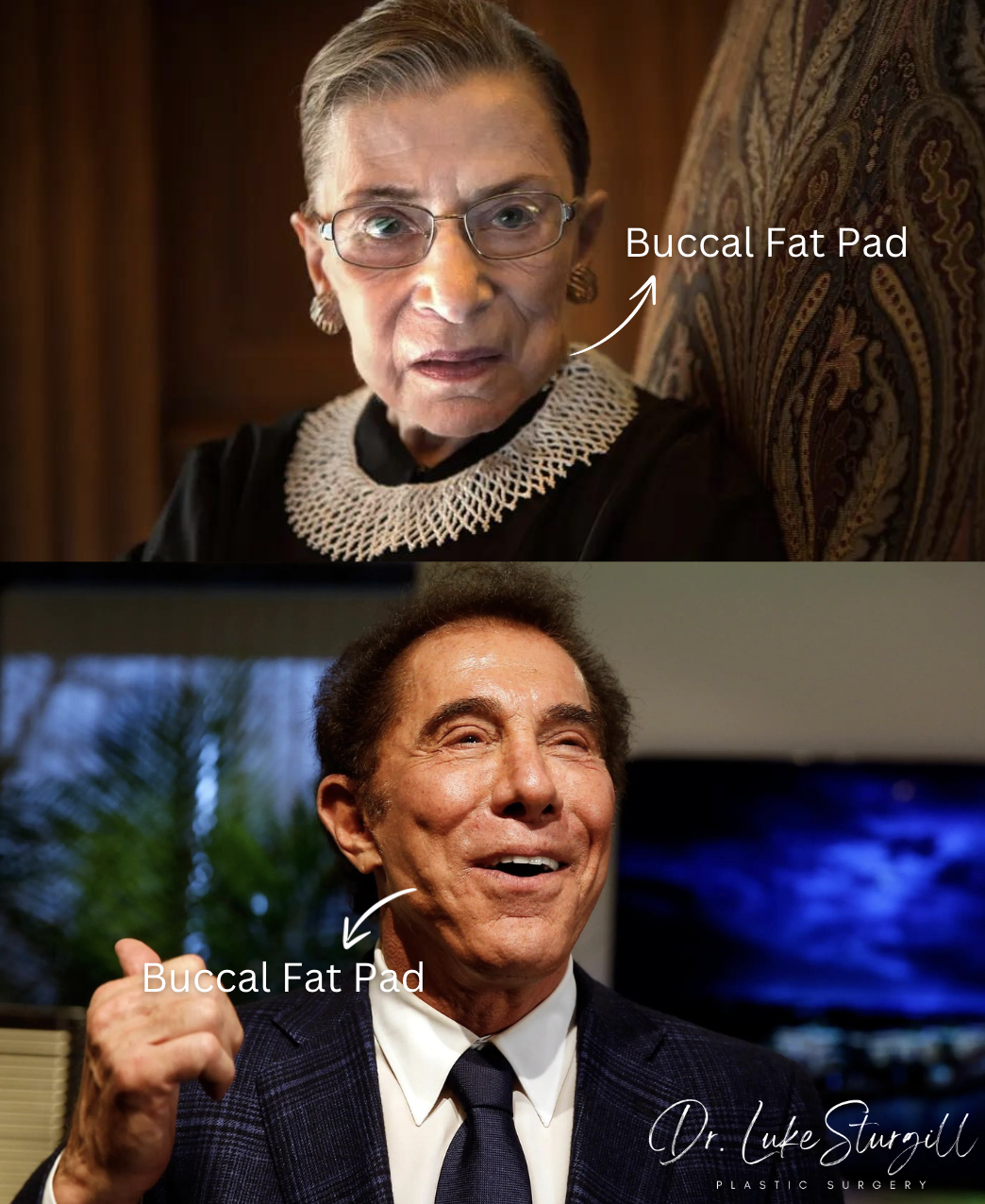
Ptotic buccal fat pads — the persistent lower-face fullness that remains even after facial rejuvenation surgery.
Who Should NOT Get This Procedure
This part matters just as much — maybe more.
A Naturally Thin or Narrow Face
Removing volume from an already-lean structure creates a gaunt, skeletal appearance — and it compounds over time. Everyone loses facial volume as they age. If you start with less, the deficit accelerates. There’s no undo button.
Chasing a Social Media Trend
If the goal is a “model hollow” look you saw on Instagram, this is the wrong procedure for the wrong reason. What looks striking in a curated photo rarely translates to real life — and the results are permanent.
Skin Laxity or Weight Fluctuation
You may need a lift, not a reduction. Buccal fat is only one of several potential contributors to lower-face fullness. Misdiagnosing the cause leads to a misguided procedure.
What to Expect
The technical steps are simple. The judgment behind them is the real procedure.
Buccal fat reduction is a straightforward operation — and that simplicity is exactly why patient selection matters so much. The technical steps are simple. The judgment behind whether to do it (and how conservatively) is the real procedure.
StandaloneStandalone Buccal Fat Reduction
When performed on its own, the incision is made inside the mouth (intraoral), so there are no external incisions and no visible scars. The buccal fat pad is carefully accessed and a measured portion is reduced — never all of it. The procedure typically takes under an hour.
While many practices perform standalone buccal fat reduction under local anesthesia, Dr. Sturgill only performs it under IV sedation or general anesthesia administered by a board-certified anesthesiologist. This approach offers a more controlled environment: better patient comfort, more consistent conditions, and the ability to work with precision without the distractions of discomfort or movement.
For a procedure where restraint and exactness matter, that control is an advantage.
Buccal Fat Reduction with Facelift Surgery
When buccal fat reduction is performed as part of an Extended Deep Plane Face & Neck Lift, it’s done under general anesthesia at Meridian Plastic Surgery Center, Dr. Sturgill’s private AAAHC-accredited surgical facility. It adds minimal operative time but can make a meaningful difference in facial balance — particularly along the jawline in the right patient.
RecoveryRecovery
Recovery is relatively quick. Expect swelling for 1–2 weeks, most noticeable in the first few days. A soft diet is recommended initially while the intraoral incision heals. Most standalone patients return to normal daily activity within a few days. When combined with a facelift, recovery follows the facelift timeline.
ResultsResults
Results are permanent. Once reduced, the buccal fat pad does not regenerate. That permanence is a benefit when the right amount is reduced from the right patient — and a liability when judgment is poor.
That’s why restraint — and candidacy — matters more than anything else.
Part of a Larger Plan
One procedure, in context.
Buccal fat reduction is rarely a standalone “fix.” It’s usually one part of a larger facial balance plan. Dr. Sturgill commonly combines it with the procedures below to create a more cohesive, natural result.
Extended Deep Plane Face & Neck Lift
Buccal fat reduction is incorporated in roughly half of Dr. Sturgill’s facelift cases — when it’s actually contributing to lower-face heaviness. In some patients, the buccal fat pad descends over time and amplifies jowling or blunts jawline definition. Addressing it during an extended deep plane lift can sharpen the transition from cheek to jaw and make the overall result feel more complete. It’s not just tightening — it’s correcting deeper anatomy that can drive the “heavy” look in the lower cheeks.
Learn MoreFacial Fat Grafting
Removing fat in one area while adding it to another can sound counterintuitive — until you understand how facial aging works. The goal isn’t “less volume” or “more volume.” The goal is better distribution. Some patients benefit from a conservative buccal fat reduction in the lower cheeks while restoring volume where it’s been lost — such as the temples, upper cheeks, or under-eyes. That combination creates balance: refined lower-cheek contour with healthier, more youthful structure above.
Learn MoreNeck & Jawline Sculpting
If the primary goal is lower-face definition, buccal fat reduction can be one piece of a more comprehensive approach. When combined with submental liposuction and/or a neck lift, it refines the entire lower third — cheeks, jawline, and neck — so the contour looks cohesive rather than “one area changed.” The result is a cleaner jawline and a more consistent profile — without relying on buccal fat reduction alone to do a job it wasn’t meant to do.
Learn MoreWhy Patients Choose Dr. Sturgill
Three reasons patients travel to Carmel from across the country.
Patients travel to Carmel from across the country for Dr. Sturgill’s care. They choose him for three specific reasons:
Exclusively Face & Neck
He is a double board-certified facial plastic surgeon. He operates exclusively on the face and neck. Buccal fat reduction isn’t a trendy standalone service — it’s one component of a comprehensive approach to facial balance, evaluated in the context of cheekbone structure, jawline definition, midface volume, and long-term aging.
He’ll Tell You If You Don’t Need It
He’ll tell you if you need it. He’ll also tell you if you don’t. Many consultations for buccal fat reduction end with him recommending against it — because the patient’s anatomy doesn’t call for it. That honesty protects your long-term appearance.
You Should Look Like Yourself
The goal isn’t hollow cheeks. It’s facial balance. You should look like yourself — just refined. No one should be able to point to your cheeks and say “they had work done.” They should just think you look good. That’s the entire point.
What Patients Are Saying About Dr. Sturgill
Real reviews from real patients—because the best referral is an honest one.
Ready to take the next step?
Your consultation is a planning session — not a sales pitch.
Dr. Sturgill will evaluate your facial anatomy, discuss your goals, and give you an honest assessment of what surgery can — and cannot — achieve. You will leave with a clear understanding of whether this procedure is right for you.
What to expect
- Review your concerns and goals in detail
- Receive a facial analysis with a personalized surgical plan
- See before-and-after photos of what YOU will look like after surgery
- Have all your questions answered directly
Consultations typically last around 45 minutes.
Book Your Consultation
Common Questions
What patients ask before booking.
Is the buccal fat pad removed entirely?
No. Dr. Sturgill never removes the entire buccal fat pad. Complete removal is what leads to the hollow, gaunt look that gives this procedure a bad reputation online. Instead, he reduces a measured, conservative portion — enough to refine the lower-cheek contour without compromising facial fullness. The goal is balance, not hollowness.
Will I look gaunt as I age?
This is the most common concern — and it’s a valid one. The worry that reducing buccal fat now will leave you looking hollow in 10 or 20 years is the reason patient selection matters so much.
Age-related volume loss primarily affects the superficial fat compartments (the fat beneath the skin in the temples, cheeks, and under-eyes) — not the buccal fat pad. The buccal fat pad is a deep structure that often persists or even descends with age. In patients with true buccal fat pad excess, a conservative reduction performed on the right anatomy does not produce a gaunt appearance over time.
That said, the operative word is conservative. If you have naturally lean facial structure or minimal deep fat, buccal fat reduction may not be appropriate — regardless of how your cheeks look today. That’s exactly what Dr. Sturgill evaluates during a consultation.
How do I know if I’m a good candidate?
Good candidates typically have persistent fullness in the lower cheeks that doesn’t respond to weight loss or facial maturation, adequate midface volume, and realistic expectations. The best way to know is an in-person evaluation — Dr. Sturgill assesses your bone structure, midface projection, skin quality, and existing fat distribution to determine whether reduction would actually improve your facial balance.
Many patients who come in asking for buccal fat reduction are told they don’t need it. That’s not a lost consultation — it’s exactly how the process should work.
Are results permanent?
Yes. The buccal fat pad does not regenerate once reduced. That permanence is a benefit when the right amount is removed from the right patient — and exactly why restraint matters. There’s no “undo” button, which is why Dr. Sturgill takes a conservative approach and turns away patients whose anatomy doesn’t call for the procedure.
Can buccal fat reduction be combined with a facelift?
Yes — and it frequently is. Roughly half of Dr. Sturgill’s Extended Deep Plane Face & Neck Lift patients also undergo buccal fat reduction when the buccal fat pad is contributing to lower-face heaviness. Adding it during a facelift adds minimal operative time but can meaningfully improve the jawline contour in the right patient.
What is recovery like?
For standalone buccal fat reduction, recovery is relatively quick. Expect swelling for 1–2 weeks, most noticeable in the first few days. A soft diet is recommended initially while the intraoral incision heals. Most patients return to normal daily activity within a few days. When combined with a facelift, recovery follows the facelift timeline.
Is there a visible scar?
No. The incision is made inside the mouth (intraoral), so there are no external incisions and no visible scars. When performed as part of a facelift, the buccal fat pad is accessed through the existing surgical approach — again, no additional external incision.
Why does Dr. Sturgill use general anesthesia instead of local?
Many practices perform standalone buccal fat reduction under local anesthesia. Dr. Sturgill only performs it under IV sedation or general anesthesia administered by a board-certified anesthesiologist at Meridian Plastic Surgery Center. This approach offers better patient comfort, more consistent surgical conditions, and the ability to work with precision without the distractions of discomfort or movement. For a procedure where restraint and exactness matter, that control is an advantage.
I’ve heard buccal fat removal is just a trend. Should I be worried?
You’re right to be cautious. Buccal fat reduction has become a social media trend — and like most trends, the nuance gets lost. The procedure itself is not new. It’s been performed by facial plastic surgeons for decades as part of comprehensive facial contouring. The problem is when it’s treated as a one-size-fits-all cosmetic shortcut.
In the right patient, with the right amount of reduction, it’s a legitimate and effective procedure. The “trend” concern is really about patient selection — not the procedure itself. That’s why Dr. Sturgill turns away a significant number of patients who request it.