
By R. Luke Sturgill, MD · Double Board-Certified Facial Plastic Surgeon · Carmel, Indiana
Volume isn’t the goal.
Restoration is.
Most people don’t wake up and think, “I need more volume.”
They think:
- “I look tired—even when I’m not.”
- “My face looks less alive in photos.”
- “My under-eyes look hollow.”
- “I look older, but I can’t put my finger on why.”
Here’s what’s actually happening: your face is losing the scaffolding underneath the skin—and when that support fades, the face doesn’t just “sag.” It deflates, it loses light-reflection, and it starts to move differently.
Fat grafting—done correctly—restores that missing layer with your own tissue so the result blends, moves, and reads as natural.
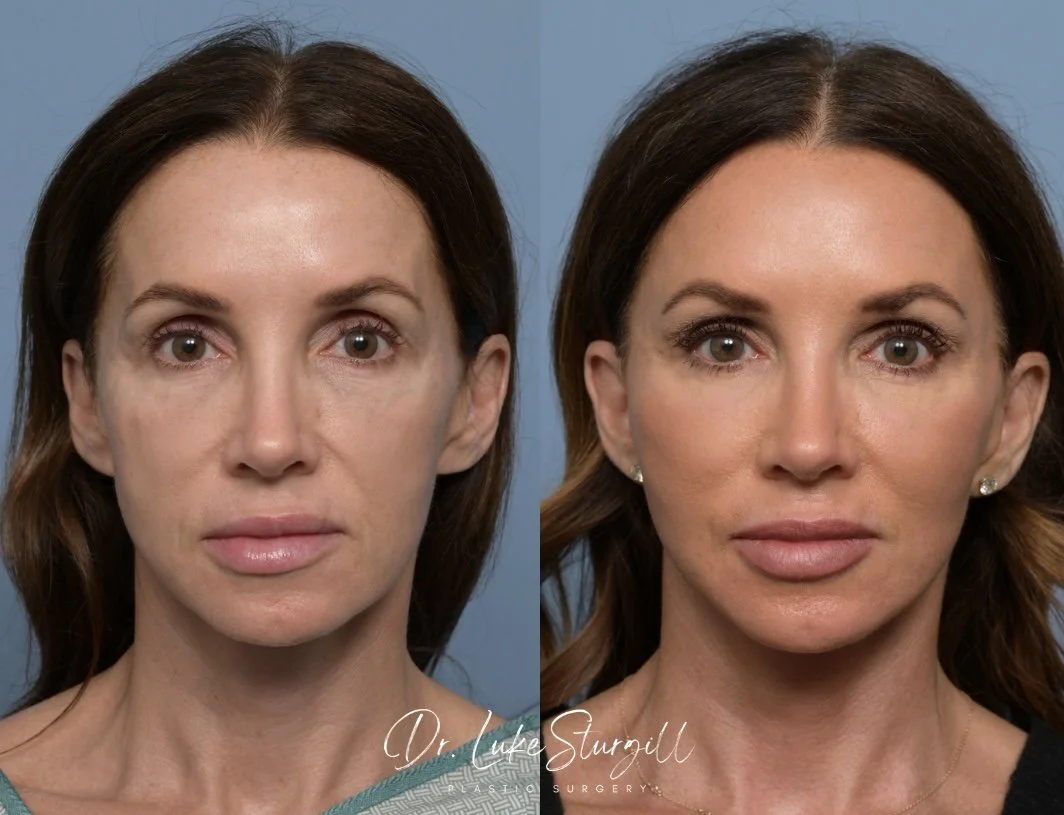
50-year-old patient before and after facial fat grafting
Why the Face Deflates
To understand why fat grafting is powerful, you have to understand modern facial aging.
Faces age in three ways:Aging doesn't remove fat evenly. It drains specific "support zones," including:
When those compartments empty, shadows appear, transitions look harsher, and the skeleton starts to show through.
Youthful faces have a thin, healthy layer of fat beneath the skin that helps light pass through and reflect back with warmth. As that layer thins, the face looks more gray, flat, and "tired" even if you aren't.
Facial expression depends on the balance of tissue around muscles. When the padding disappears, expressions can look sharper, harsher, and less smooth—because the face is moving without the normal cushioning it used to have.
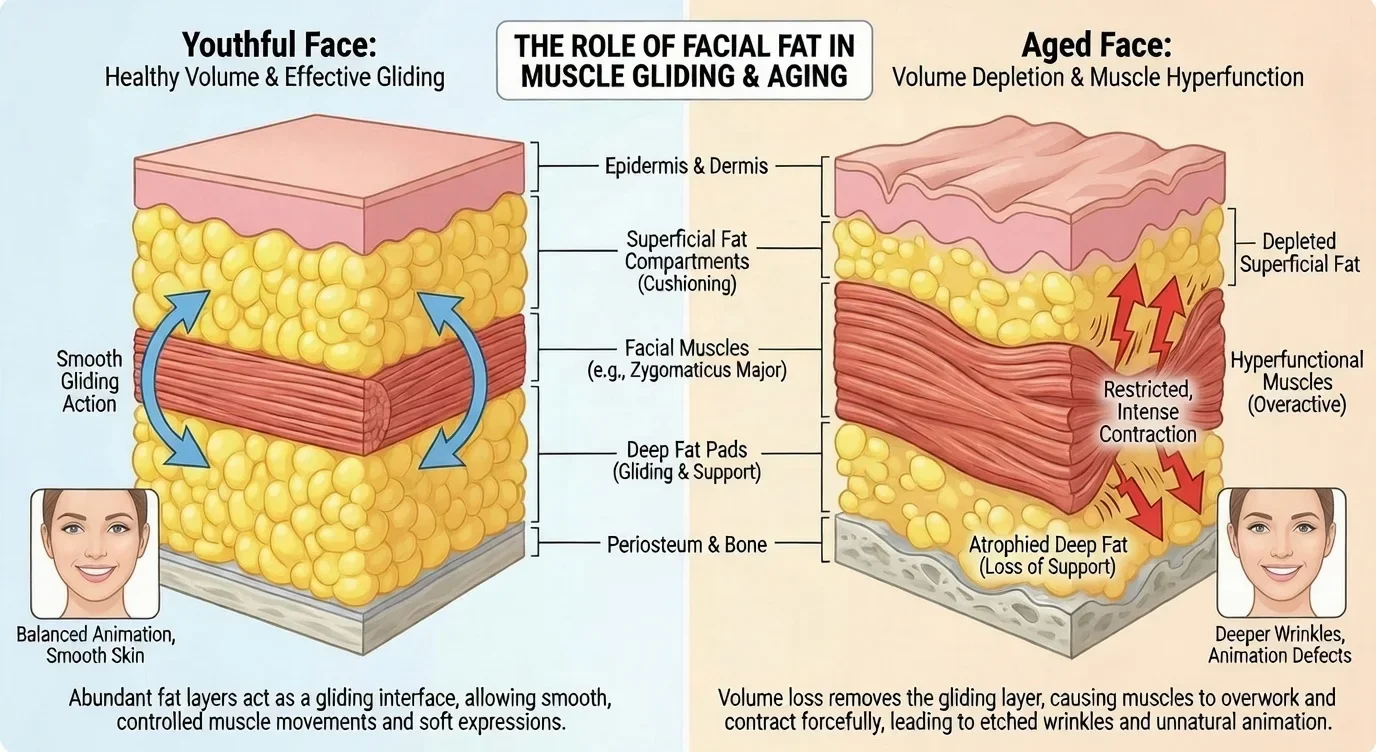
As the facial skeleton subtly remodels with time, the support platform shrinks—so volume loss becomes even more visible.
Strategic Facial Volume Restoration
Many "puffy" outcomes are created intentionally—surgeons overfill because they expect poor survival. Dr. Sturgill's technique is designed to produce excellent take so he can place appropriate, conservative volumes and expect them to live.
Great fat grafting is anatomy-driven: restoring the right areas, in the right planes, in the right amounts—so your face looks better from every angle, not just straight-on.
Microfat restores deeper structural volume. Nanofat is placed more superficially—targeting skin quality, fine lines, and the vibrancy that comes from restoring a healthy yellow layer beneath the surface.
"Fat grafting is not 'filler with fat.' The goal is NOT to make you look fuller. The goal is to make you look restored."
— Dr. Sturgill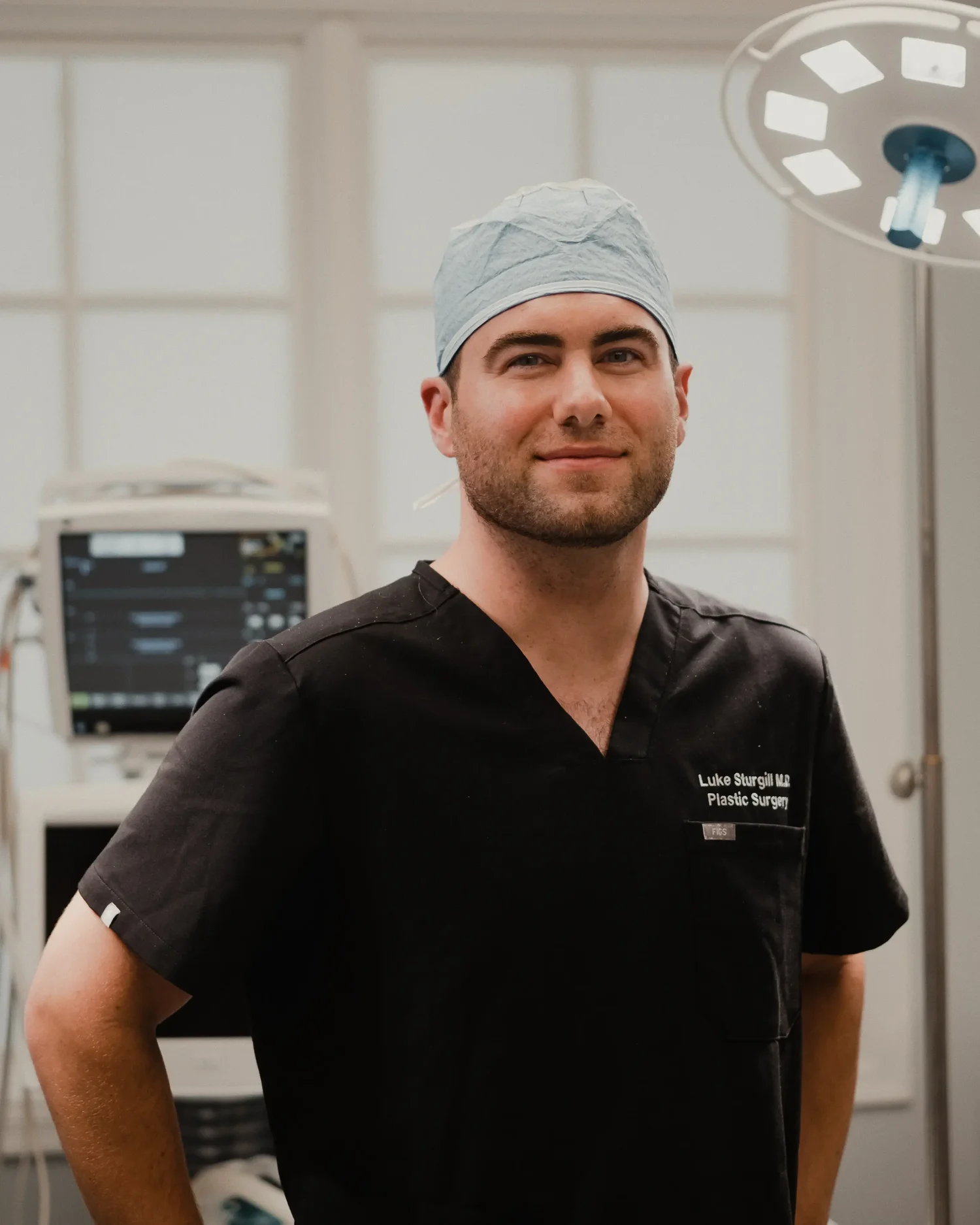
Microfat + Nanofat: Why Most Cases Use Both
Most surgeons treat fat grafting as one thing. Dr. Sturgill treats it as two complementary tools—each placed at a different depth, for a different purpose.
Microfat
Structural Volume RestorationPlaced into the subcutaneous and deep structure layers—where support and contour matter most. This is what recreates youthful architecture: the scaffolding beneath the skin that aging quietly dissolves.
Nanofat
Skin Quality + Texture UpgradeMechanically processed to a finer consistency and placed superficially—dermal and subdermal—to improve what volume alone can't fix.
Microfat rebuilds structure—you see that immediately. Nanofat is more like putting fertilizer on a lawn. You won't see it working the next day, but months later the skin quality, texture, and vibrancy tell the whole story. That's why Dr. Sturgill uses both in most facial fat grafting cases.
Facial Fat Grafting Before & After
Volume loss is the silent driver of facial aging — and restoring it correctly is what separates a refreshed face from an overfilled one. What you'll notice across these patients isn't added volume for volume's sake. It's a return to the contours that time took away. That's the standard. You want to look like you — just refined. Using a dual microfat and nanofat grafting technique, fat is harvested, purified, and placed into precise layers — restoring structure where it's needed and improving skin quality from the inside out. Pay attention to the seamless transitions, the restored under-eye hollows, and the natural fullness that looks like it was always there.
What to Look For
Here's what separates a technically excellent result from an average one:
A note on photos: All images are unretouched and show real patients of Dr. Sturgill photographed under consistent clinical lighting. Results vary by individual anatomy, skin quality, and healing response. These photos represent typical outcomes — not best-case-only marketing.
What to Expect
Fat grafting recovery is usually about swelling management and patience—not intense pain.
How It Works
Fat is gently harvested from an area with available reserve—commonly:
This is not "weight loss." It's a controlled harvest to obtain healthy, transferable fat cells.
Harvested fat is processed to maximize graft survival and purity. This is where many outcomes are won or lost—technique directly influences take rate.
Fat is placed with meticulous control:
Microfat restores deeper structure. Nanofat is used more superficially for skin quality.
Fat grafting is most commonly performed:
As part of a larger facial procedure under general anesthesia As a standalone procedure with anesthesia tailored to the case complexity and goalsFat Grafting vs. Filler: How They Compare
Both restore facial volume—but they work very differently, last very differently, and deliver very different outcomes. Here's an honest breakdown.
| Category | Your Own Tissue Facial Fat Grafting | Manufactured Product Dermal Filler |
|---|---|---|
| Material | Your own harvested fat tissue—living cells that integrate with your face | Manufactured gel, typically hyaluronic acid (Juvéderm, Restylane, etc.) |
| Longevity | Years to decades once grafts integrate Long-term | 6–18 months, then dissolves and requires repeat treatment |
| Skin Quality | Improves texture, tone, and glow (especially with nanofat) Bonus benefit | Adds volume only—no skin quality improvement |
| How It Feels | Integrates as natural tissue—indistinguishable from your own face | Can sometimes feel firm or "pillowy," especially in thin-skinned areas |
| Sessions | Usually one comprehensive session One & done | Repeated sessions every 6–18 months to maintain results |
| Recovery | 1–2 weeks of swelling; plan on being "off-grid" for about a week | Minimal—most patients resume normal activity same day Less downtime |
| Best For | Comprehensive volume restoration and facial rejuvenation | Targeted fine-tuning, maintenance, or patients not ready for surgery |
| Combines With | Facelift, blepharoplasty, skin resurfacing—part of a comprehensive plan | Often standalone; sometimes combined with neurotoxin (Botox) |
The bottom line: Filler is a tool—and a useful one for the right situation. But if you're looking for lasting volume restoration that actually improves your skin quality and becomes part of your face, fat grafting delivers what filler simply can't.
Completing the Picture
Fat grafting is powerful on its own—but most of the time, it's used to make another operation look more complete and more natural.
Common CombinationsA facelift corrects descent. Fat grafting restores deflation—softening transitions a lift alone can't fix.
Dr. Sturgill performs fat grafting in about 90% of facelift cases.
Learn moreFat grafting restores under-eye and lid-cheek support when hollowing is part of the problem—preventing the "operated" look that can happen when tissue is removed in an already-deflated area.
Dr. Sturgill performs fat grafting in about 70% of lower eyelid cases.
Learn moreA lip lift restores shape and show; fat grafting can restore perioral support so the result looks more balanced and youthful.
Learn moreRhinoplasty changes how the center of the face reads; restoring facial support and transitions can make the overall result feel more harmonious.
Learn moreResurfacing improves damage (texture/pigment). Fat grafting improves structure and vibrancy. Together: surface + scaffolding.
Learn moreBuccal fat removal refines lower facial fullness; fat grafting can simultaneously restore volume where it's needed—creating more definition without overcorrection.
Learn moreWhy Patients Choose
Dr. Sturgill
Patients travel from across the country for care that prioritizes honesty, artistry, and results that look like you.
Specialization
Double board-certified in facial plastic surgery. He focuses exclusively on the face and neck — performing facial fat grafting at a volume that ensures consistency and mastery.
Truth & Transparency
No sales pressure. No "magic" wands. Just honest assessments of what anatomy and surgery can achieve — so you can make decisions with clarity, not confusion.
The "Unoperated" Look
His aesthetic goal is for you to look like yourself — just rested, refined, and restored. Never overdone, never obvious.
What Patients Are Saying About Dr. Sturgill
Real reviews from real patients—because the best referral is an honest one.
Ready to take the next step?
Your consultation is a planning session — not a sales pitch.
Dr. Sturgill will evaluate your facial anatomy, discuss your goals, and give you an honest assessment of what surgery can — and cannot — achieve. You will leave with a clear understanding of whether this procedure is right for you.
What to expect
- Review your concerns and goals in detail
- Receive a facial analysis with a personalized surgical plan
- See before-and-after photos of what YOU will look like after surgery
- Have all your questions answered directly
Consultations typically last around 45 minutes.
Book Your Consultation
FAQ
Your Questions, Answered
-
More than most people realize. Filler is a manufactured gel—it adds volume, but it sits in tissue rather than becoming tissue. Fat grafting transplants your own living cells into areas of deflation, where they integrate, develop a blood supply, and behave like the fat that was originally there. But the bigger distinction is what each one actually solves. Filler is excellent for precise, targeted corrections—a specific fold, a shadow, a contour tweak. Fat is the answer when the problem is global volume loss—the kind of deflation that makes the entire face look tired, hollow, or aged beyond your years. That's not a "fill this line" problem. That's a "rebuild the foundation" problem. There's also something filler simply can't replicate: the effect fat has on skin quality itself. The stem cells and growth factors transferred with nanofat can improve texture, tone, and vibrancy from beneath the surface—what I call restoring the yellow layer that gives youthful skin its warmth and glow. No syringe of hyaluronic acid does that. The honest answer is that many patients walking into offices asking for filler actually need fat—but fat grafting requires real surgical skill and an OR, so it's easier to just keep selling syringes.
-
Surviving fat is long-lasting because it becomes part of you. The key variable is survival—technique and placement determine how much reliably takes. While clinical studies might quote a 60% to 70% average survival rate across a massive cohort of patients, that statistic is completely meaningless for the individual sitting in the surgical chair. For a single patient, the "take rate" can be anywhere from 0% to 100%. Dr. Sturgill prides himself in perfecting his fat grafting techniques, as demonstrated by his excellent survival rates. This is why he never "overcorrects" patients.
-
Not with the right plan. The entire philosophy is restoration, not inflation—conservative, anatomy-driven placement with no need to "stuff" the face to chase survival.
-
Most facial cases require a relatively small harvest. Common donor sites are the abdomen, flanks, and thighs—chosen based on what makes sense for your body and the amount needed.
-
Nanofat is mechanically processed fat designed for more superficial placement to improve skin quality—texture, fine lines, and crepey areas—rather than deeper structural volume.
-
Yes. Microfat rebuilds structure. Nanofat improves the skin envelope. Using both is often how you get the most natural, complete improvement.
-
Sometimes—depending on the cause. If the darkness is primarily from hollowing and shadowing, restoring the tear trough and lid-cheek transition can help a lot. If pigment or thin skin is the dominant driver, nanofat and/or resurfacing may be part of the strategy.
-
Irregularity is primarily technique-driven. Smooth outcomes come from careful processing and meticulous micro-layering—tiny deposits, multiple passes, correct planes.
-
It can be done, but it's not Dr. Sturgill's go-to for the lips, and here's why. Fat is yellow tissue. When you inject it into the red lip, it can shift the hue—giving the vermilion a slightly muted or discolored appearance that's difficult to correct. The lips also lack the surrounding fat compartments that exist elsewhere in the face, which means transferred fat doesn't have the same scaffolding to integrate into. The survival environment just isn't as favorable as it is in the cheeks, temples, or periorbital region.
For lip rejuvenation, I lean on three options depending on what the anatomy actually needs: hyaluronic acid filler for targeted volume and vermilion definition, a lip lift when the problem is a long upper lip with hidden tooth show, and SMAS lip augmentation for patients who need genuine structural restoration rather than just surface plumping. Each one solves a different problem—and sometimes the best result comes from combining two of them.
The honest reality is that fat grafting is one of my favorite tools in facial rejuvenation. But favoring it everywhere just because it works beautifully in most places would mean ignoring the reasons it's less predictable in the lips. -
If hands are bothering you, it's one of the most elegant add-ons because the harvest is already being done. The goal is not puffy hands—it's restoring padding so veins and tendons aren't the headline.
-
Standalone is absolutely possible, but most fat grafting is performed with other facial procedures—especially facelift and eyelid surgery—because it completes the result by addressing deflation alongside structural correction.
-
Expect swelling to be most noticeable in week 1, turning the corner in week 2. Most people feel significantly more presentable by weeks 2–3, with continued refinement for months.
-
Most patients describe it as soreness and swelling more than sharp pain. Donor-site tenderness is often the main complaint, and it typically feels like a deep bruise.
-
Dr. Sturgill's goal is simple: one session. And for most patients, one well-planned session is exactly what it takes. The key word there is well-planned. Fat graft survival isn't random—it's a direct reflection of technique. How the fat is harvested, how it's processed, how it's placed, and how much respect is given to the biology at every step all determine what lives and what doesn't. When survival is high, patients don't need to "come back for a touch-up" because half of it disappeared.
That said, Dr. Sturgill would rather deliver a beautiful, natural result in one session and offer a conservative refinement later than overfill on day one just to avoid a second procedure. Overfilling to "account for absorption" is one of the most common mistakes in fat grafting—and it's how patients end up looking puffy or overdone for months while they wait for things to "settle." That's not a strategy. That's a gamble with someone's face.
If a second session is ever warranted, it's a refinement—not a redo.