

By R. Luke Sturgill, MD · Double Board-Certified Facial Plastic Surgeon · Carmel, Indiana
Lip Lift & Perioral Rejuvenation
The Problem Isn’t Thin Lips.
It’s Lost Proportion.
Most people who ask about lip enhancement don’t actually need “more.” They need better proportions.
Patients chase lip volume for years—injection after injection—and something still isn’t right. The lips look fuller, technically, but not better. Not more youthful. That’s because the problem was never volume alone.
The perioral area ages through structural changes fillers cannot address. The upper lip skin elongates. The red lip border flattens and rolls inward. The corners descend. Fine lines etch into the skin. Adding volume to a lip that has lengthened doesn’t make it look younger—it makes it look heavier, projecting outward rather than rolling upward.
Dr. Sturgill’s approach is different: identify what’s actually driving the aged appearance—lip length, red lip show, corner position, volume distribution, and skin quality—then select the precise combination of procedures that restores harmony. Not every patient needs surgery. Not every patient needs filler. The right plan depends on your specific anatomy.
Proportion first. Volume only when it improves balance.
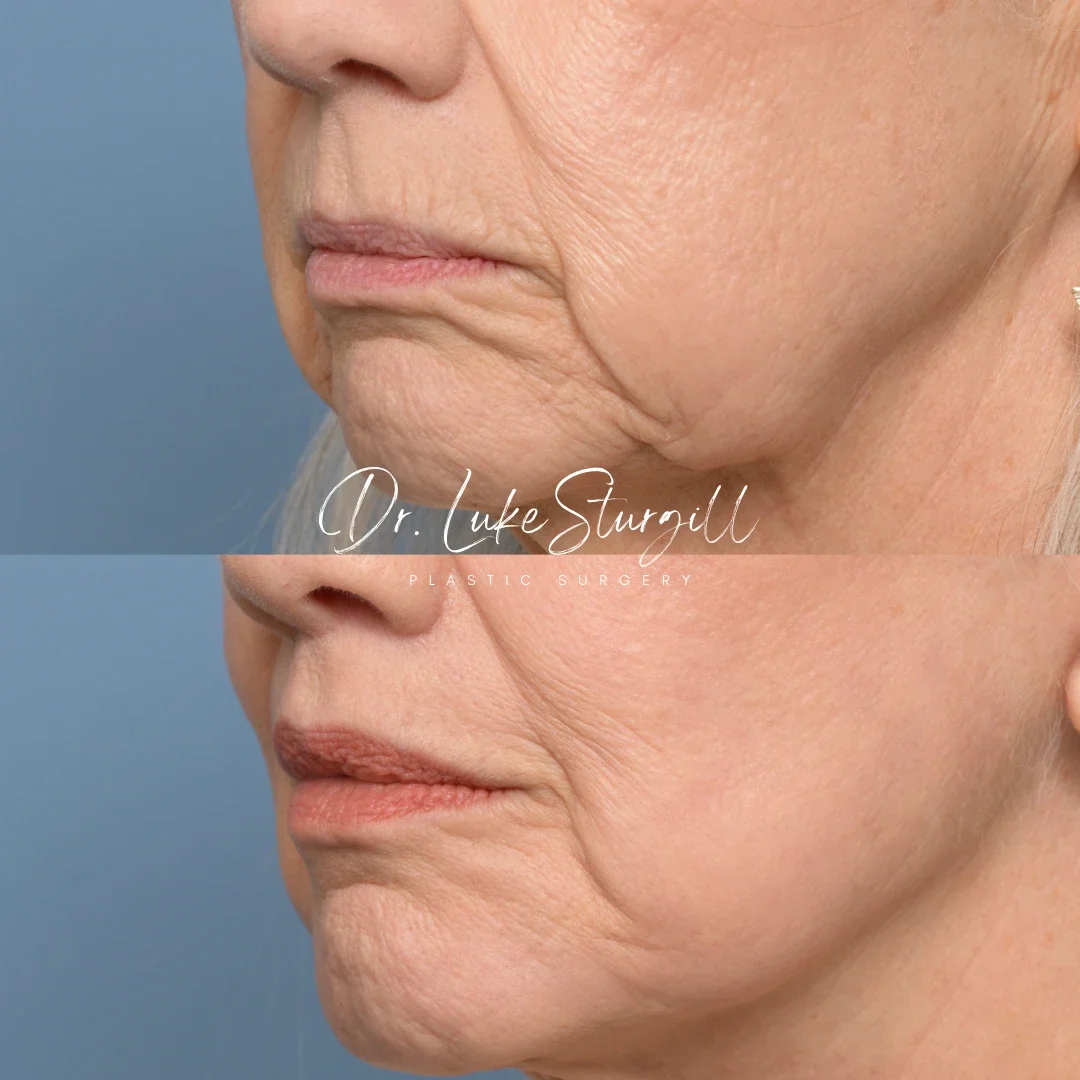
Lip Lift ◆ Before & After
Why the Mouth Ages—and Why Filler Alone Can't Fix It
Faces age in three ways: descent (gravity and soft tissue shift), deflation (volume loss), and damage (skin quality and fine lines). The perioral region is where all three show up—and they stack.
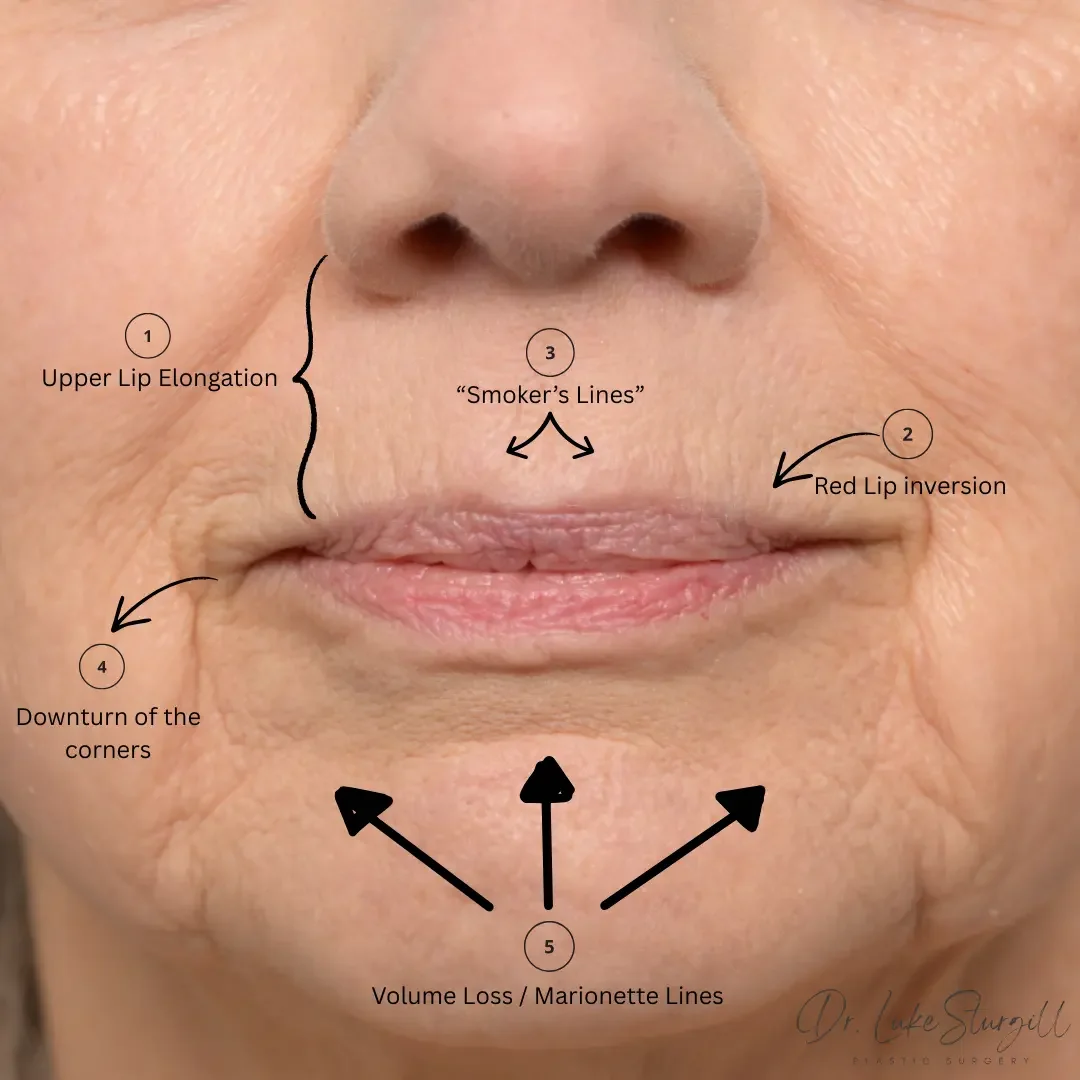
The five aging changes that stack in the perioral region
The distance from nose to lip border (the philtrum) can measure 12–15mm in youth. With age, it stretches to 18mm, 20mm, or more. This elongation hides the upper teeth, thins the visible pink lip, and makes the entire lower face look longer and older.
No amount of filler shortens this distance. Only a lip lift can.
The pink part of the lip naturally rolls inward with age, hiding what used to show. Filler can push it outward—but often creates that unnatural "shelf" or duck-lip appearance rather than restoring what was lost.
Vertical lip lines ("smoker's lines" or "barcode lines") develop from years of muscle movement and sun damage. These fine lines make lipstick bleed and age the lower face—and they require resurfacing, not filling.
Gravity pulls the oral commissures downward, creating a permanent frown or "marionette" expression—even when you're happy. This isn't about volume; it's about position. Filler cannot reposition tissue.
The lips and perioral region do lose volume with age—but strategic fat grafting, not filler stacking, restores this most naturally when combined with structural correction.
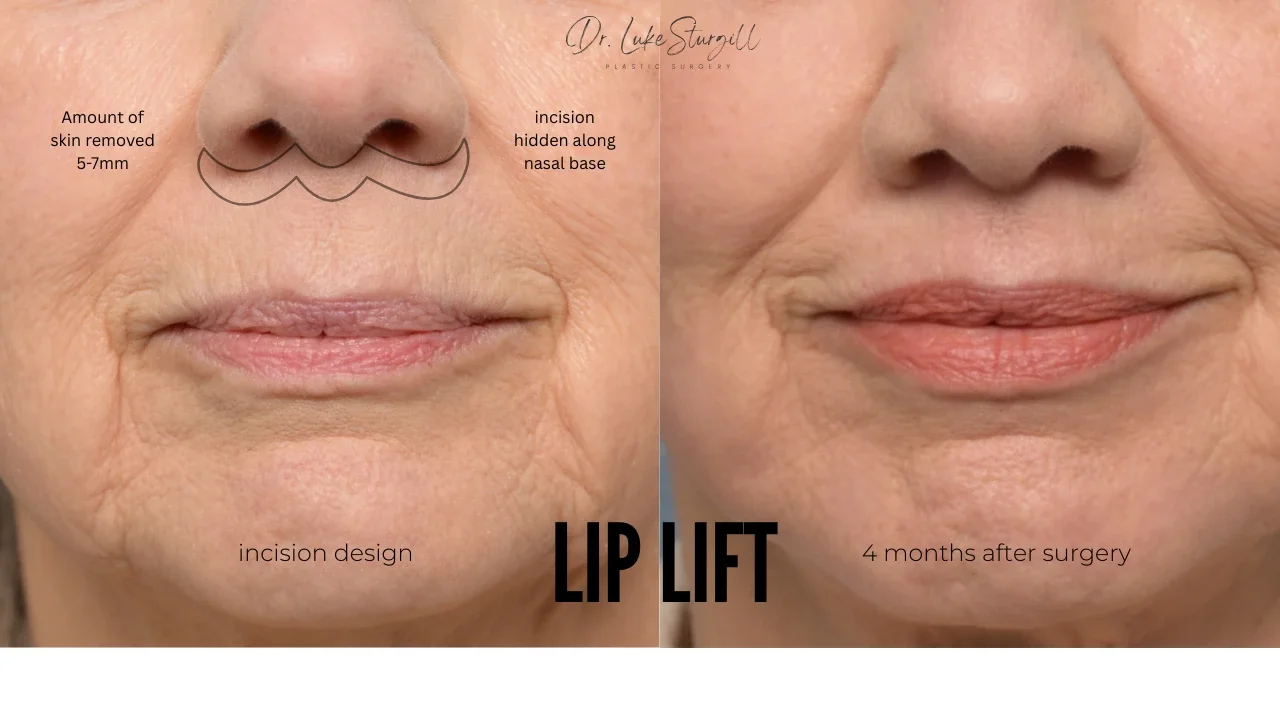
Lip Lift: The Structural Solution
A lip lift is not "making lips bigger." It is restoring the upper lip's position and balance.
What is a lip lift?
A subnasal (bullhorn) lip lift shortens an elongated upper lip by removing a precise strip of skin hidden at the base of the nose, then elevating the upper lip into a more youthful position. The result: more red lip show, improved tooth display, a defined Cupid's bow, and a mouth that reads younger because the lip-to-nose relationship is corrected—not because volume was added.
How Dr. Sturgill does it differently:
-
Conservative, anatomically-driven excision Enough to make a visible difference, not so much that the lip looks pulled or the scar widens.
-
Deep tissue anchoring The key to a natural result is securing tissues to deep structures, not just skin, ensuring the scar doesn't stretch over time.
-
Hidden scar placement The incision sits in the natural shadow at the base of the nose, following the nostril contour where it becomes virtually imperceptible once healed.
-
Evaluation of the complete perioral unit Lip lift alone isn't always the answer; sometimes it's part of a larger plan.
Who benefits most:
-
—
Long upper lip Philtrum >15–16mm
-
—
Limited red lip show The pink lip is hidden at rest
-
—
Minimal upper tooth show When lips are relaxed
-
—
"Filler fatigue" Tired of maintenance, migration, or the "done" look
-
—
Permanent improvement Rather than endless injections
The scar:
The incision is placed at the base of the nose, designed to hide in natural contours. Early healing looks like any incision—pink, visible, healing. Then it continues to refine as the scar matures. Most patients find the scar is essentially invisible within several months. Browse our before-and-after gallery to see how well the scar heals.
Results:
A lip lift is permanent. The shortened philtrum does not re-elongate. While aging continues at its natural pace, the structural improvement holds indefinitely. Most patients see their final result by 3–6 months as swelling resolves and the tissue softens.
Recovery & Results
Lip lift recovery is among the most straightforward in facial surgery. Most patients are surprised by how manageable the process is—and how quickly the results begin to show.
Day 1–3
Initial Healing
Mild swelling and tightness around the upper lip. Discomfort is minimal—most patients manage with over-the-counter medication. Sutures hold the incision at the base of the nose. Eating soft foods and limiting wide mouth movements helps keep tension off the repair.
Day 5–7
Suture Removal
Sutures are removed in the office. Swelling is noticeably improved. The upper lip will appear slightly over-shortened at this stage—this is expected and resolves as tissues settle. Most patients feel comfortable returning to non-strenuous daily activities.
Weeks 2–4
Settling & Scar Maturation Begins
Residual swelling continues to diminish. The scar at the nose base transitions from pink to progressively lighter. Lip movement and expression feel increasingly natural. Most patients are socially comfortable within two to three weeks.
Months 2–3
Results Taking Shape
The upper lip length has settled into its final position. Vermillion show is balanced and natural. The scar is fading and increasingly difficult to detect. Sensory changes, if any, have largely resolved.
6–12 Months
Final Result
The scar matures to a fine line concealed within the natural crease at the base of the nose. Results are permanent—unlike filler, the structural change to upper lip length does not revert. The lip ages naturally from this new, improved position.
At a Glance
Procedure Time
45–90 minutes depending on whether corner lip lift or additional perioral work is included
Anesthesia
IV sedation or general anesthesia administered by a board-certified MD anesthesiologist in our accredited private surgery center
Back to Daily Life
Most patients return to non-strenuous activities within 7–10 days*
Final Result
Structural improvement visible within weeks; scar maturation complete by 6–12 months*
Recovery timelines reflect lip lift performed as a standalone procedure. Combining with skin resurfacing, facial fat grafting, or other procedures may extend healing time and modify post-operative care instructions.
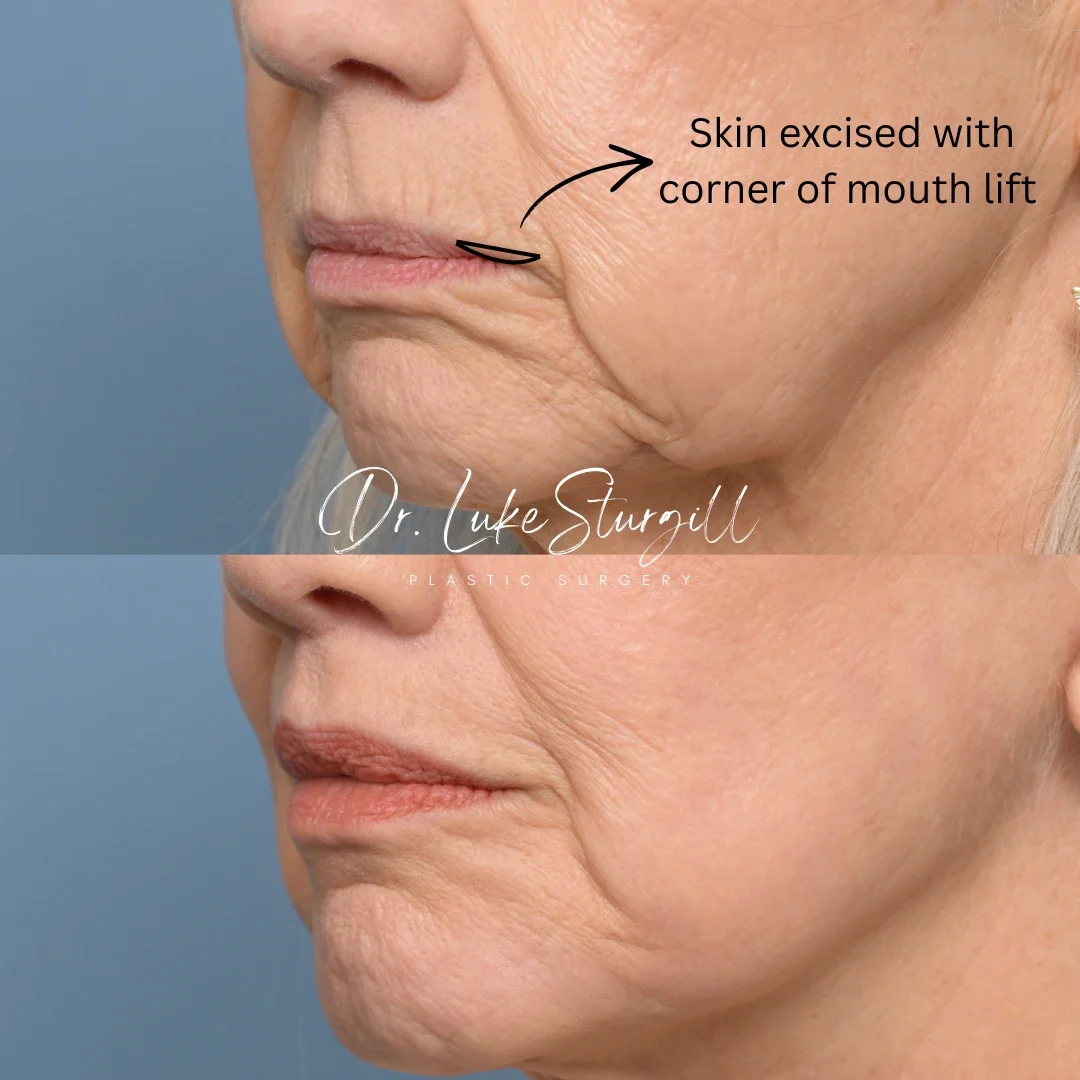
Corner of Mouth Lift
Correct the downturn—with structure, not volume.
Sometimes the feature that "spoils" an otherwise refreshed face is the downturned corner of the mouth. Gravity pulls the oral commissures downward, creating a perpetual frown or tired expression that no amount of filler can reposition.
A corner of mouth lift removes a small triangle of skin just above each commissure, physically elevating the corners to a neutral or slightly upturned position. The result is subtle but meaningful: a resting expression that conveys approachability instead of fatigue.
Why it's often paired with lip lift:
A lip lift improves the upper lip and central mouth. A corner of mouth lift improves the edges of the smile. For the right patient, combining them restores harmony across the entire perioral unit—especially when the corners are asymmetrical or noticeably downturned.
Addressing only the upper lip can sometimes make downturned corners more noticeable. Treating both creates balanced improvement.
Lip Augmentation
A fuller upper lip means nothing if the lower lip doesn't match.
Here's an industry secret: most practitioners focus almost entirely on the upper lip while neglecting the lower lip. The result is often disproportion—an enhanced upper lip sitting above a comparatively thin lower lip. In youthful faces, the lower lip is typically fuller than the upper, and the relationship between the two is what looks natural.
Dr. Sturgill augments either the upper lip, the lower lip, or both, using two primary methods. The right choice depends on your anatomy, your goals, and whether you're already undergoing surgery.
Which is right for you?
Choose filler if you want a reversible option, want to trial volume, prefer a non-surgical approach, or aren't ready for a permanent commitment. Choose SMAS grafting if you're already undergoing facelift surgery and want a permanent, maintenance-free solution.
During your consultation, Dr. Sturgill will evaluate your lip shape, proportions, and facial balance—and recommend the best approach for enhancing the upper lip, lower lip, or both in a way that looks natural and intentional.
Full Perioral Rejuvenation
For patients with multiple concerns—a long upper lip, downturned corners, volume loss, and perioral rhytids—addressing one issue at a time leaves the others more obvious. Dr. Sturgill's full perioral rejuvenation combines multiple modalities based on your specific presentation.
The Three Levers of a Complete Result
Tap each lever to learn more
Lip lift to shorten the philtrum and restore vermilion show—the single most impactful structural change in upper lip aging.
Corner of mouth lift to correct the downturn that creates a perpetually tired or unhappy expression.
Lower lip augmentation if needed for balance—because the upper and lower lip exist in proportion, and restoring one without considering the other can look incomplete.
Lip Lift Corner Lift Lip AugmentationFacial fat grafting restores lost volume to the lips, perioral region, and surrounding areas using your own tissue. Unlike filler, fat that survives the transfer lasts indefinitely. Fat also contains regenerative stem cells that may improve skin quality over time.
Nanofat is a specialized preparation that removes larger fat cells, leaving behind a concentration of stem cells and growth factors. Injected superficially, it improves skin quality, reduces fine lines, and enhances texture—benefits beyond simple volume replacement. Particularly effective for fine "barcode" lines.
Fat Grafting NanofatLaser resurfacing (CO₂ or erbium) targets perioral rhytids—the vertical lines that make lipstick bleed. Creates controlled injury to stimulate collagen remodeling and smooth the skin surface.
Dermabrasion when appropriate—often the strongest perioral line tool in experienced hands, either alone or combined with laser for severe textural damage.
Laser Resurfacing DermabrasionThink of it like renovating a house: you can repaint the walls (resurfacing), but if the foundation has shifted (structure) and the furniture is gone (volume), the fresh paint only highlights what's missing. Addressing all three produces a result that's more complete—and more natural—than treating any single component alone.
Combination Protocols
Select a stage to see the recommended approach
The goal is not to perform every possible procedure—it's to select the precise combination that addresses your specific anatomy.
Lip Lift & Perioral Rejuvenation Before & After
Every face tells a story — and these results speak for themselves. What you'll notice across these patients isn't a "done" look. It's the opposite: a refreshed, natural version of themselves. That's the standard. You want to look like you — just refined. A well-executed lip lift shortens the distance between the nose and the upper lip, restoring youthful proportions and revealing more of the vermilion — without filler, without distortion, and without looking "worked on." Pay attention to the balance between the upper and lower lip and how the Cupid's bow is defined yet natural.
What to Look For
Here's what separates a technically excellent result from an average one:
A note on photos: All images are unretouched and show real patients of Dr. Sturgill photographed under consistent clinical lighting. Results vary by individual anatomy, skin quality, and healing response. These photos represent typical outcomes — not best-case-only marketing.
Complementary Procedures
The mouth doesn't exist in isolation—it must harmonize with the rest of the face. Dr. Sturgill often combines perioral rejuvenation with other procedures to create balanced, comprehensive results.
A facelift addresses descent of the midface, jowls, and neck—but it doesn't shorten the upper lip or lift the mouth corners. Dr. Sturgill performs lip lift in approximately one-third of facelift cases because the lips are the visual center of the face and must match the rejuvenation achieved elsewhere. SMAS grafts harvested during facelift provide permanent lower lip augmentation without additional surgery.
Learn MoreThe relationship between the nose and upper lip is one of the most important aesthetic pairings on the face. A long upper lip can make the nose appear longer; rhinoplasty can change the nose-lip relationship in ways that make a lip lift more—or less—beneficial. When both are concerns, addressing them together produces a more harmonious central face.
Learn MoreThe eyes and mouth are the two areas most responsible for expressing emotion and energy. For comprehensive facial rejuvenation, brightening the eyes while restoring the perioral region creates balanced improvement—the entire face reads as refreshed rather than one feature standing out.
Learn MoreFat grafting can restore volume to the nasolabial folds, marionette areas, and perioral region—softening transitions and supporting the corners of the mouth from beneath.
Learn MoreLip lift and corner lift address structure. Fat grafting addresses volume. Neither improves skin quality. Laser resurfacing or dermabrasion addresses fine lines, texture, and sun damage—completing the rejuvenation.
Learn MoreWhy Patients Choose
Dr. Sturgill
Patients travel from across the country for care that prioritizes honesty, artistry, and results that look like you.
Specialization
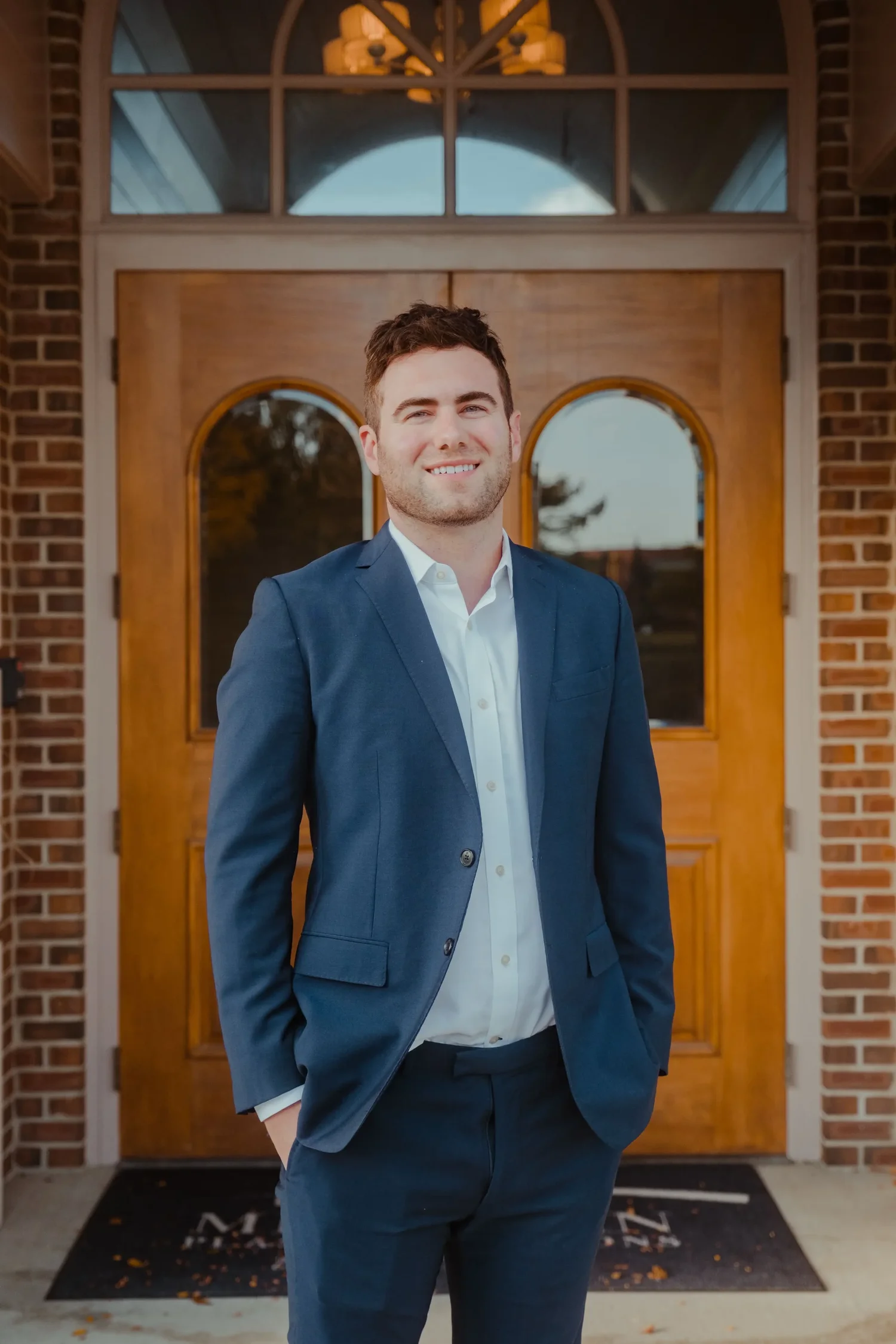
Double board-certified in facial plastic surgery. He focuses exclusively on the face and neck — performing lip lifts at a volume that ensures consistency and mastery.
Truth & Transparency
No sales pressure. No "magic" wands. Just honest assessments of what anatomy and surgery can achieve — so you can make decisions with clarity, not confusion.
The "Unoperated" Look
His aesthetic goal is for you to look like yourself — just rested, refined, and restored. Never overdone, never obvious.
What Patients Are Saying About Dr. Sturgill
Real reviews from real patients—because the best referral is an honest one.
Ready to take the next step?
Your consultation is a planning session — not a sales pitch.
Dr. Sturgill will evaluate your facial anatomy, discuss your goals, and give you an honest assessment of what surgery can — and cannot — achieve. You will leave with a clear understanding of whether this procedure is right for you.
What to expect
- Review your concerns and goals in detail
- Receive a facial analysis with a personalized surgical plan
- See before-and-after photos of what YOU will look like after surgery
- Have all your questions answered directly
Consultations typically last around 45 minutes.
Book Your Consultation
Lip Lift & Perioral Rejuvenation
Straightforward answers about structure, recovery, and what to realistically expect.
Filler adds volume — it makes lips bigger by injecting material beneath the surface. A lip lift changes structure — it shortens the upper lip, increases vermilion show, and improves proportion without adding "pillow volume." Filler cannot shorten a long philtrum; only surgery can.
Many patients benefit from a lip lift first, then subtle filler later if desired. Others find they no longer want filler at all once their lip structure is corrected.
A lip flip uses a small amount of Botox or similar neuromodulator injected into the muscle above the upper lip, causing the lip to gently roll outward. The effect is subtle, temporary (lasting 6–8 weeks), and adds no structural change. A lip lift is a surgical procedure that permanently shortens the philtrum and reveals more vermilion. A lip flip can be a good trial for patients curious about showing more upper lip, but it does not address a structurally long philtrum — only a lip lift can do that.
It usually makes the upper lip look more present because more vermilion shows — without injecting volume. If you want true added fullness (especially in the body of the lip), that's where filler or surgical grafting comes in.
A lip lift is permanent. The shortened philtrum does not re-elongate. While aging continues at its natural pace, the structural improvement holds indefinitely. Corner-of-mouth lifts and SMAS grafts are also intended to be long-lasting. Filler, by comparison, requires maintenance every 6–12 months.
The lip lift incision is placed at the base of the nose, hidden in the natural shadow where the nostrils meet the upper lip. In most patients, the scar fades to a fine line that's difficult to notice — even without makeup. Dr. Sturgill's before-and-after photos include healed scar examples. Meticulous technique and proper aftercare make a big difference.
Most patients take 5–7 days off work for a lip lift alone. Swelling is most noticeable in the first 3–5 days and improves substantially by 2 weeks. Sutures are typically removed around day 5–7. Most patients feel comfortable being seen socially with light makeup by 10–14 days. The lip often feels tight early on — this softens over 4–8 weeks.
Most patients describe mild discomfort rather than significant pain — more tightness than sharp sensation. Temporary numbness can occur and typically improves over weeks. Many patients transition to Tylenol quickly.
Early on, yes — temporarily. Swelling and tightness can make your smile look stiff or "restricted" for a few weeks. As the tissues relax, your smile returns to normal, just with improved upper-lip proportion and tooth show.
A lip lift and corner-of-mouth lift can be performed under IV anesthesia administered by a board-certified anesthesiologist. When combined with other procedures like an Extended Deep Plane Face and Neck Lift, general anesthesia is typically used. Surgery is performed at Meridian Plastic Surgery Center, Dr. Sturgill's private AAAHC-accredited surgical facility.
That's a candidacy and planning issue — not a reason to avoid the procedure altogether. The goal is balanced tooth show at rest and a natural smile. Dr. Sturgill tailors the amount of lift so the result looks refined, not "over-lifted."
Yes. Many patients need less filler — or none — after a lip lift because the structural improvement gives them what they were seeking. If you want additional volume after healing, filler remains an option. Dr. Sturgill typically recommends waiting at least 3 months after surgery before considering filler.
Often yes. Existing filler can distort lip measurements, weigh down the lip, or mask the true anatomy. Dissolving first helps accurate planning and cleaner results. This is decided during your consultation based on exam and goals.
A corner-of-mouth (commissure) lift removes a small triangle of skin above each mouth corner to physically reposition the corners upward. It treats the downturned "frown" look that filler typically cannot fix in a durable, predictable way. It's often combined with a lip lift for comprehensive perioral improvement.
There will be a scar — because the incision sits at or near the mouth corner. In good candidates, it usually blends into a natural crease and becomes difficult to notice by about 3 months, then continues to soften over time.
The SMAS is the deeper tissue layer lifted during facelift surgery. A small amount can be harvested and used as a graft in the lower lip to create permanent, natural-feeling augmentation using your own tissue. It's especially useful when the lower lip is the "missing piece" and patients want lasting balance — not maintenance filler.
It can help a bit by improving structure and subtly tensioning the skin, but it does not erase etched vertical lines on its own. That's why Dr. Sturgill often pairs perioral rejuvenation with laser resurfacing or dermabrasion to improve the skin surface while surgery improves structure.
Perioral aging is usually a mix of structure, volume, and skin quality. Depending on your anatomy, combinations may include: lip lift, corner-of-mouth lift, lower lip augmentation (filler or SMAS graft), fat grafting to the marionette and pre-jowl region, and resurfacing.
Yes — and it's one of the most common combinations. A facelift addresses the sides of the face and neck; perioral rejuvenation addresses the central face. Together, the result looks complete and harmonious rather than leaving the mouth "behind."
Still have questions?
The best answers come from evaluating your anatomy in person.
Book ConsultationLooking for general practice questions? Visit our main FAQ page.