

Signature Extended Deep Plane Face & Neck Lift
By R. Luke Sturgill, MD · Double Board-Certified Facial Plastic Surgeon · Carmel, Indiana
The Gold Standard in Facelifts
Repositioning, Not Pulling
You don’t want to look “different.” You want to look like you—just restored. A sharper jawline, a cleaner neckline, less heaviness through the midface, and a result that doesn’t announce itself as surgery.
That is the goal of Dr. Sturgill’s signature Extended Deep Plane Face & Neck Lift: to lift what has truly descended, without placing tension on the skin.
As a double board-certified facial plastic surgeon serving Carmel and Indianapolis, Dr. Sturgill has built one of the busiest facelift practices in the country by specializing in one thing: the face and neck. Patients often arrive after extensive research—and many travel from out of state—because they are looking for a technique that prioritizes structure, not shortcuts.
If you are looking for natural results that hold up over time, you must start with the work beneath the surface. Click below to see real results for yourself.
View Before & After Gallery
R. Luke Sturgill, MD ♦ Facial Plastic Surgeon
Understanding Facial Aging
It Isn’t Just Loose Skin
Why the face you see in the mirror no longer matches the way you feel inside—and why most approaches only address part of the problem.
Most patients don’t describe their concern as “aging.” They describe something more specific: a heaviness through the lower face, jowling that wasn’t there five years ago, a neck that no longer looks clean in photographs, or a tired expression that doesn’t reflect how they actually feel.
These changes aren’t caused by loose skin alone. They are driven by three deeper forces working together—and understanding them changes the entire conversation about what a facelift can and should do.
Descent
The muscles, fat pads, and connective tissues that once gave your face its youthful shape don’t stay in place forever. Gravity pulls them downward and the ligaments that held them begin to loosen. The cheek falls away from the eye, the midface slides toward the jawline producing jowls, and the neck muscles separate and band. This is structural migration—no amount of skin tightening can reverse it.
Deflation
As facial fat pads thin and shift, areas that were once full appear sunken or gaunt. The result is a face that looks drawn rather than lifted—hollows under the eyes, flattening through the cheeks, and a loss of the soft contours that define a rested appearance.
Damage
Sun exposure, environmental stress, and the slow breakdown of collagen and elastin. Skin becomes thinner, less elastic, and more textured. This is the most visible layer—but not the most important one. Treating skin alone is like repainting a house with a shifting foundation.
Why This Matters
Less invasive approaches—skin-only facelifts, thread lifts, SMAS-plication techniques—tighten the outer envelope without addressing what has moved underneath. The result may look tighter at first, but because the deeper structures remain displaced, it tends to look pulled rather than restored—and it doesn’t last.
A truly natural, lasting result requires a technique that works beneath the skin—one that releases and elevates the deeper structural tissues to their youthful position. By restoring this underlying foundation, the skin can simply re-drape completely tension-free.
This is the fundamental principle behind Dr. Sturgill’s Extended Deep Plane Face & Neck Lift technique.
The Technique
What an Extended Deep Plane Face & Neck Lift Actually Does
Most facelifts work by pulling the skin tighter. Dr. Sturgill’s Extended Deep Plane Face & Neck Lift technique takes an entirely different approach. Rather than relying on skin tension, the procedure releases the deep structural ligaments that tether the face in its aged position—then elevates the entire SMAS-platysma complex as a single, continuous unit.
That structural repositioning is what produces results that look natural and last. The jawline sharpens because the tissue supporting it has been moved back where it belongs. The neck regains its angle because the platysma has been addressed at the source. And the face appears rejuvenated rather than operated on because nothing has been pulled tight—it has been lifted from within.
The word “extended” is not marketing language. It describes how far the dissection reaches beneath the surface—and that difference changes everything about the outcome.
01
Full Midface Release
Dr. Sturgill releases the zygomatic and masseteric retaining ligaments—the deep anchors that hold descended cheek tissue in place. This allows the malar fat pad to be elevated vertically, restoring cheek volume and softening nasolabial folds without the need for filler.
02
Comprehensive Neck Work
The dissection extends through the platysma, addressing submental fat, platysmal banding, and the deep cervical structures responsible for neck laxity. Rather than treating the neck in isolation, Dr. Sturgill addresses it as a direct continuation of the facial plane.
03
Multi-Vector Repositioning
Each zone of the face—midface, jowl, jawline, and neck—is repositioned along its own optimal vector. This avoids the one-directional pull that creates a “windswept” appearance and instead produces balanced, three-dimensional correction.
04
Zero-Tension Skin Closure
Because the deep structural layers carry the entire load of the lift, the skin is re-draped without any tension whatsoever. This is what produces the finest possible scars and eliminates the tight, pulled look that patients fear most.
What It Improves Best
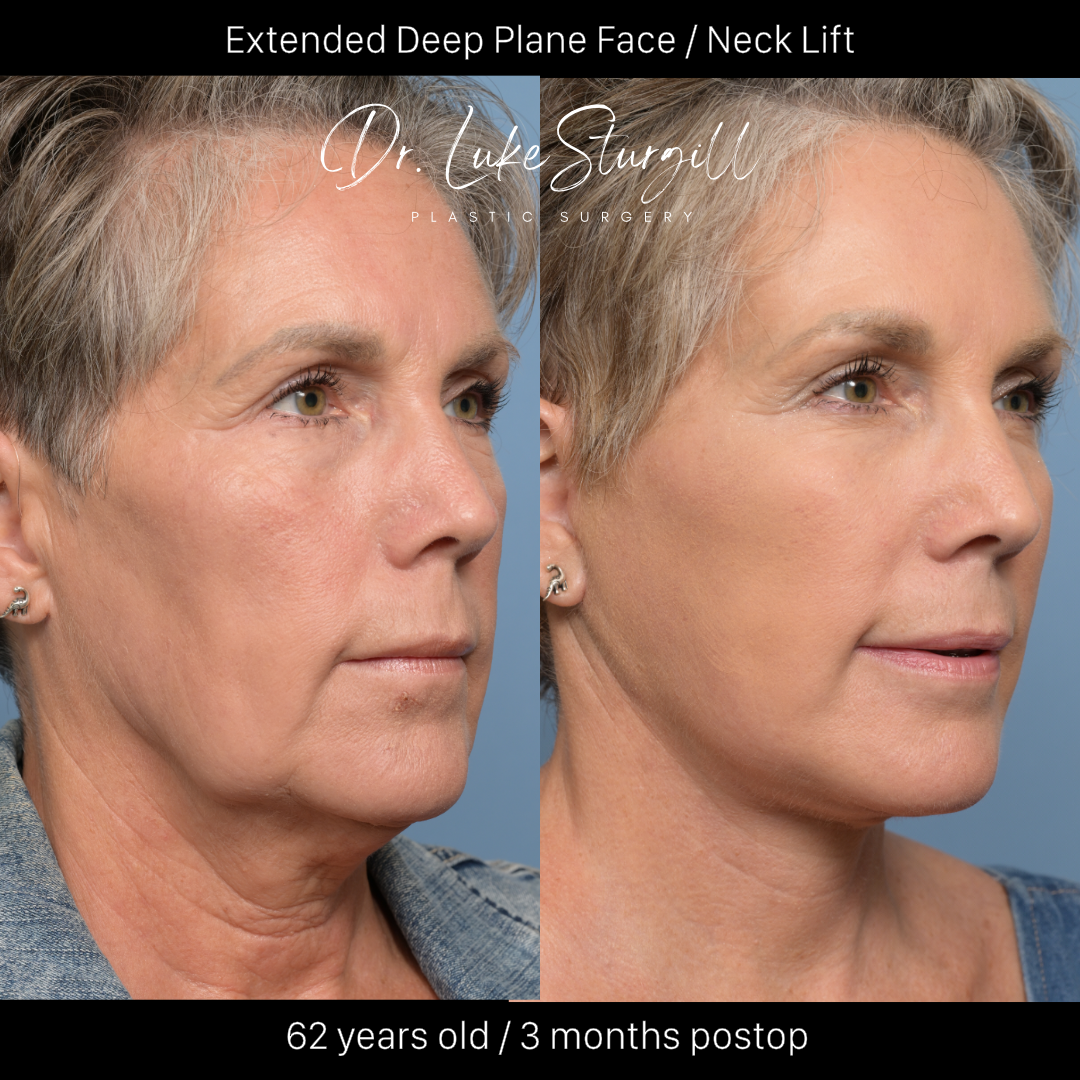
Dr. Sturgill’s Extended Deep Plane technique is designed to address the structural changes that create an aged appearance across the entire lower two-thirds of the face and neck:
What It Does Not Do by Itself
An honest surgical plan acknowledges what a single technique can and cannot achieve. The deep plane lift repositions structure—but some concerns require complementary approaches:
-
—
Fat grafting to restore volume lost from the temples, periorbital hollows, or lips
-
—
Eyelid surgery to address upper or lower eyelid hooding and under-eye bags
-
—
Brow lift to correct forehead heaviness or brow ptosis
-
—
Lip lift to shorten a lengthened upper lip and restore vermilion show
-
—
Skin resurfacing to improve texture, fine lines, and pigmentation that lifting alone will not correct
The difference is not a bigger incision. It is a more complete correction—treating the midface, jawline, and neck as a single connected system rather than isolated zones. Dr. Sturgill evaluates the entire face and builds each surgical plan accordingly.
Discuss Your GoalsPatient Story
Tina’s Story
She flew from Miami to Carmel for the procedure that changed everything — just in time for her daughter’s wedding
Watch Tina’s Interview
She searched the entire country for the right surgeon — and flew from Miami to find him.
When Tina learned her daughter was getting married, she decided it was time. Living in Miami, Florida, she had no shortage of local options — but after researching deep plane facelift surgeons nationwide, she chose to travel to Carmel, Indiana for Dr. Sturgill’s exceptional results and his genuine, unhurried approach to patient care.
Three months after Dr. Sturgill’s Extended Deep Plane Face & Neck Lift, Tina didn’t just look refreshed — she felt like the best version of herself, just in time to celebrate as mother of the bride.
Tina is one of many patients who travel from out of state for Dr. Sturgill’s technique. His practice welcomes patients from across the country and provides a seamless experience for those traveling to Carmel for their procedure.
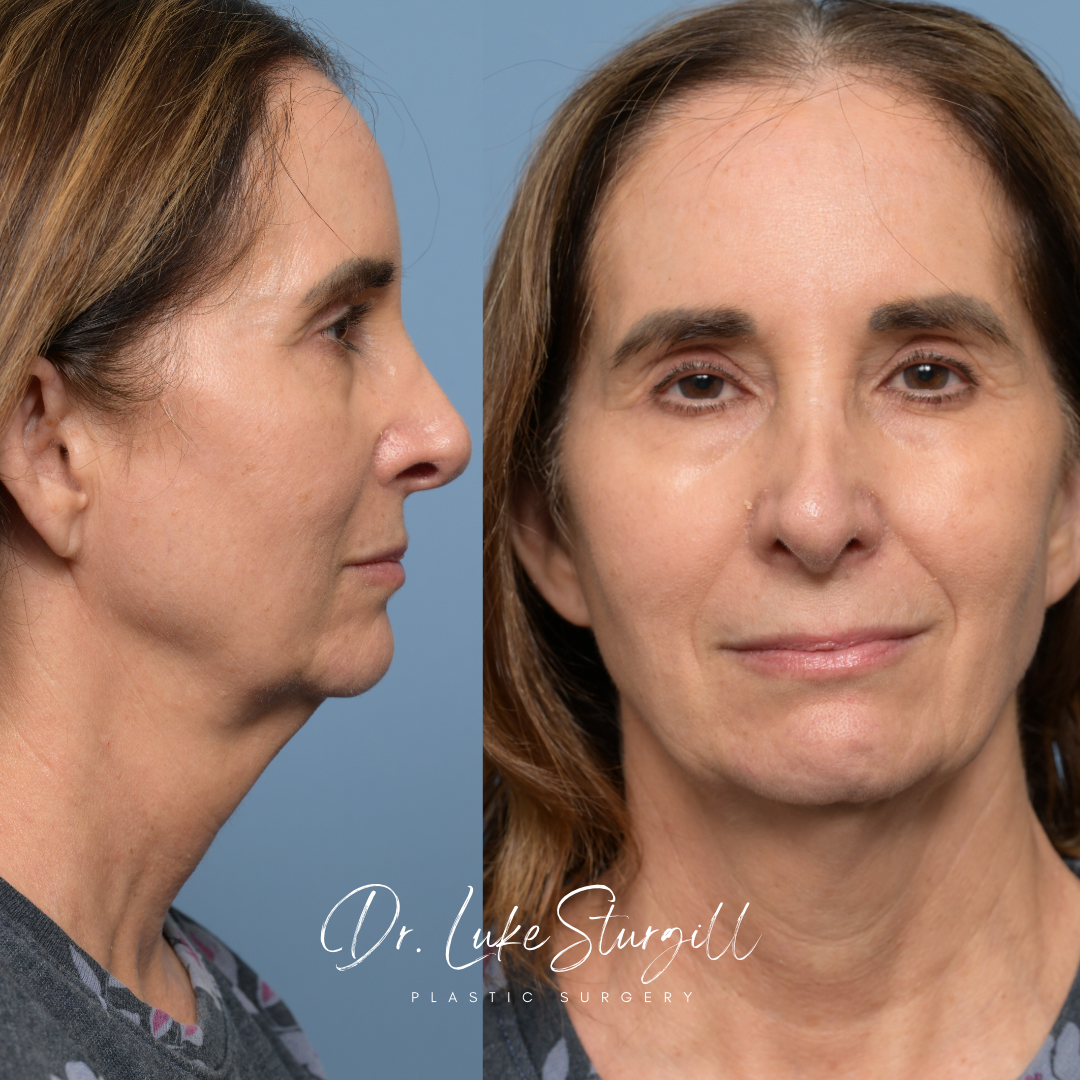
Before
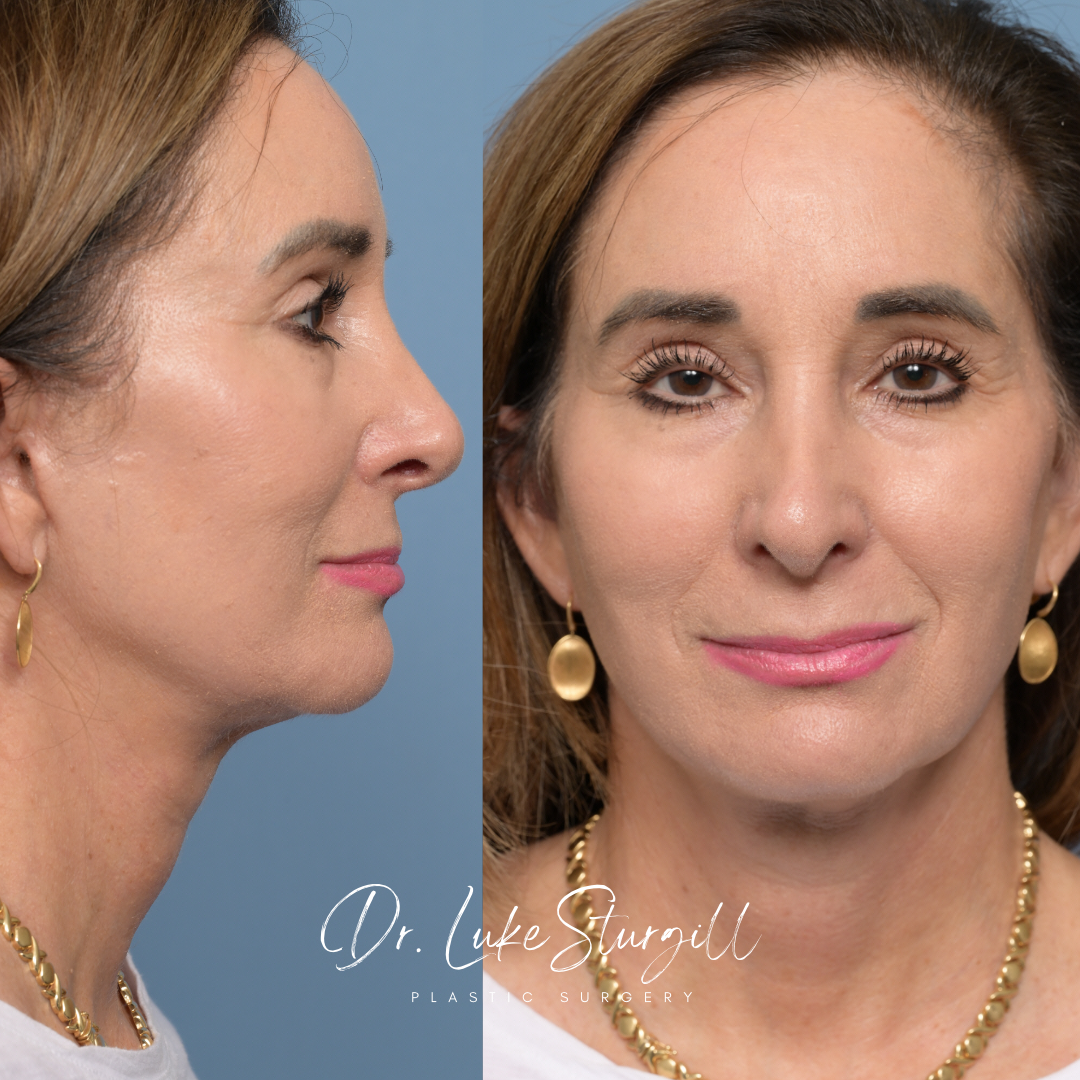
Three Months Post-Op

Mother of the Bride
Side by Side
Not All Facelifts Are the Same
Traditional Facelift
Skin-only or SMAS techniques
Pulls skin without addressing deeper structures
Limited midface correction — misses the cheeks
Higher risk of “pulled” or windswept appearance
Results typically last 3–7 years
Skin bears the tension — wider scars over time
Extended Deep Plane
Full structural repositioning
Lifts the entire deep tissue layer as one unit
Full midface, jawline, and neck correction
Natural result — restores rather than distorts
Results last 10–15+ years and age gracefully
Minimal skin tension — finest possible scars
Real Patient Results
Before & After
The goal of Dr. Sturgill’s Extended Deep Plane Face & Neck Lift technique is never just to look “tighter.” It’s to look like yourself — only refreshed, rested, and undeniably natural. What patients notice first in these results isn’t any single change. It’s that everything looks right again — the midface, the jawline, the neck, all working together the way they used to. No two faces are treated the same way because no two faces age the same way.
Our Photography Standards
100mm macro lens. Dual-light setup. Standardized positioning. No angles, no tricks. Learn why this matters and how to evaluate any surgeon’s before & after photos.
What to Look For
Here’s what separates a deep plane result from a superficial facelift:
A note on photos: All images are unretouched and show real patients of Dr. Sturgill photographed under standardized clinical lighting with a 100mm macro lens. Results vary by individual anatomy, skin quality, and healing response. These photos represent typical outcomes — not best-case-only marketing.
Your First Night
Recovery Begins at Meridian Plastic Surgery Center
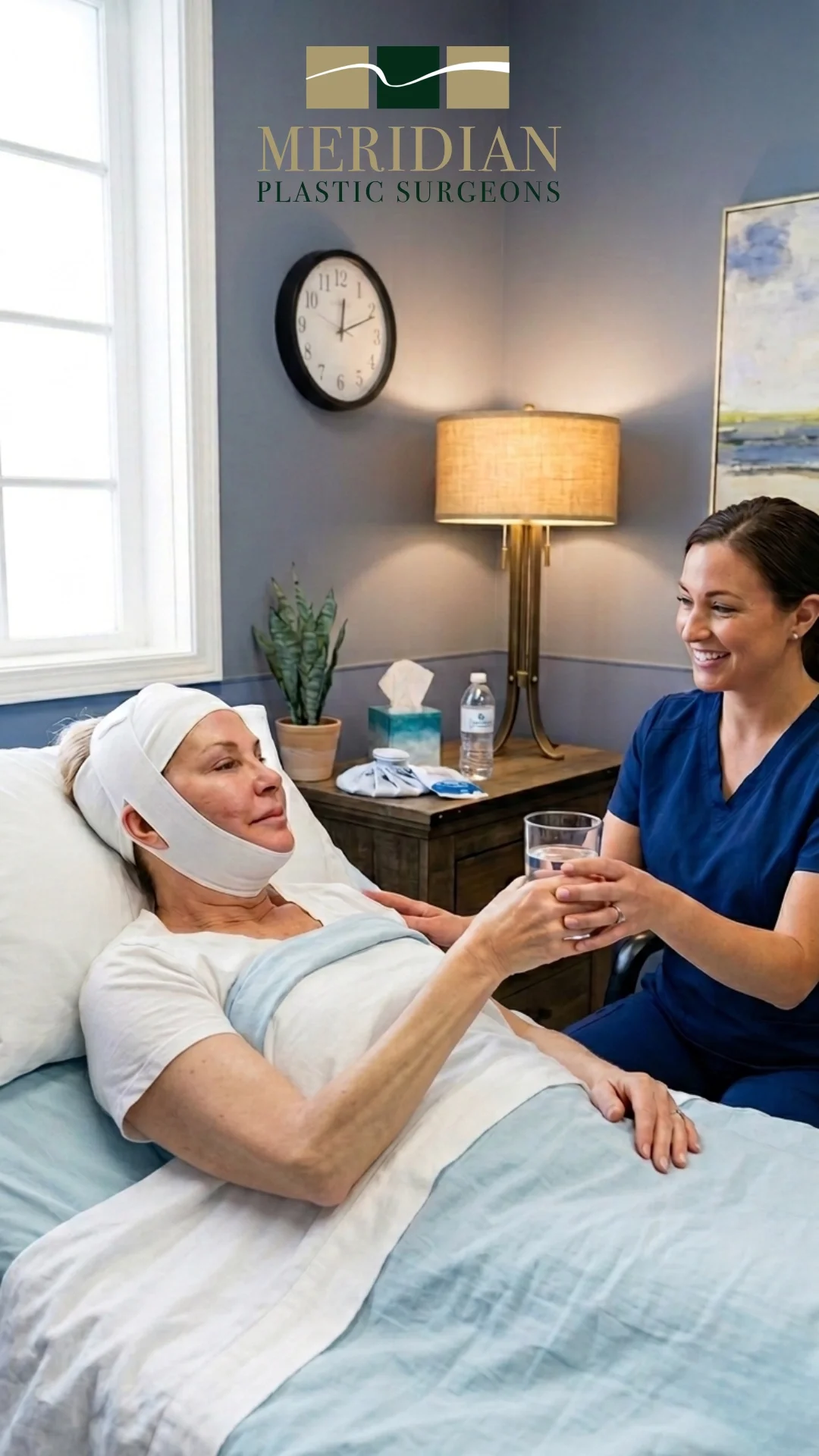
Following Dr. Sturgill’s Extended Deep Plane Face & Neck Lift, every patient spends their first night in a private overnight suite at Meridian Plastic Surgery Center — monitored by dedicated nursing staff from the moment surgery ends through discharge the next morning.
Private Suite & Dedicated Nursing
Each patient recovers in a fully private suite with continuous one-on-one nursing care. Vitals, medications, and comfort are monitored throughout the night — allowing patients to rest while their care team manages every detail of early recovery.
Surgeon-Owned, Purpose-Built Facility
Unlike hospital-based settings, Meridian Plastic Surgery Center was designed specifically for facial aesthetic surgery. The environment is quiet, private, and focused entirely on the surgical patient — with no shared rooms, no overhead paging, and no competing priorities.
Board-Certified Anesthesia & Safety Standards
Every procedure is performed under the care of a board-certified anesthesiologist. Meridian Plastic Surgery Center is Medicare-certified and licensed by the Indiana State Department of Health — ensuring hospital-grade safety protocols in a private, concierge-level setting.
What to Expect
Recovery & Results Timeline
Every patient heals differently, but the general arc of recovery follows a predictable pattern. Here’s what most patients experience after Dr. Sturgill’s Extended Deep Plane Face & Neck Lift.
The “Down” Time
Swelling and tightness peak during the first week. Patients rest with the head elevated, use ice regularly, and keep activity to a minimum. Sutures are typically removed around days 3 and 7. Most patients describe this phase as more uncomfortable than painful.
Restaurant Ready
This is the milestone most patients ask about. While not fully healed, most are presentable enough to go to dinner, run errands, or return to light social activity with makeup and hair down. The face looks noticeably refreshed, though tissues may still feel firm to the touch.
Big Event Ready
For patients planning around a wedding, reunion, or major event — three months is the benchmark. By this point, roughly 90% of swelling has resolved, tissues have softened, and the result looks completely natural. Most people simply say the patient looks “really well-rested.”
Long-Term Results
Because Dr. Sturgill’s technique relies on structural repositioning rather than skin tension, results typically last decades. Patients continue to age — but from a more youthful set point, gracefully and naturally. The procedure doesn’t stop time, but it resets the clock.
Individual recovery timelines vary based on anatomy, skin quality, and adherence to post-operative instructions. Dr. Sturgill’s team provides detailed guidance at every stage.
Complementary Procedures
Addressing the Complete Picture
Facial aging reflects three overlapping forces: descent — deep tissues shifting downward — deflation — loss of youthful volume — and damage — decline in skin quality and surface texture. The Extended Deep Plane Face & Neck Lift corrects descent. Complementary procedures allow Dr. Sturgill to address what remains, creating a result that feels complete, balanced, and coherent.
He often compares it to renovating a room — refinishing only part of it makes the untouched areas stand out more. The face works the same way.
Addresses Deflation
Facial Fat Grafting
Microfat and nanofat transfer restores the volume that aging quietly removes — from the midface and temples to the hollows beneath the eyes and around the mouth. Because the grafts are placed on a stable, repositioned deep-plane foundation, they integrate more predictably and last longer than volume restoration performed in isolation. Dr. Sturgill performs facial fat grafting in approximately 90 percent of his Extended Deep Plane Face & Neck Lift cases.
Learn MoreAddresses Damage
Skin Resurfacing
Laser and chemical peels treat what structural lifting cannot — fine lines, sun damage, uneven texture, and age spots at the skin’s surface. When performed alongside the Extended Deep Plane technique, resurfacing sharpens skin quality over a foundation that has already been tightened and repositioned beneath it — producing a result that neither procedure achieves as effectively on its own.
Learn MoreCompletes the Upper Face
Brow & Eyelid Surgery
The Extended Deep Plane addresses the lower two-thirds of the face and neck, but aging also descends the brow, weighs down the upper eyelids, and hollows the under-eye region. Endoscopic brow lifting repositions a heavy brow through small, hidden incisions, while upper and lower blepharoplasty refines excess lid skin and under-eye fullness. Combined with the facelift, the result is a consistently refreshed appearance from forehead to jawline. Dr. Sturgill performs brow and⁄or eyelid surgery in approximately two-thirds of his facelift cases.
Learn MoreAdditional Refinements
Lip Lift
A lip lift shortens an elongated upper lip and restores youthful lip show — improving the central face in a way the facelift alone does not reach. Dr. Sturgill combines a lip lift in approximately one-third of his facelift cases.
Learn MoreBuccal Fat Reduction
Selective buccal fat removal refines lower-cheek fullness and improves facial contour — achieving subtle definition without a hollow appearance. Performed in roughly half of Dr. Sturgill’s facelift cases.
Learn MoreEarlobe Reduction
Earlobes elongate with age and years of earring wear, and can appear disproportionate next to a newly rejuvenated jawline and neck. A brief reduction restores natural proportion and is frequently performed alongside the facelift.
Performed at time of surgery
Hand Rejuvenation
The hands are one of the most common areas that reveal a patient’s true age. Fat grafting restores lost volume, softening visible tendons and veins and returning a smoother, more youthful contour to the dorsal hand.
Performed at time of surgery
“Here’s something I tell my patients — as a facial plastic surgeon, when I want to estimate someone’s real age, the first place I look is their hands. The face can be beautifully restored, but the hands often tell the whole story.”
Fat grafting changes that equation entirely — restoring volume so that not even an expert eye can give away your age.
— Dr. SturgillRevision & Secondary Facelifts
Expert Solutions for Complex Cases
Revision facelift surgery is higher-stakes than a first-time lift — whether the patient is seeing aging years after a prior procedure or correcting an unsatisfying result performed elsewhere. These cases demand a surgeon who operates in this space routinely, not occasionally.
~50%
of Dr. Sturgill’s practice is dedicated to revision and secondary Extended Deep Plane Face & Neck Lifts — making it one of the highest-volume revision facelift practices in the Midwest.
Common Concerns Dr. Sturgill Corrects
01
Early Relapse
Recurrent sagging after “mini” lifts or skin-only procedures that never addressed the deeper structural layers.
02
Windswept Tension
An unnatural lateral sweep or widened mouth caused by excessive skin pull without proper deep-tissue repositioning.
03
Pixie Ear Deformity
Earlobes pulled downward or distorted by skin tension at the incision line — a telltale sign of a prior facelift.
04
Visible Scars
Widened, misplaced, or poorly concealed incisions that compromise an otherwise improved result.
The Advantage
Why Deep Plane Excels in Revision
Revision surgery is inherently more difficult because of scar tissue. Prior procedures create adhesions in the superficial plane — the exact layer most surgeons work within. Attempting to re-dissect through scarred tissue increases the risk of nerve injury, skin necrosis, and an outcome that looks no better than the first.
Dr. Sturgill’s Extended Deep Plane approach works beneath the SMAS, often allowing access to less-scarred, untouched tissue planes. This makes it possible to fully release the retaining ligaments and reposition deep structures without relying on skin tension — producing a result that looks natural and lasts longer than the original lift.
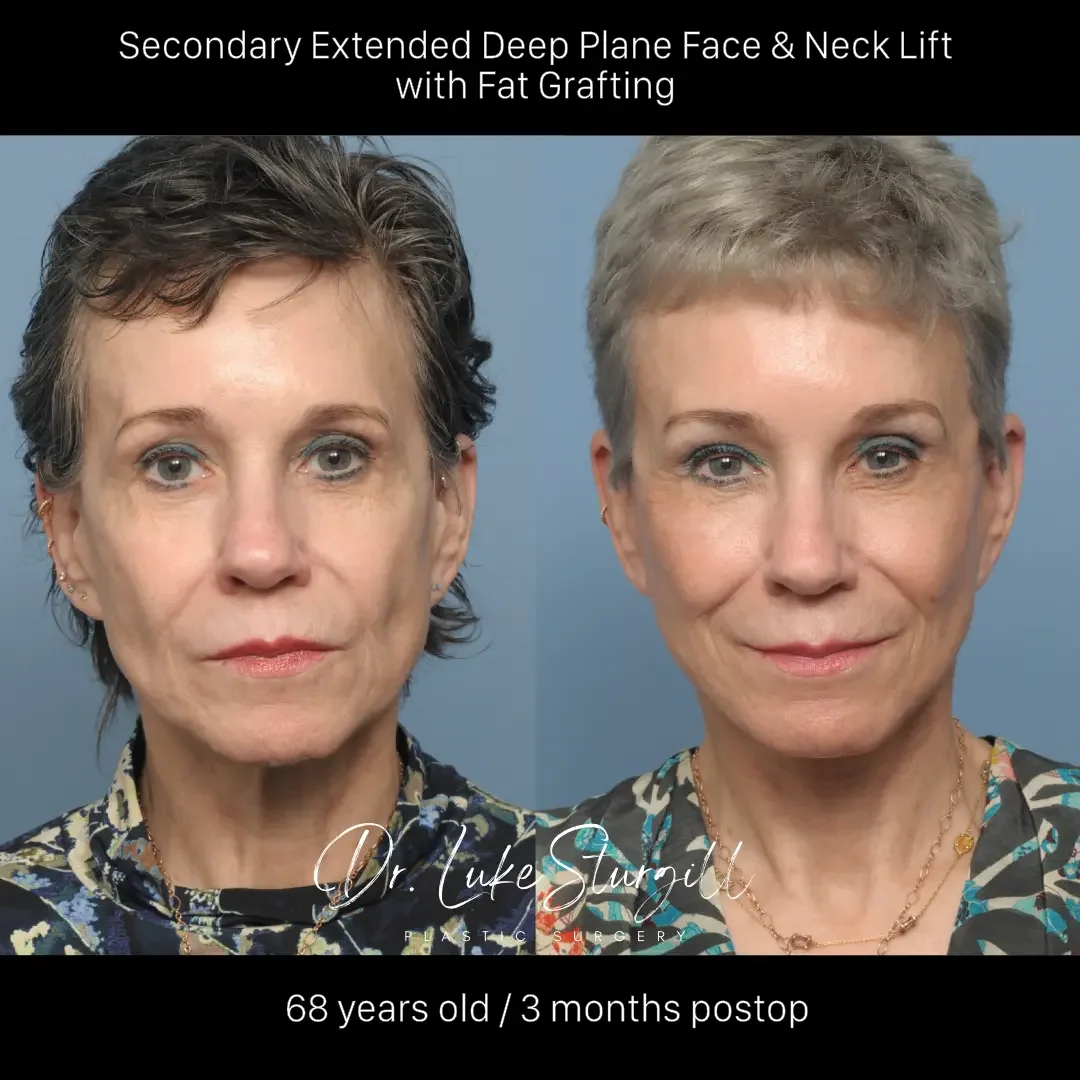
Secondary Extended Deep Plane Face & Neck Lift with Fat Grafting — 3 Months Post-Op
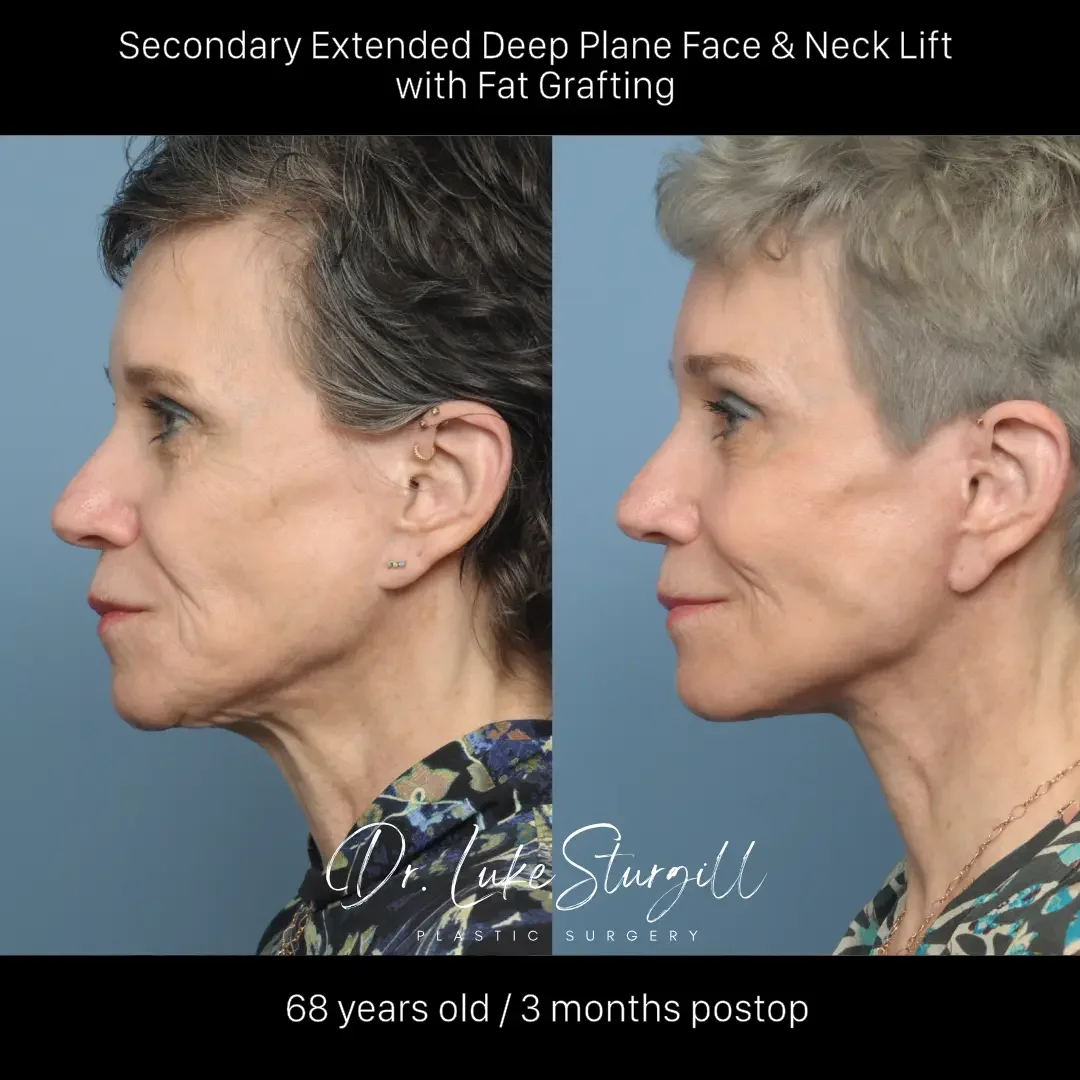
Same Patient — Lateral View
Your Surgeon Matters
Why Patients Choose Dr. Sturgill
Patients travel from across the country for a surgeon who combines deep anatomical expertise with an uncompromising standard for natural results — and the honesty to recommend only what will genuinely make a difference.
Deep Plane Focus
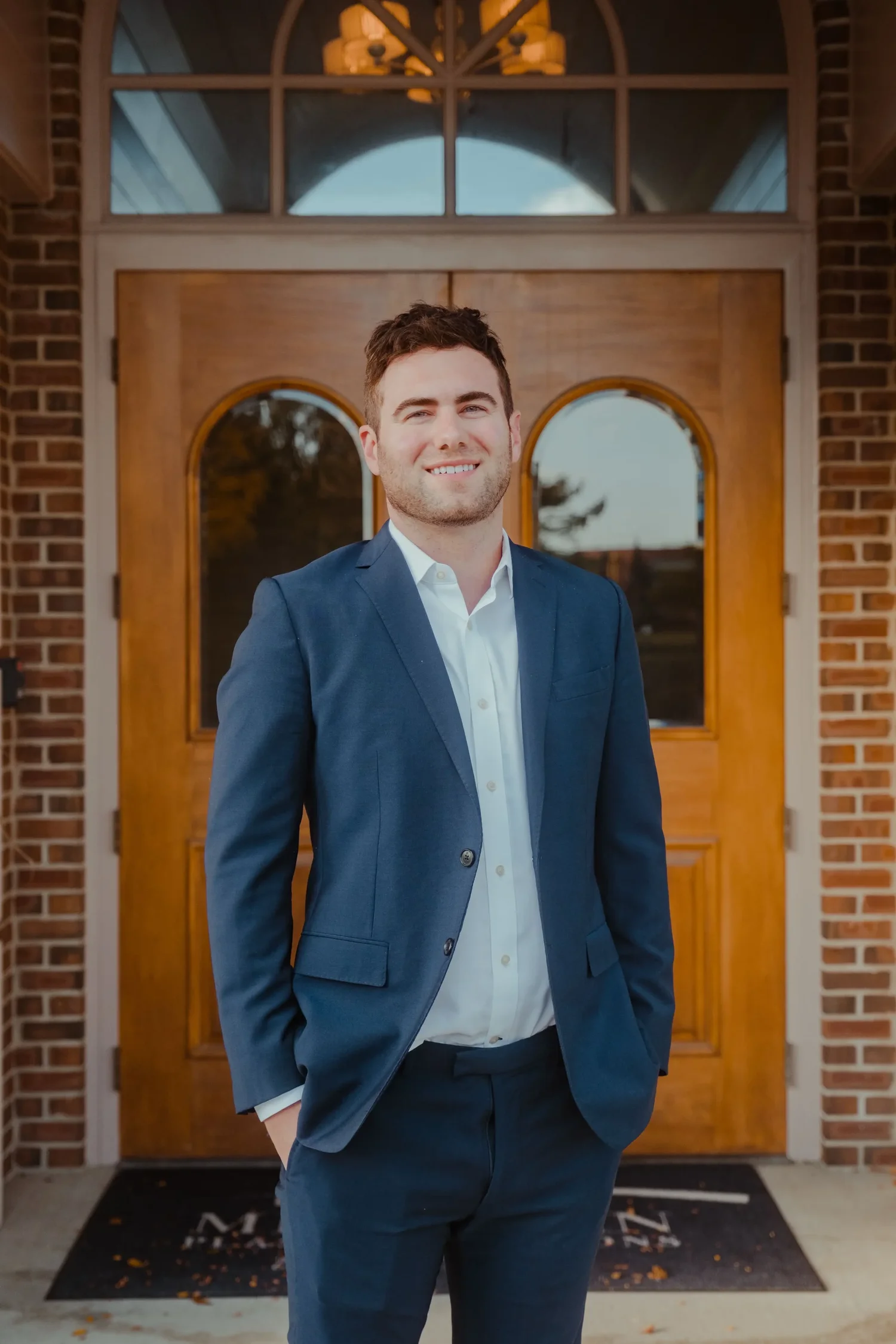
Dr. Sturgill is a double board-certified facial plastic surgeon who operates exclusively on the face and neck. The Extended Deep Plane technique is his primary operation — performed multiple times per week, including complex revisions and secondary cases that other surgeons refer to him.
Truth & Transparency
Not every patient needs a deep plane facelift. Dr. Sturgill will say so directly — no sales pressure, no inflated promises. Patients receive an honest assessment of what their anatomy allows and what surgery can realistically achieve.
The “Unoperated” Look
The goal is never to look “done.” By repositioning deep tissue rather than pulling skin, the Extended Deep Plane technique produces results that appear rested, refined, and natural — not tight, windswept, or obviously surgical.
What Patients Are Saying About Dr. Sturgill
Real reviews from real patients—because the best referral is an honest one.
Ready to take the next step?
Your consultation is a planning session — not a sales pitch.
Dr. Sturgill will evaluate your facial anatomy, discuss your goals, and give you an honest assessment of what surgery can — and cannot — achieve. You will leave with a clear understanding of whether this procedure is right for you.
What to expect
- Review your concerns and goals in detail
- Receive a facial analysis with a personalized surgical plan
- See before-and-after photos of what YOU will look like after surgery
- Have all your questions answered directly
Consultations typically last around 45 minutes.
Book Your Consultation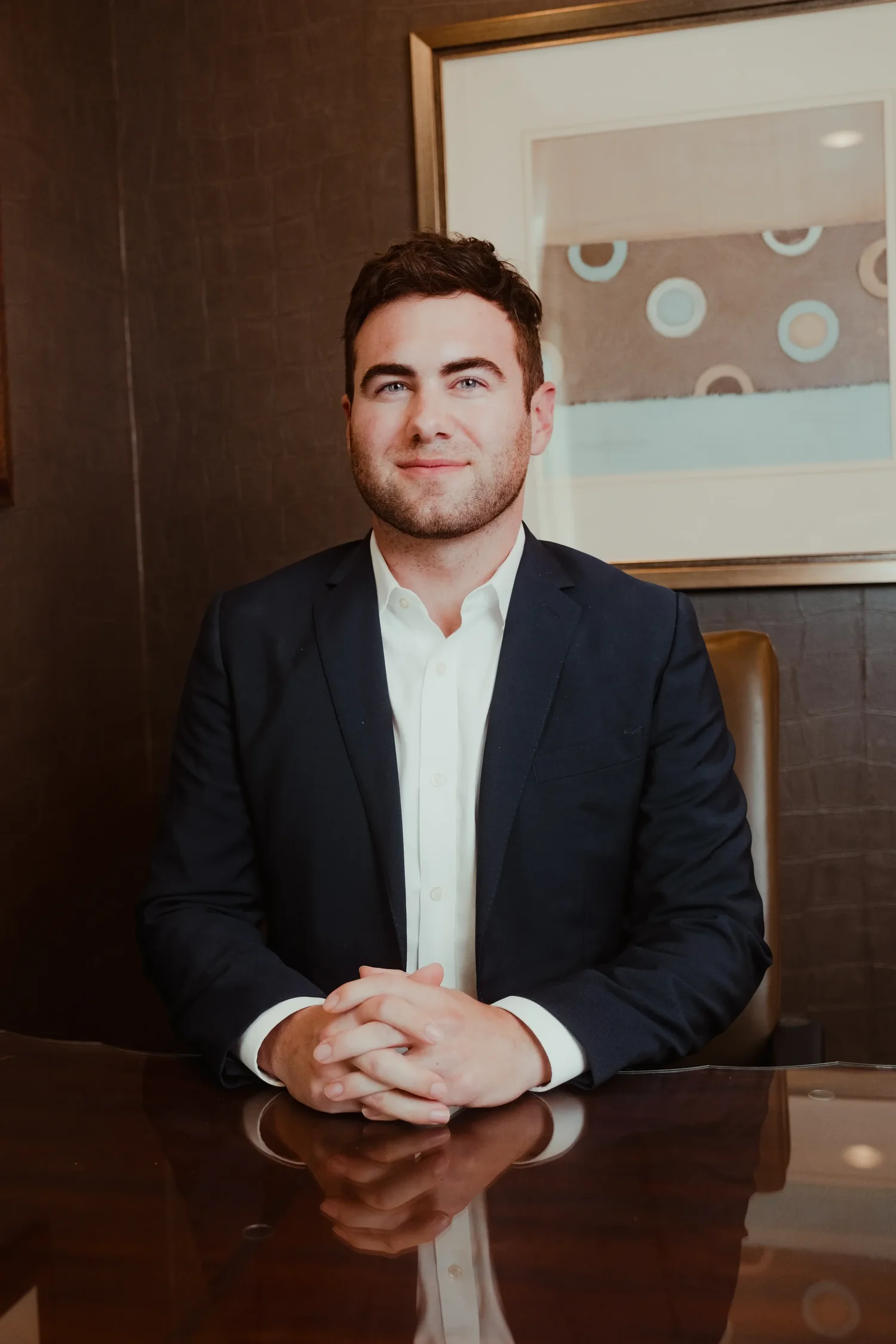
Common Questions
Frequently Asked Questions
Honest, detailed answers about Dr. Sturgill’s Extended Deep Plane Face & Neck Lift — from the procedure itself to recovery and long-term results.
About the Procedure
What is an Extended Deep Plane Face & Neck Lift?
An Extended Deep Plane Face & Neck Lift repositions the deeper structural tissues of the face and neck — not just the skin — to restore the jawline, midface, and cervicomental angle in a way that looks natural rather than pulled.
The “extended” component means the dissection and repositioning address the midface, jowl, jawline, and neck as one connected anatomic unit rather than stopping short and relying on skin tension to compensate. This is what distinguishes Dr. Sturgill’s approach from more limited facelift techniques.
How is the deep plane technique different from a traditional facelift?
A traditional facelift often relies on skin tightening and superficial tissue repositioning. A deep plane approach works underneath those layers, releasing and repositioning the descended structural tissues that actually create jowls, lower-face heaviness, and the aged facial shape.
Think of it this way: a superficial lift pulls the carpet tighter across the floor. A deep plane lift fixes what’s underneath the carpet so the surface lies flat on its own. This allows more natural structural correction with less dependence on skin tension — which is one of the biggest reasons results look more natural and last longer.
Where are the incisions placed?
Incisions are placed in natural creases around the ear and into the hairline where appropriate. The goal is scar placement that hides well and heals cleanly. Great scars come from good planning, minimal tension on the skin closure, and meticulous technique — not from pulling tighter.
In most patients, the hairline is not meaningfully affected. When hairline incisions are used, they are designed to preserve natural hair-bearing patterns and can be tailored to individual hairstyle preferences.
What type of anesthesia is used?
Dr. Sturgill’s Extended Deep Plane Face & Neck Lift is performed under general anesthesia administered by a board-certified anesthesiologist in an AAAHC-accredited surgical facility.
General anesthesia allows the surgeon to work with full anatomic control while the patient remains completely comfortable throughout the procedure. A dedicated anesthesiologist — not a nurse anesthetist working independently — monitors every physiologic parameter from induction through recovery. This is the safest, most controlled environment for a procedure of this scope and precision.
Candidacy
Who is a good candidate for this procedure?
Most candidates are bothered by jowls, loss of jawline definition, heaviness through the lower face, and/or neck laxity or fullness. Chronologic age matters less than anatomy — some patients need a deep plane lift earlier because their descent is more pronounced, while others may not need it until later.
Ideal candidates want to look refreshed, not “different,” and understand that great results come from the right technique rather than the tightest pull. During consultation, Dr. Sturgill evaluates each patient’s specific anatomy and aging pattern to determine whether this procedure is the right approach — or whether something else would serve them better.
Is surgery worth it after filler, biostimulators, or devices?
Often yes. Many facelift patients arrive after realizing that repeated non-surgical treatments are no longer meaningfully correcting the problem. Once tissues have descended enough, camouflage stops working — and continued filler or biostimulator use can actually distort the anatomy rather than improve it.
An Extended Deep Plane Face & Neck Lift addresses the structural root cause — tissue descent — in a way that no injectable or device can replicate. For patients at that threshold, surgery provides a single definitive correction rather than ongoing maintenance that yields diminishing returns.
What if I’ve had a facelift before?
Revision and secondary cases can be excellent candidates, but they require more planning due to scar tissue and altered anatomy from the previous procedure. Dr. Sturgill customizes the approach based on what was done previously and what needs correction now.
Deep plane revision is often about undoing the tension and unnatural pull left behind by a skin-only or superficial technique — and restoring normal anatomic position. Dr. Sturgill regularly performs complex revision and secondary deep plane cases that other surgeons refer to him.
Results & Expectations
Will the result look pulled or “windswept”?
That pulled or windswept appearance is typically the result of skin tension, lateral pull, or incomplete deep structural correction — exactly what Dr. Sturgill’s Extended Deep Plane technique is designed to avoid.
By repositioning the deeper structural foundation and letting the skin re-drape naturally with minimal tension, the goal is a face that looks structurally younger, cleaner, and less heavy — without obvious surgical stigma. The result should look like the patient, not like a procedure.
What concerns does this procedure improve?
The Extended Deep Plane Face & Neck Lift is most effective for jowling and jawline blurring, heaviness through the lower cheeks, deepening nasolabial folds related to descent, neck laxity and loss of the cervicomental angle, and early platysmal banding.
When nasolabial folds or marionette lines are driven primarily by tissue descent and jowling, the lift alone can produce meaningful improvement. When the lines are also driven by volume loss or skin texture changes, fat grafting or skin resurfacing can refine the result further.
What about neck bands?
Neck banding is often improved, but the result depends on the anatomy: muscle bands versus skin laxity versus gland or fat. When bands are primarily platysmal in nature, deeper neck work can significantly soften or eliminate them.
Some patients may still see mild banding with certain expressions — because the goal is natural function, not a “frozen” or overcorrected neck. The neck plan is individualized for every patient based on their specific anatomy and goals.
Will I still look like myself?
That is the entire point. The goal is restoration — a sharper jawline, a cleaner neck, a refreshed midface — while keeping the patient’s facial identity intact. Patients should look like themselves, just rested and refined. Not like someone else, and not like someone who had surgery.
Recovery
What is recovery like?
Recovery follows a predictable trajectory for most patients:
| Timeframe | What to Expect |
|---|---|
| Week 1 | Swelling, bruising, and tightness — patients will look and feel post-op |
| Weeks 2–3 | Rapid improvement; most patients are presentable and comfortable being seen socially |
| Weeks 4–6 | Major swelling mostly resolved; refinement continues |
| Months 3–6+ | Continued settling, especially in the neck and under the jawline |
Dr. Sturgill provides every patient with a detailed recovery guide that covers activity restrictions, skincare timelines, and what to expect at each stage.
When can I return to work?
Most patients return to desk work in 10–14 days, depending on how public-facing their role is and how quickly bruising fades. For patients who are frequently on camera or in meetings, two to three weeks is a more comfortable target.
For out-of-town patients, Dr. Sturgill typically clears travel at two weeks post-op. Light walking is encouraged from day one, with a structured return to more vigorous exercise over several weeks.
Is the procedure painful?
Most patients describe more tightness and soreness than sharp pain. The first few days are the most intense, and then it improves steadily. The neck can feel especially tight early on — this is normal and temporary.
Pain management is straightforward for the vast majority of patients, and Dr. Sturgill’s team provides detailed post-operative instructions to keep patients comfortable throughout recovery.
Can I smoke or use nicotine before or after surgery?
No. This is non-negotiable. Nicotine in any form — cigarettes, vaping, patches, pouches, gum — causes vasoconstriction that directly compromises blood flow to the elevated skin flaps. The consequence can be tissue necrosis, wound breakdown, and severe scarring.
Patients must stop all nicotine products at least four weeks before surgery and remain nicotine-free for a minimum of four weeks after. Dr. Sturgill will not operate on a patient who cannot commit to this requirement. This is about protecting the result and protecting the patient.
Combining Procedures
Can a deep plane lift be combined with other procedures?
Yes — and often it should be. Faces age through descent, deflation, and surface damage simultaneously. Addressing only one dimension can leave the overall result feeling incomplete. Common complementary procedures include:
Facial Fat Grafting to restore volume where deflation contributes to the aging pattern. Upper or Lower Eyelid Surgery to address excess skin or puffiness around the eyes. Endoscopic Brow Lift for forehead descent and brow ptosis. Lip Lift for select patients with elongation of the upper lip. Laser Resurfacing for skin texture, fine lines, and discoloration.
Dr. Sturgill builds the operative plan around each patient’s anatomy rather than applying a one-size-fits-all combination.
Is fat grafting needed as well?
Not every patient requires fat grafting, but many benefit from it. Lifting corrects descent; fat grafting restores deflation. These are two different problems, and when volume loss is a meaningful part of the aging pattern, combining the two produces a more complete, healthy-looking result — not overfilled, but genuinely restored.
When done thoughtfully, fat grafting adds the fullness and softness that a lift alone cannot recreate. The decision is always based on what the anatomy needs, not a default protocol.
Longevity
How long do results last?
An Extended Deep Plane Face & Neck Lift provides long-lasting structural improvement because the deeper SMAS tissues have been repositioned rather than simply tightened at the skin level. For the vast majority of patients, results last 10–15 years or more — some even longer depending on genetics, skin quality, and maintenance habits.
The procedure does not stop aging, but it meaningfully resets the clock. Patients continue aging from a younger, stronger baseline. Sun protection, medical-grade skincare, and periodic maintenance treatments such as neurotoxin or light-based therapies help preserve the result over time. A secondary procedure, if ever desired, is typically 10–20 years out.
When will I see my final result?
Meaningful improvement is visible early — most patients feel encouraged by the end of week two and have a good sense of the overall direction by one month. The result continues to refine over three to six months, especially in the neck and along the jawline where residual swelling resolves most gradually.
Most patients feel they look very good by six to eight weeks. The “finished” result — where everything has fully settled and softened — typically emerges closer to three months, with subtle refinement continuing through twelve months in some patients.
What are common mistakes seen in other facelifts?
Common issues include skin-only tightening that relies on tension rather than structural repositioning, short-scar “mini lifts” that relapse within a few years, lateral tension that creates an unnatural mouth or cheek pull, and scar placement that is difficult to conceal.
These problems often share a root cause: the deeper tissues were not adequately released and repositioned, so the skin was asked to do the heavy lifting — literally. The result is a face that looks tight rather than young. Dr. Sturgill’s revision work frequently involves releasing that tension and restoring normal anatomic position through a comprehensive deep plane approach.
Your face. Your anatomy.
Your plan.
Dr. Sturgill evaluates each patient’s anatomy individually and builds a surgical plan around their specific goals — not a one-size-fits-all approach.
Book Your ConsultationCarmel, Indiana ◆ In-Person & Virtual Available