
By R. Luke Sturgill, MD · Double Board-Certified Facial Plastic Surgeon · Carmel, Indiana
The Truth About Deep Wrinkles
You don’t want wrinkles that look “softened.” You want them erased.
If you’ve spent thousands on medical-grade skincare, RF microneedling treatments, or non-ablative laser sessions and your deep wrinkles look essentially the same — you’re not doing something wrong. You were sold treatments that physically cannot do what was promised.
Here’s the problem: the aesthetics industry has convinced patients that enough sessions of the wrong treatment will eventually produce the right result. It won’t. Deep, etched-in wrinkles require a level of tissue remodeling that expensive serums, Morpheus 8, and non-ablative lasers simply cannot reach. These treatments can improve surface texture and fine lines — and they have their place — but they cannot erase deep wrinkles. That distinction matters, because it’s the difference between spending wisely and spending endlessly.
Dr. Sturgill is a double board-certified facial plastic surgeon who will tell you the truth about what works and what doesn’t. Not because the truth is convenient — but because patients deserve to stop wasting time and money on treatments that can’t deliver.
There are only three modalities that can permanently erase deep wrinkles: ablative lasers, dermabrasion, and medium-to-deep chemical peels. Most surgeons pick one and use it everywhere. Dr. Sturgill uses all three — matched to the right area of the face — because the best result comes from deploying the right tool in the right zone.
That’s the Skin Resurfacing Trifecta™.
R. Luke Sturgill, MD ◆ Facial Plastic Surgeon
What Actually Works for Deep Wrinkles
Not everything marketed for wrinkles actually erases them. Understanding this distinction will save you thousands of dollars and years of frustration.
Treatments that improve surface texture but cannot erase deep wrinkles:
- Expensive medical-grade skincare and serums
- RF microneedling (Morpheus 8 and similar devices)
- Non-ablative lasers (Fraxel non-ablative, Clear + Brilliant, BBL, IPL)
- Most “lunchtime” laser treatments
These can improve fine lines, tone, and texture — and for the right patient with the right expectations, they’re worthwhile. But if your concern is deep, etched-in lines around the mouth, across the forehead, or radiating from the eyes, these technologies cannot reach the depth of tissue remodeling required to eliminate them. The physics don’t match the promise.
Treatments that can permanently erase deep wrinkles:
- Fully ablative lasers (Erbium YAG and CO2)
- Dermabrasion
- Medium-to-deep chemical peels (such as TCA)
These are the only three modalities aggressive enough to remodel the deeper layers of the skin where wrinkles are structurally embedded. Each one works differently, each has different strengths and limitations, and each belongs on specific areas of the face.
A note on Botox and fillers:
These can improve deep wrinkles — particularly dynamic wrinkles that form with expression — but they cannot completely erase them. They have their role in facial rejuvenation, but they are not resurfacing. They treat the wrinkle from underneath or by relaxing the muscle; resurfacing treats the wrinkle within the skin itself.
The question isn’t which of the three resurfacing modalities to choose. It’s how to use all three — strategically, in the right zones — to get the best possible result with the safest possible approach.
Stop chasing tools that can’t do the job. Save your money for what actually moves the needle.
The Skin Resurfacing Trifecta™
Three modalities, deployed by zone — each chosen because it’s the right tool for that tissue.
Most surgeons who perform skin resurfacing rely on a single modality — usually a laser — and apply it broadly across the face. It’s simpler. It requires less decision-making. And for many patients, the results are good.
This is the opposite approach.
The Skin Resurfacing Trifecta™ is Dr. Sturgill’s strategic combination of all three proven resurfacing modalities — ablative lasers, dermabrasion, and TCA chemical peels — deployed across different facial zones based on what each area of the face can safely tolerate and what each modality does best.
Think of it as a stepladder. Each rung is more aggressive and more effective than the last — but also involves more downtime:
3
Rung 3
Dermabrasion — The Secret Weapon
The most aggressive modality. A diamond fraise mechanically resurfaces skin in real time — no laser, no heat, no machine setting. Depth is controlled entirely by the surgeon’s hand. This is a lost art most surgeons don’t offer.
Intensity
▾
2
Rung 2
Erbium YAG Ablative Laser — The Workhorse
Full-field ablative resurfacing — the entire surface is treated, not a fractionated grid with untreated bridges left behind. The Erbium YAG delivers comparable results to CO2 with less thermal damage, shorter recovery, and lower hyperpigmentation risk.
Intensity
▾
1
Rung 1
TCA Chemical Peel — Precision for Delicate Zones
A 35% TCA peel — strong enough to produce meaningful improvement, controlled enough to respect tissue that can’t tolerate ablation. This is the right tool where skin is thinnest, oil glands are fewest, and scarring risk from more aggressive approaches is highest.
Intensity
▾
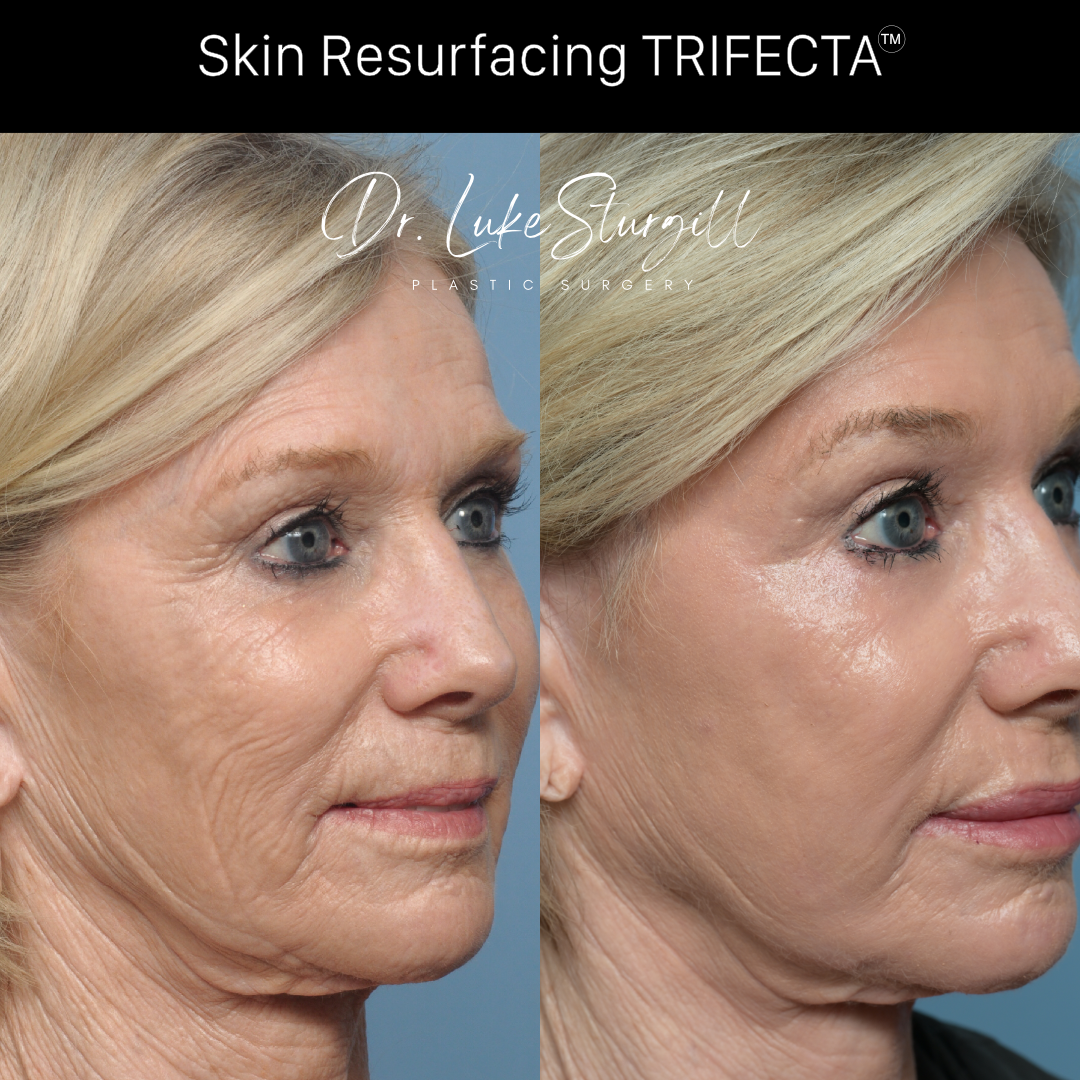
Actual patient result — Skin Resurfacing Trifecta™
The Trifecta advantage is the zone-based approach. Rather than treating the entire face with a single modality and accepting its limitations everywhere, Dr. Sturgill maps the face into zones and assigns each zone the modality that will produce the best result with the least risk.
Aggressive techniques go where the skin can handle them. Gentler techniques go where it can’t.
That’s why it’s called the Trifecta — not because three sounds better than one, but because deploying all three strategically produces a result that no single modality can match.
The Comprehensive Approach
Skin resurfacing treats the surface. But wrinkles aren’t just a surface problem — they’re a whole-tissue problem.
And treating one without addressing the other leaves the result incomplete.
Think of a house with cracked, peeling paint on the exterior walls. You can sand down the surface and repaint — and it will look better. But if the walls themselves are structurally compromised — sagging, crumbling from within — the new paint job won’t hold, and the cracks will return. The walls need structural support first.
The face works the same way. The skin surface — the epidermis and dermis — sits on top of the subcutaneous fat layer. When that fat layer has thinned and atrophied with age, the skin loses its scaffolding. It collapses inward, creating deeper creases, a deflated appearance, and a hollow quality that even the best resurfacing cannot correct.
Resurfacing the surface without addressing what’s underneath is treating half the problem.
This is why Dr. Sturgill frequently combines skin resurfacing with facial fat grafting — specifically using both microfat and nanofat — to produce results that neither treatment can achieve alone.
Rebuilds the Foundation
Microfat is injected beneath the dermis to replace the structural volume that age has taken — giving the skin a foundation to sit on. Without this foundation, resurfaced skin can still look thin, deflated, and creased, because the problem beneath the surface was never addressed.
Stimulates Skin Biology
Nanofat is injected into the dermis itself and acts like fertilizer for the skin. Rich in stem cells and growth factors, it stimulates collagen production, improves skin quality, and creates ongoing rejuvenation from the inside out. This isn’t a filler — it’s a biological treatment that improves the skin’s own regenerative capacity.
When combined with resurfacing, the result is comprehensive:
Resurfacing alone can produce excellent improvement. Fat grafting alone can restore volume and improve skin quality. But the combination produces a level of rejuvenation that neither achieves independently — because it addresses every layer of the problem, not just one.
This is how Dr. Sturgill thinks about facial rejuvenation: not as isolated treatments aimed at isolated problems, but as a coordinated approach that treats the face as a complete system.
Skin Resurfacing Before & After
Skin resurfacing is measured in texture, tone, and the quality of light reflecting off the skin — details that are difficult to capture and impossible to fake. What you’ll see across these patients isn’t airbrushed perfection. It’s a genuine improvement in the structural quality of the skin itself. Acne scars soften. Fine lines disappear. Pore size shrinks. Sun damage fades. The skin looks healthier because it is healthier — rebuilt from the dermal level up. Each result reflects a customized Trifecta™ protocol — the specific combination of TCA, laser, and dermabrasion chosen for that patient’s anatomy, skin type, and goals.
What to Look For
Here’s what separates a precision resurfacing result from a generic peel:
A note on photos: All images are unretouched and show real patients of Dr. Sturgill photographed under consistent clinical lighting. Results vary by individual anatomy, skin quality, and healing response. These photos represent typical outcomes — not best-case-only marketing.
What to Actually Expect
Three modalities. Three different paths back to your life.
Recovery is where most patients’ anxiety lives — and where most websites are deliberately vague. So here’s the honest, day-by-day picture of what each resurfacing modality actually looks like as it heals.
Understanding these timelines isn’t just about managing expectations. It’s about choosing the right approach for your life, your schedule, and your comfort level.
- Day 0 Skin frosts white during application, then shifts to a pink flush within the first hour. You’ll look sunburned.
- Days 1–3 Tightness and mild swelling. Skin darkens to a bronzy brown as the treated layers prepare to shed.
- Days 3–5 Peeling begins. Sheets of darkened skin slough off, revealing fresh pink skin underneath. Don’t pull.
- Days 5–7 Active peeling continues. Most of the old surface has separated by now. New skin is delicate.
- Days 7–10 Peeling largely complete. New skin is pink but can be covered with mineral makeup.
- Wks 2–4 Pinkness fades steadily. Beneath the surface, the real work has begun — new collagen synthesis is accelerating.
- Mo 3–6 Full results emerge as new collagen architecture matures. Skin texture and tone continue to improve.
- Day 0 The laser vaporizes the full epidermis. Treated areas are raw, weeping, and intensely red — an open wound.
- Days 1–3 Active wound care. Skin oozes and must be kept continuously moist with ointment. Swelling peaks around day 2.
- Days 3–7 Re-epithelialization begins. New skin cells migrate across the wound bed. You’ll see islands of new skin forming.
- Days 7–10 Most areas have re-epithelialized. Skin is intact but intensely erythematous — deep persistent redness.
- Days 10–14 Mineral makeup can be applied. The redness is still significant, but the surface barrier has been restored.
- Wks 2–8 Persistent pinkness gradually fades week by week. SPF is non-negotiable. New collagen deposition accelerates.
- Mo 6–12 Final results — maximum collagen density, skin tightening, and textural improvement reach their peak.
- Day 0 A high-speed rotary instrument mechanically removes the epidermis and upper dermis. Looks like a deep abrasion.
- Days 1–3 Wound oozes under occlusive dressings. The body’s healing cascade is in full activation. Moderate swelling.
- Days 3–7 New epithelium forms beneath the dressing. Dressing changes reveal raw but actively healing tissue.
- Days 7–10 Most re-epithelialization is complete. New skin is extremely pink and fragile. Gentle care only.
- Days 10–14 Surface healed enough for gentle skincare and mineral makeup. Erythema remains pronounced.
- Mo 1–3 Persistent erythema — significantly longer than laser. The mechanical disruption triggers a more robust and prolonged inflammatory healing response that can take 2–3 months to fully resolve.
- Mo 6–12 Final results — new dermal architecture is mature. The mechanical disruption creates dense, organized collagen.
Dermabrasion carries slightly more social downtime than laser — the mechanical disruption creates a broader inflammatory response and more prolonged erythema that can persist for 2–3 months. TCA heals fastest because it works as a controlled chemical injury that preserves more of the epidermal architecture during the initial peel.
The real variable isn’t the modality — it’s the depth. A lighter TCA pass heals faster than listed above. A deeper erbium pass may take longer. These timelines represent the treatment depths Dr. Sturgill uses for meaningful resurfacing results. Your personalized plan may adjust these ranges based on your skin, your goals, and the specific zones being treated.
Recovery is part of the transformation — not something you endure before it begins.
What Dr. Sturgill Is Actually Evaluating
Skin resurfacing isn’t one-size-fits-all. In your consultation, Dr. Sturgill evaluates multiple factors to determine which combination of modalities — and what level of aggression — will produce the best result for your specific anatomy.
Wrinkle Depth & Location
Not all wrinkles require the same treatment. Moderate wrinkles across the cheeks respond well to laser resurfacing. Very deep perioral lines may need dermabrasion. Crepey under-eye skin needs a chemical peel. The depth and location of each wrinkle determine which modality goes where.
Skin Type & Tone
Skin type affects how the tissue heals after resurfacing and the risk profile for each technique. Lighter skin types generally have a more predictable healing course with ablative lasers. Darker skin types have a higher risk of post-inflammatory hyperpigmentation and may require modified approaches. Dr. Sturgill accounts for this in the treatment plan — it directly influences which modality is safest for each zone.
Anatomical Zone
The face, neck, and chest tolerate resurfacing very differently. Facial skin — with its dense network of sebaceous glands — heals faster and can tolerate more aggressive treatment. Neck and chest skin is thinner, has fewer glands, and is at higher risk for scarring with aggressive techniques. The Trifecta approach exists precisely because of these differences.
Subcutaneous Fat Volume
If the fat layer beneath the skin has significantly thinned, resurfacing alone may not produce the best result. Dr. Sturgill evaluates whether fat grafting should accompany the resurfacing to rebuild the structural foundation beneath the skin.
Overall Facial Aging Pattern
Sometimes skin resurfacing is all you need. Other times, wrinkles are part of a larger aging pattern that includes descent (sagging), deflation (volume loss), and structural changes that are better addressed with a facelift, blepharoplasty, or other procedures. Dr. Sturgill evaluates the full picture and will tell you honestly whether resurfacing alone is sufficient — or whether it should be part of a comprehensive plan.
Your Downtime Tolerance & Expectations
More aggressive treatment produces more dramatic results — and requires more recovery. Dr. Sturgill will walk you through the tradeoffs for each modality so you can make an informed decision about what’s right for your life and your goals.
Consultation ◆ Meridian Plastic Surgeons
Complementary Procedures
Skin quality is only one dimension of facial aging. Dr. Sturgill evaluates — and often combines — resurfacing with structural procedures for a comprehensive result.
Extended Deep Plane Face & Neck Lift ▾
The most common combination. Skin resurfacing addresses surface damage — wrinkles, texture, sun damage. But if the underlying structural support has descended, resurfacing alone won’t correct the jowling, neck laxity, or midface deflation that’s often driving the aged appearance. Dr. Sturgill’s extended deep plane facelift repositions the SMAS and deep tissues to restore structural foundation. When combined with skin resurfacing, the facelift addresses the architecture while the resurfacing addresses the surface — producing a result that neither procedure could achieve alone.
Learn More About the Deep Plane Facelift →Eyelid Surgery (Blepharoplasty) ▾
The periorbital area is often the first area of the face to show age — and the area where patients are most frustrated. Upper eyelid hooding, under-eye bags, and hollow tear troughs are structural problems that resurfacing cannot fix. Blepharoplasty removes excess skin and fat (or repositions it) to open up the eyes. Skin resurfacing then addresses the crepey skin texture around the eyes — the fine wrinkles that remain after structural correction. Together, these two procedures produce an eye area that looks both rested and youthful.
Learn More About Eyelid Surgery →Facial Fat Grafting ▾
Volume loss is the invisible driver of aging that most patients don’t recognize. When subcutaneous fat thins — especially in the cheeks, temples, and perioral region — the skin loses the structural padding beneath it. Wrinkles appear deeper because the foundation has deflated. Resurfacing the skin without rebuilding the volume underneath is like repainting a wall without fixing the cracks in the plaster. Fat grafting restores the subcutaneous layer, and skin resurfacing then addresses the surface damage — the combination produces a more natural, longer-lasting result.
Learn More About Facial Fat Grafting →Lip Lift ▾
The upper lip elongates with age — sometimes dramatically. When the distance between the nose and the upper lip vermilion becomes too long, the lip thins, the teeth disappear behind it, and the mouth takes on an aged appearance that no filler can adequately correct. A lip lift surgically shortens the philtrum to restore youthful lip proportions. Dermabrasion around the mouth then addresses the perioral wrinkles (“barcode lines”) that almost always accompany lip aging. Together, these two procedures comprehensively rejuvenate the perioral area — structure and surface.
Learn More About the Lip Lift →Endoscopic Forehead / Brow Lift ▾
Forehead wrinkles have two causes: surface damage and muscular activity pulling the brow down. Skin resurfacing addresses the surface — sun damage lines, texture, crepiness. But if the brow has descended and the forehead muscles are chronically contracting to hold it up, the horizontal lines and glabellar furrows will persist after resurfacing. An endoscopic brow lift elevates the brow to its youthful position and releases the muscles driving the deep lines. Resurfacing then polishes the surface. Together, they produce a forehead that’s both structurally lifted and texturally smooth.
Learn More About the Brow Lift →Why Patients Choose Dr. Sturgill
for Skin Resurfacing
Skin resurfacing is only as good as the surgeon directing it. The difference between a good result and a transformative one is understanding — not equipment.
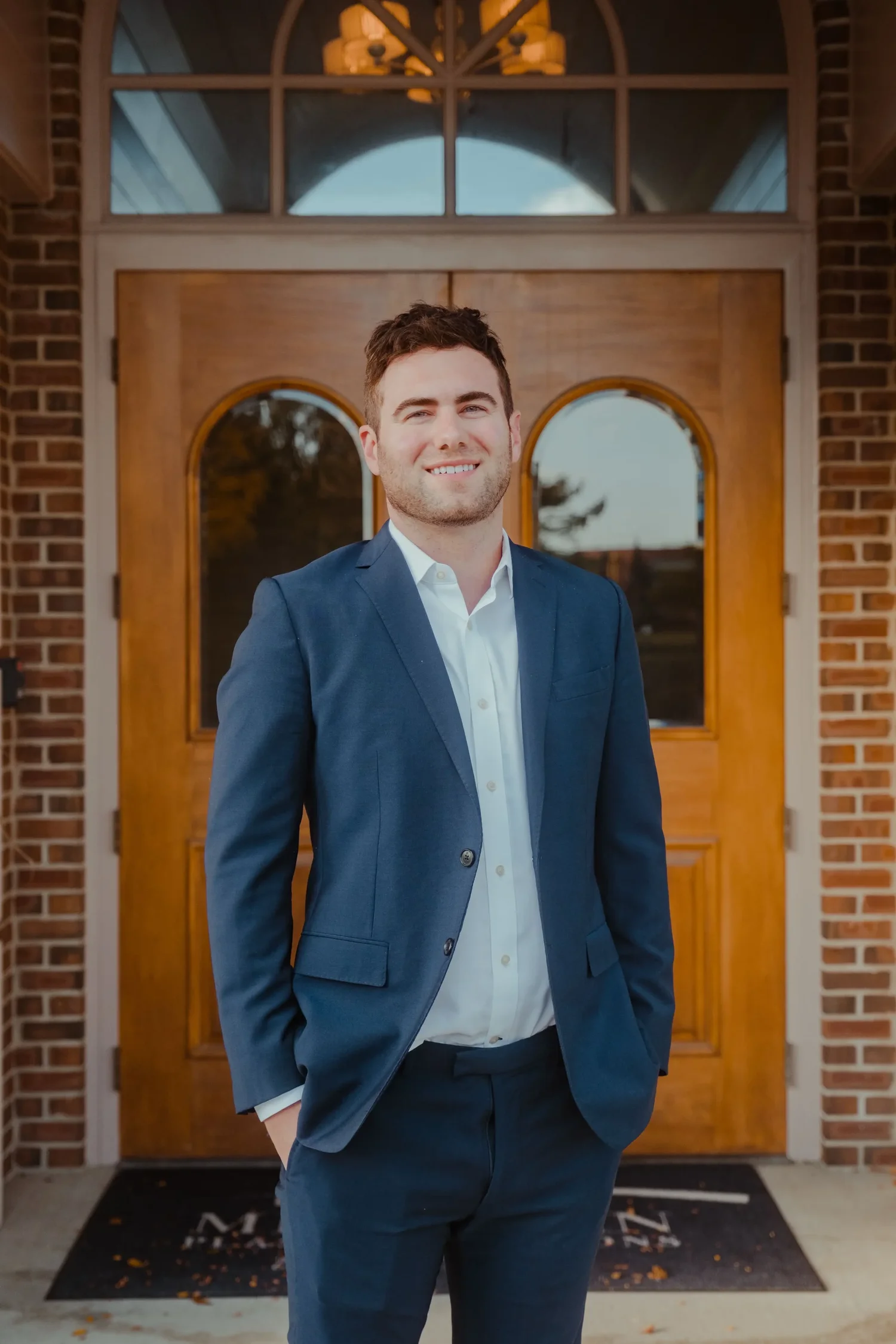
Academic Authority on Aging Skin
Dr. Sturgill is double board-certified in facial plastic and reconstructive surgery and authored the chapter on management of the aging skin in Cummings Otolaryngology—Head and Neck Surgery, Eighth Edition — the definitive textbook in the field. This isn’t a physician who picked up a laser at a weekend course. His understanding of skin biology, wound healing, and resurfacing technique is rooted in years of academic study and surgical practice.
Technique-Driven, Not Device-Driven
Many practices build their resurfacing programs around a single device and then apply it to every patient. Dr. Sturgill works in reverse — he evaluates the specific problem, then selects the technique that solves it. CO₂ laser for deep wrinkles and sun damage. Dermabrasion for perioral lines and surgical scar blending. Chemical peels for diffuse pigment and surface texture. The tool follows the diagnosis, not the other way around.
The Natural Result
The goal is skin that looks healthy, rested, and genuinely yours — not skin that looks obviously treated. Dr. Sturgill calibrates resurfacing depth and technique to the specific facial zones involved, avoiding the uniform “lasered look” that signals intervention. The best resurfacing is the kind nobody can identify.
What Patients Are Saying About Dr. Sturgill
Real reviews from real patients—because the best referral is an honest one.
Ready to take the next step?
Your consultation is a planning session — not a sales pitch.
Dr. Sturgill will evaluate your facial anatomy, discuss your goals, and give you an honest assessment of what surgery can — and cannot — achieve. You will leave with a clear understanding of whether this procedure is right for you.
What to expect
- Review your concerns and goals in detail
- Receive a facial analysis with a personalized surgical plan
- See before-and-after photos of what YOU will look like after surgery
- Have all your questions answered directly
Consultations typically last around 45 minutes.
Book Your Consultation
Your Questions, Answered
Specific questions about skin resurfacing with Dr. Sturgill. For general practice questions, visit our FAQ page.
What is the Skin Resurfacing Trifecta™?
It’s my term for the strategic combination of the three — and only three — modalities that can permanently erase deep wrinkles: ablative lasers, dermabrasion, and medium-to-deep chemical peels. Rather than relying on a single technique and applying it everywhere, I use all three — each one deployed where it’s safest and most effective based on the anatomy.
The face is treated in zones: aggressive techniques where the skin can handle it, gentler techniques where it can’t.
Why do you use three different resurfacing techniques instead of just one?
Because no single modality is best everywhere on the face. The skin on the neck is very different from the skin on the cheeks, which is very different from the skin around the mouth. A laser that works beautifully on the forehead could scar the neck. Dermabrasion that’s ideal for deep mouth wrinkles would be overkill on the temples.
Matching the technique to the zone produces a better result with fewer complications. Most surgeons use one tool because it’s simpler. I use three because it’s better.
What’s the difference between ablative and non-ablative lasers?
This is a critical distinction. Ablative lasers (like the Erbium YAG) actually remove the outer layers of skin, forcing the body to generate entirely new skin — which is how deep wrinkles get erased. Non-ablative lasers (like Fraxel Dual, Clear + Brilliant, BBL) leave the skin surface intact and try to stimulate collagen deeper down.
Non-ablative lasers can improve fine lines and skin tone, but they cannot erase deep wrinkles. The difference isn’t subtle — it’s the difference between a treatment that can deliver what you want and one that physically can’t. If someone is telling you a non-ablative laser will erase your deep wrinkles, that’s a claim the technology can’t support.
Why do you prefer the Erbium YAG laser over CO₂?
Both are ablative lasers and both produce excellent results. I prefer the Erbium YAG for most patients because it delivers comparable wrinkle reduction with less residual thermal damage. In practical terms, that means less prolonged redness, slightly shorter recovery, and a lower risk of pigmentation issues.
The CO₂ laser generates more heat in the surrounding tissue, which extends healing and increases certain risks without — in my experience — producing a meaningfully better result for the majority of patients.
Can laser resurfacing or dermabrasion be done on the neck?
Not safely in most cases — and this is exactly why the Trifecta approach exists. The neck, chest, and under-eye area have thinner skin with fewer oil glands, which means they heal differently and are at much higher risk for scarring from aggressive resurfacing techniques.
I use a 35% TCA chemical peel for these areas because it produces meaningful improvement while respecting the biology of the tissue. Applying a laser or dermabrasion to the neck to “be aggressive” isn’t bold — it’s dangerous.
What does dermabrasion actually involve?
Dermabrasion is a mechanical technique where I use a high-speed rotary instrument (a diamond fraise) to precisely plane the skin layer by layer. Unlike a laser, which uses energy to vaporize tissue, dermabrasion physically removes it with no heat generation — giving me direct, tactile control over the depth in real time.
I can go deeper in the troughs of very deep wrinkles and shallower on the surrounding skin. It’s a lost art — most surgeons don’t offer it because it’s entirely technique-dependent, not device-driven. But for the deepest wrinkles — typically the vertical “barcode” lines around the mouth and deeply etched cheek wrinkles — it’s the most effective resurfacing option available. Nothing else comes close.
How long is the recovery for skin resurfacing?
It depends on which modalities are used. For a TCA peel (neck, under-eyes, chest), expect visible peeling for about 5–7 days with redness fading over the following weeks. For Erbium YAG laser resurfacing (face), the skin is raw for the first several days with new skin forming within 7–10 days; redness can persist for several weeks. For dermabrasion (deep perioral or cheek wrinkles), recovery is more intensive — raw skin for 7–10 days with more prolonged redness that can last weeks to months.
I discuss the specific timeline for your treatment plan in detail at your consultation so there are no surprises.
Will I need to take time off work?
Yes. Most patients plan for 1–2 weeks depending on which modalities are included. If the plan includes dermabrasion, plan for the longer end. If it’s laser and peel without dermabrasion, many patients are comfortable returning to social activities with light makeup within 10–14 days.
The correct answer is: plan based on the plan, not based on generic averages. I’ll give you a specific timeline based on your treatment plan.
Can skin resurfacing be combined with a facelift?
Absolutely — and it frequently is. A facelift addresses descent (sagging) and structural laxity. Resurfacing addresses skin quality — wrinkles, texture, and surface damage. These are different problems that benefit from different solutions, and combining them in a single surgical session means one recovery period for a more comprehensive result.
Many of my facelift patients include some component of skin resurfacing.
What about Morpheus 8 / RF microneedling — doesn’t that work for wrinkles?
RF microneedling devices like Morpheus 8 can improve skin texture, mild laxity, and fine lines. They are real treatments with real — but limited — effects. What they cannot do is erase deep wrinkles. The depth of tissue remodeling these devices achieve is not sufficient to eliminate etched-in lines.
If your concern is deep wrinkles and you’ve been told RF microneedling will erase them, you’ve been given unrealistic expectations. I see patients regularly who have spent $3,000–$5,000 on multiple RF sessions and are frustrated that their deep wrinkles look essentially the same. That’s not because the treatments were done poorly — it’s because the technology was never capable of producing that result. I’d rather tell you that upfront than let you spend thousands more finding out the hard way.
I’ve spent a lot on skincare products for wrinkles. Why aren’t they working?
Because topical products — even medical-grade ones — can only penetrate so far into the skin. They’re effective for maintaining skin health, improving surface hydration, and providing some textural benefit. But deep wrinkles are structural. They exist within the dermis, not on the surface. No cream, serum, or topical treatment can remodel tissue at the depth required to erase them.
Good skincare is like maintenance on a house — it keeps things in good shape. But when the walls need to be rebuilt, you need a contractor, not a fresh coat of polish.
What is nanofat, and why do you combine it with resurfacing?
Nanofat is your own fat that has been processed to a very fine consistency — essentially a liquid rich in stem cells, growth factors, and regenerative signaling molecules. I inject it directly into the dermis, where it acts like fertilizer for the skin — stimulating collagen production, improving skin quality, and promoting ongoing rejuvenation from the inside out.
When combined with resurfacing, you’re treating the wrinkle from both directions: the resurfacing renews the surface, and the nanofat improves the skin’s biology from within. The combination produces better skin quality than either treatment alone.
How many resurfacing treatments will I need?
With the Trifecta approach, most patients need one treatment session — not a series. This is fundamentally different from non-ablative laser protocols that require 3, 5, or more sessions to see incremental improvement.
Because we’re using modalities that produce definitive tissue remodeling in a single session — matched to the right zones — the result is achieved upfront rather than accumulated over months of repeat treatments. Some patients choose maintenance treatments over time, but the primary result is from one comprehensive session.
Is skin resurfacing painful?
All skin resurfacing performed by Dr. Sturgill is done under general anesthesia — you won’t feel anything during the procedure. Afterward, the treated areas feel tight, warm, and sensitive — more like a sunburn than sharp pain.
Discomfort is manageable with prescribed medication for the first few days and typically transitions to over-the-counter options quickly. The intensity of post-procedure discomfort correlates with the aggressiveness of the treatment — dermabrasion areas tend to be more sensitive during healing than laser or peel areas.
Who is NOT a good candidate for skin resurfacing?
Patients who want deep-wrinkle results without accepting real downtime usually aren’t a good match for true resurfacing — and I’d rather have that conversation upfront than have you disappointed afterward.
Beyond expectations, candidacy depends on specific medical factors: patients with active skin infections, certain autoimmune conditions, or a history of poor wound healing or keloid formation require careful evaluation. Isotretinoin (Accutane) needs to be discontinued well before resurfacing. Darker skin types require a modified approach due to the higher risk of pigmentation changes. And if what you actually need is a facelift, resurfacing alone won’t give you the result you’re looking for.
That’s exactly what the consultation is for — I’d rather tell you what will actually work than let you pursue something that won’t.
How much does skin resurfacing cost?
The cost depends on which modalities are included, how many facial zones are being treated, and whether resurfacing is being combined with other procedures like a facelift or fat grafting. I provide a specific quote during your consultation once your treatment plan has been outlined. Financing options are available.
Real answers start with a
real evaluation.
Dr. Sturgill will assess your skin quality, anatomy, and goals — then build a resurfacing plan specific to you. No pressure, no upselling, no generic protocols. Virtual consultations available for out-of-town patients.
Book Your ConsultationCarmel, Indiana ◆ In-Person & Virtual Available