
By R. Luke Sturgill, MD · Double Board-Certified Facial Plastic Surgeon · Carmel, Indiana
Facial Implants
Facial Proportion Is the Goal—Not a “Bigger” Chin
There’s a reason you keep staring at your profile in photos.
Something looks off—but it’s hard to pinpoint exactly what. Your nose seems too large. Your jawline feels soft. Your face looks like it’s missing something, but you can’t name it.
Most of the time, the answer is structural proportion. The bones of your face—your chin, your jaw, your cheekbones—create the framework that everything else sits on. When that framework is deficient, no amount of filler, skincare, or contouring will fix it. The architecture has to change.
That’s what facial implants do. They don’t make you look “different.” They make you look like the version of yourself that your soft tissue has been hiding.
If you’ve been researching filler, fat grafting, or even jaw surgery—you’re in the right place. But the real answer starts with anatomy—not with picking a procedure.
Dr. Sturgill is a double board-certified facial plastic surgeon practicing in Carmel, Indiana—just north of Indianapolis. He focuses exclusively on the face and neck, and facial implants—chin implants in particular—are one of the procedures he performs most frequently. Not because implants are the answer for every patient, but because when they are the answer, nothing else comes close.
R. Luke Sturgill, MD ◆ Facial Plastic Surgeon
Three Tools. One Honest Evaluation.
The treatment you receive shouldn’t depend on who you happen to see. Dr. Sturgill evaluates the anatomy first—then tells you which tool fits.
Some patients need an implant. Many need fat grafting. Some need both. A few just need to stop getting filler. The consultation is where that distinction is made.
Book a ConsultationThe Honest Conversation
Implant vs. Fat Grafting vs. Filler
Patients are told to pick a solution before anyone has evaluated the actual problem.
You walk into a med spa asking about chin filler—you get chin filler. You see a surgeon who specializes in implants—you get offered an implant. You consult with someone who does fat grafting for everything—you’re told fat grafting will fix it. The treatment you receive depends on who you happen to see, not on what your face actually needs.
Dr. Sturgill’s approach is the opposite. He evaluates the anatomy first—then tells you which tool fits.
Dermal Filler
Filler is temporary—requiring maintenance every 6–18 months. It can create the illusion of projection, but it doesn’t change structure. Filler migrates over time—especially in the chin and jawline—leading to soft, undefined results after repeated treatments. Many patients have spent thousands of dollars on filler over several years when a single implant would have solved the problem permanently.
Filler is appropriate for patients who want a subtle, reversible change—or who aren’t ready for surgery. But if you’ve been getting chin filler every 9–12 months for the past five years, you’ve been renting a result you could own. That’s not a judgment—it’s math. And it’s a conversation Dr. Sturgill has regularly.
Facial Fat Grafting
Fat grafting uses living tissue—your own fat, transferred and integrated permanently. It improves skin quality in the grafted area through nanofat’s regenerative properties. It’s excellent for volume restoration—temples, cheeks, under-eyes, nasolabial folds, jawline contour. Dr. Sturgill performs facial fat grafting at high volume and considers it one of the most versatile tools in facial rejuvenation.
But fat grafting has limits for significant structural projection. You can’t reliably build 8–10mm of chin projection with fat alone. For most patients with volume concerns, fat grafting is the better answer. For patients who need skeletal-level change—implants fill that gap.
Facial Implants
Implants provide permanent structural augmentation—changing the skeletal framework of the face. They’re best suited for cases where projection is the primary goal, not volume or soft tissue quality. A chin implant can add 4–12mm of real, measurable projection to the skeletal chin point. Fat and filler can’t do that reliably. Implants are also indicated when a patient has very little donor fat available for harvesting.
The bottom line: these aren’t competing treatments. They’re different tools for different problems. Some patients need an implant. Many need fat grafting. Some need both. A few just need to stop getting filler. The consultation is where that distinction is made—and Dr. Sturgill will give you an honest answer, not just the one you came in expecting to hear.
That’s the whole point.
Chin Implants
The Procedure Dr. Sturgill Performs Most
Of all facial implant procedures, chin augmentation is the one Dr. Sturgill performs most frequently—and the one where his technique diverges most significantly from the standard approach.
Who Needs a Chin Implant?
A chin implant is indicated when the chin is structurally recessive—meaning the bone itself doesn’t project far enough forward relative to the rest of the face. This is called retrogenia, and it’s more common than most people realize.
Signs that your chin may be structurally deficient:
- Your profile feels “weak” or recessive—like your face slopes backward from your lower lip
- Your nose appears disproportionately large—not because your nose is big, but because your chin is small
- Your neck looks soft or undefined—even though you’re not overweight—because the chin doesn’t provide enough forward projection to create a clean jaw-to-neck angle
- You’ve been getting chin filler repeatedly—and the results never quite look right, or they fade too quickly, or the filler has started to migrate
- Your lower face “doesn’t match”—as though the upper two-thirds is proportionate, but the lower third is lagging behind
If any of that sounds familiar, a chin implant may be the most direct and permanent solution.
The Chin–Nose Relationship
Many patients come in focused on the nose.
Here’s what most patients don’t realize: your nose doesn’t exist in isolation. It exists in proportion to your chin, your forehead, and the overall balance of your profile. When you look in the mirror and think “my nose is too big”—sometimes it is. But sometimes the real issue is that your chin is too small.
A recessive chin makes the nose appear more prominent by comparison. If the lower third of your face doesn’t project far enough forward, the middle third—where the nose lives—looks like it’s sticking out.
Think of it like a seesaw—when one side is deficient, the other appears exaggerated.
Reducing the nose addresses one end. Augmenting the chin addresses the other. Correcting the chin can dramatically improve profile balance—sometimes without touching the nose at all.
Here’s the Problem with Traditional Chin Implants
Most chin implants on the market are pre-formed silicone shells. They come in a handful of standard sizes—small, medium, large—and the surgeon selects the closest match, places it on the bone, and closes.
The issue isn’t that silicone is dangerous. It’s that one pre-formed shape doesn’t fit every patient’s anatomy.
Silicone implants sit on top of the bone like a cap. They have defined edges—and in patients with thin skin or minimal soft tissue coverage, those edges can be visible or palpable. You can feel the rim of the implant along the jawline. In some cases, you can see it. And customization is limited—a silicone implant gives you the projection it was manufactured to give, in the shape it was manufactured in. Your anatomy has to accommodate the implant, rather than the other way around.
This Is the Opposite Approach: Prolene Mesh
Dr. Sturgill uses Prolene mesh implants for chin augmentation—and the difference matters.
Prolene mesh is a surgical-grade polypropylene material used safely across multiple surgical disciplines for decades—the same material used in hernia repair and reconstructive surgery, with an extensive track record of biocompatibility.
Here’s why Dr. Sturgill chose it for chin augmentation:
01
Fully Customizable Intraoperatively
Dr. Sturgill shapes and layers the Prolene mesh during surgery to match each patient’s specific anatomy. He can build projection exactly where it’s needed—more centrally, more laterally, more vertically—whatever the bone structure requires. This isn’t selecting a size from a catalog. This is building the implant to fit you.
02
No Palpable Edges
Because the mesh is layered and shaped to conform to the underlying bone—rather than sitting on top of it like a rigid shell—it integrates smoothly with surrounding tissue. No hard rim. No visible step-off. The transition from implant to native bone is gradual and undetectable.
03
Low–Inflammatory Response
The body tolerates Prolene mesh well, producing minimal capsule formation compared to solid silicone—meaning less tightening, less distortion, and a more natural feel long-term.
04
Tissue Integration
Over time, your body’s own tissue grows into and around the mesh, securing it in place. This is fundamentally different from a silicone implant, which remains encapsulated—a foreign object sitting in a pocket, held in place by the capsule your body forms around it.
Think of it this way: a silicone implant is a pre-formed mold—one shape, designed to approximate a range of anatomies. Prolene mesh is more like a tailored garment—Dr. Sturgill builds it, shapes it, and fits it to your specific skeletal structure during the procedure. The result is an implant that looks and feels like it belongs there—because it was designed for your face and no one else’s.
That’s the entire point.
The Procedure
Chin implant surgery is performed under general anesthesia or deep sedation, depending on whether it’s combined with other procedures.
Dr. Sturgill places chin implants through a small incision beneath the chin (submental approach). This provides direct visualization of the bone, precise pocket creation, and accurate positioning—while the incision itself heals in the natural shadow of the chin crease and becomes virtually invisible.
The Prolene mesh is shaped, layered, and secured in position. Dr. Sturgill confirms symmetry and projection before closing. Key technical considerations include:
- Projection vector—forward advancement, vertical length, and symmetry are each addressed independently
- Soft tissue thickness—because a natural result depends on how the implant integrates with your tissues, not just the implant itself
- Proximity to the mental nerve—the sensory nerve that provides feeling to the lower lip and chin. Dr. Sturgill’s approach is designed to protect this nerve while achieving optimal positioning
When performed alone, the procedure typically takes approximately 45–60 minutes.
Combined Procedures
Rhinoplasty + Chin Implant: The Profile Combination
This combination deserves a dedicated conversation—because it’s one of the most powerful pairings in all of facial plastic surgery, and one of the most commonly overlooked.
Why These Two Procedures Are So Frequently Combined
The nose, chin, and forehead exist in a proportional relationship. In profile, these three landmarks define your facial balance. Change one without evaluating the others, and you can create a new imbalance—even if each procedure was technically well-executed.
Here’s what most patients don’t realize:
01
The Best Rhinoplasty May Require a Chin Implant
Refining the nose without supporting the chin can still leave the profile feeling “off.” The rhinoplasty may be technically perfect—but the face still doesn’t look balanced because the lower third hasn’t been addressed.
02
A Chin Implant Can Make the Rhinoplasty More Conservative
Less reduction is needed when the proportions are corrected from both directions. A smaller change at the nose plus a small change at the chin can produce better harmony than a large change at the nose alone.
03
Sometimes You Only Need One of Them
Some patients come in for a rhinoplasty—and all they actually need is a chin implant. When the chin is augmented, the nose suddenly looks proportionate. Dr. Sturgill won’t perform a rhinoplasty you don’t need.
And some patients come in for a chin implant and learn they’d benefit from a rhinoplasty. Once the chin projects properly, a minor dorsal hump or subtle tip asymmetry that wasn’t noticeable before may become more apparent.
Dr. Sturgill evaluates chin projection during every rhinoplasty consultation—because profile harmony is not optional. It’s the foundation of a natural result.
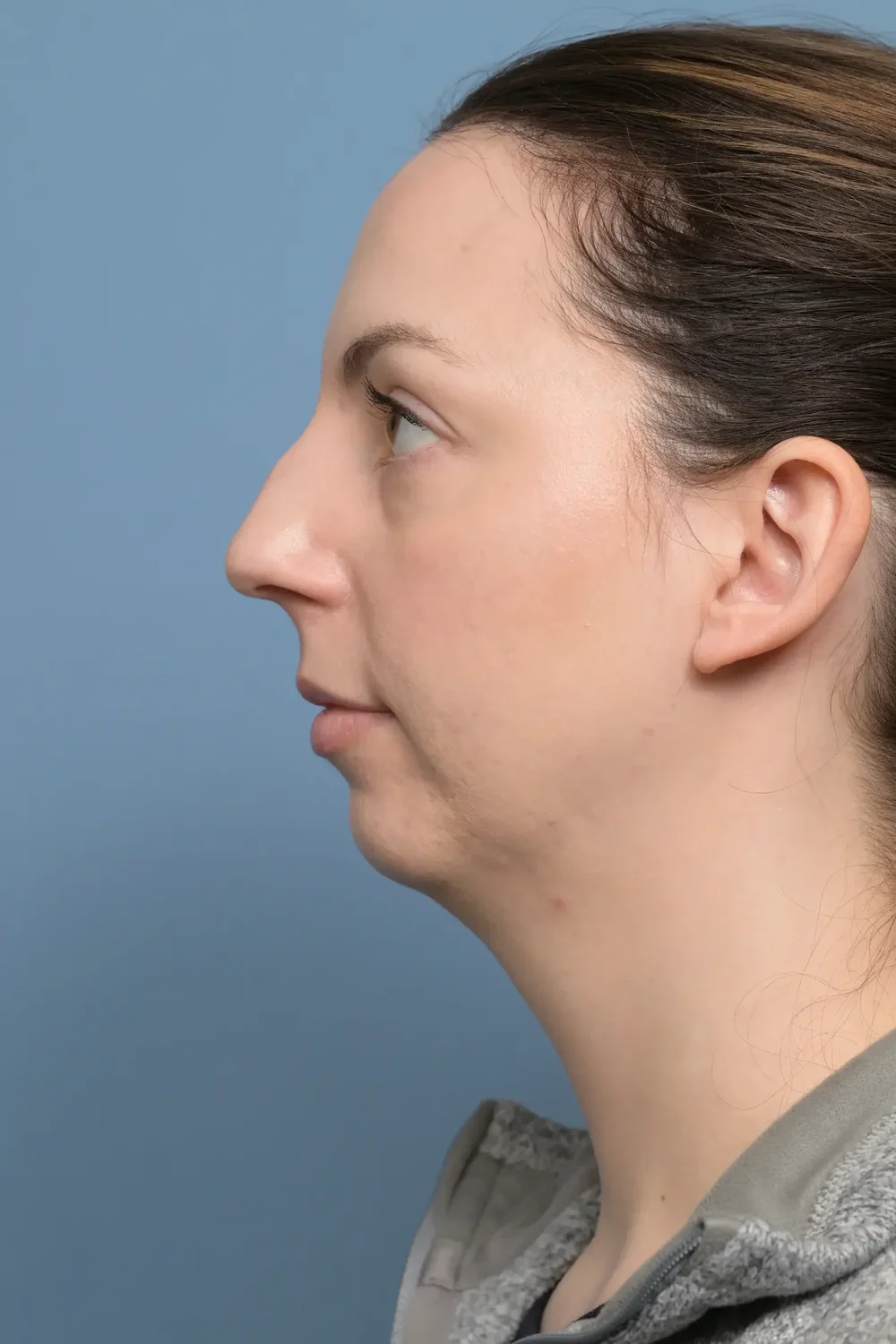 Before
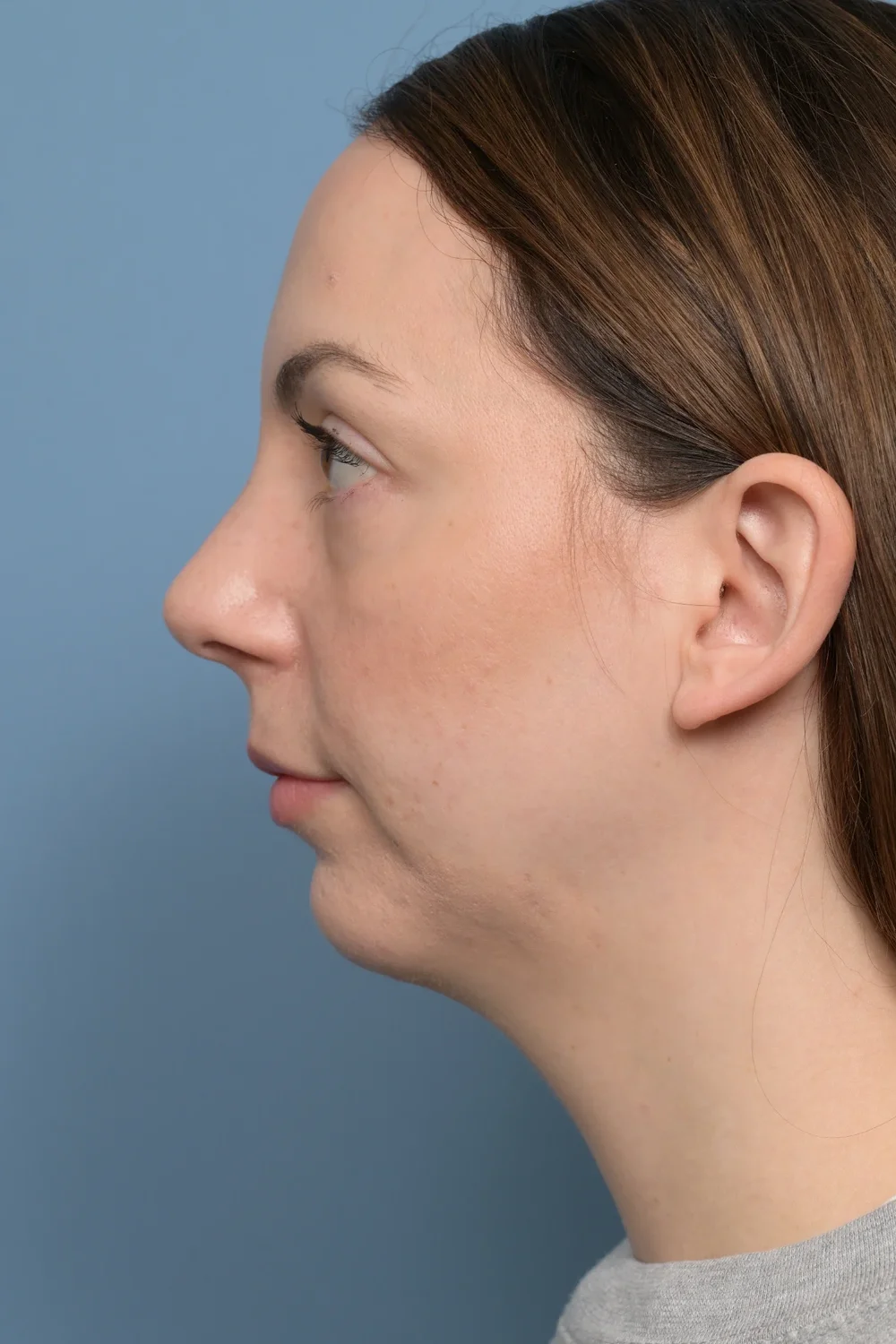 After
After
Rhinoplasty + chin implant — performed by Dr. Sturgill. Single surgery, one recovery.
Related Procedure
Considering rhinoplasty—with or without a chin implant?
Learn about Dr. Sturgill’s approach to rhinoplasty, including what makes a good candidate, the consultation process, and what to expect from recovery.
When rhinoplasty and chin augmentation are performed together, both happen during a single surgery under one anesthesia—with no additional recovery time beyond what the rhinoplasty alone would require. The chin implant adds minimal time to the procedure and no meaningful additional downtime.
The Consultation
What Dr. Sturgill Is Actually Evaluating During Your Consultation
The consultation isn’t a sales appointment. It’s a diagnostic evaluation.
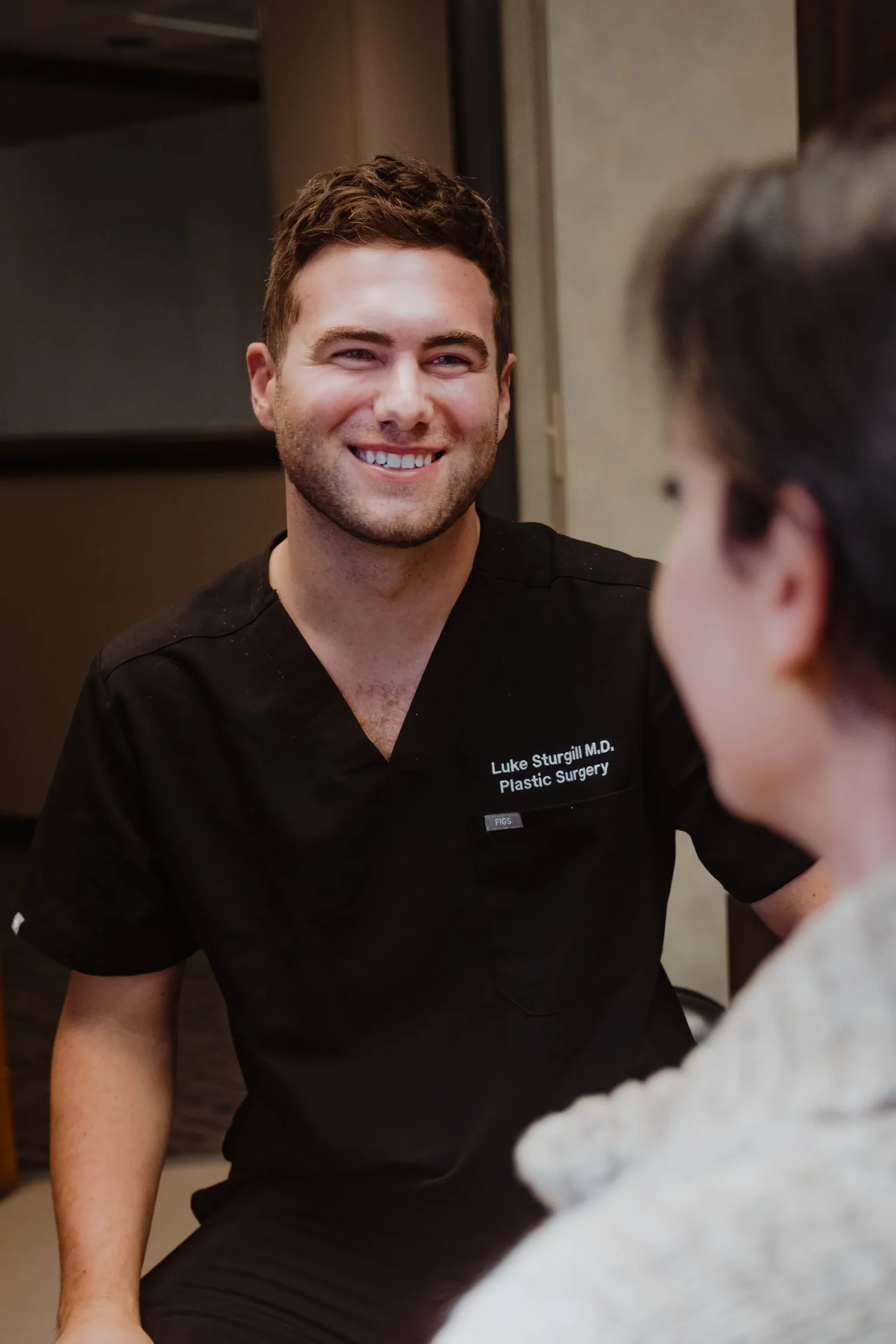
Dr. Sturgill evaluating facial proportions during an in-office consultation.
Here’s what Dr. Sturgill is specifically analyzing:
Facial Proportions and the Rule of Thirds
The face is classically divided into three horizontal sections—hairline to brow, brow to base of nose, base of nose to chin. These thirds should be roughly equal. When the lower third is short or recessive, the entire face looks unbalanced. Dr. Sturgill measures these relationships directly.
Profile Analysis
From the side, the chin should project to approximately the same vertical line as the lower lip—with variation based on gender, ethnicity, and individual anatomy. Dr. Sturgill evaluates your profile using standardized landmarks—not guesswork. If your chin falls significantly behind this line, you have a measurable structural deficiency.
Structural vs. Volumetric Deficiency
This is the critical distinction. Is your concern about projection—how far the chin or cheekbone extends forward—or about volume—fullness, contour, soft tissue quality? Projection is implant territory. Volume is fat grafting territory. Sometimes it’s both. Dr. Sturgill will identify which one—or which combination—applies to you.
The Filler Question
If you’ve been receiving chin filler, Dr. Sturgill will evaluate whether that filler has been masking an underlying structural problem. Some patients have filler “stacked” in ways that blur jawline definition or widen the chin unnaturally over time. The plan may include dissolving filler first so the true anatomy can be assessed.
Skin Thickness and Soft Tissue Quality
The amount of soft tissue covering the chin bone affects implant selection, sizing, and material choice. Patients with very thin skin need an implant material that won’t show edges—one of the reasons Dr. Sturgill prefers Prolene mesh over silicone for chin augmentation.
Dental Occlusion
Not everyone with a recessive chin needs an implant. Some patients have a skeletal malocclusion—meaning the lower jaw itself is positioned too far back, affecting both appearance and bite function. In these cases, the correct treatment may be orthognathic surgery (jaw surgery) performed by an oral and maxillofacial surgeon—not a chin implant. Dr. Sturgill screens for this during every consultation and will refer you appropriately if it applies.
The Honest Recommendation
At the end of the consultation, you’ll receive a clear recommendation: implant, fat grafting, filler, a combination—or sometimes nothing at all. The plan is built around your anatomy and your goals, not around a predetermined procedure.
Beyond the Chin
Other Facial Implant Types
Chin implants are the facial implant Dr. Sturgill performs most frequently. Other implant types exist for specific anatomic indications—but they are performed selectively, because for most patients with concerns in these areas, a different approach is the better answer.
Cheek Implants
Malar / Submalar Augmentation
Cheek Implants
Malar / Submalar Augmentation
Cheek implants augment the malar eminence—the cheekbone—in patients with true midface skeletal deficiency. This means the cheekbone itself doesn’t project enough, creating a flat or hollow midface that isn’t simply age-related volume change.
The Honest Assessment
Most patients who feel their cheeks are “flat” or “hollow” don’t have a skeletal deficiency—they have volume loss. The fat pads over the cheekbone have descended or atrophied with age, and what they actually need is volume restoration, not a bone-level implant. Facial fat grafting addresses this beautifully—restoring fullness with living tissue while simultaneously improving skin quality.
Cheek implants are reserved for the smaller subset of patients with a true structural deficiency—where the bone itself is the issue, not the soft tissue on top of it.
Learn more about facial fat grafting for cheek and midface volume →
Jawline Implants
Mandibular Body & Angle Augmentation
Jawline Implants
Mandibular Body & Angle Augmentation
Jawline implants augment the mandibular body and angle—the sides and corners of the jaw—to create more width, definition, or angularity.
The Honest Assessment
Social media has created enormous demand for a “chiseled” jawline—and implants seem like the obvious solution. In reality, most patients who want better jawline definition don’t need a jawline implant. What’s actually causing the lack of definition in most cases: submental fat blunting the jaw-to-neck angle (solution: liposuction, not an implant), jowling and skin laxity obscuring the jawline (solution: a deep plane face and neck lift), or volume loss along the mandible (solution: facial fat grafting).
Jawline implants are appropriate for patients with true mandibular skeletal deficiency—where the jaw bone itself is narrow or lacks angularity, and the issue persists even after addressing soft tissue. That’s a much smaller group than Instagram would have you believe.
Temple Implants
Temporal Fossa Augmentation
Temple Implants
Temporal Fossa Augmentation
Temple hollowing—the concavity that develops along the sides of the forehead with age—is a common concern, particularly in lean patients or those who have lost significant weight.
The Honest Assessment
For the vast majority of patients, temple hollowing is best treated with fat grafting—not an implant. Fat grafting restores the natural “yellow layer” of subcutaneous fat in the temple, which restores both volume and the warm, healthy skin quality that temple hollowing takes away. It’s one of the most satisfying applications of facial fat grafting.
Temple implants are exceedingly rare in Dr. Sturgill’s practice and reserved for cases where fat grafting is not feasible.
Learn more about facial fat grafting for temple rejuvenation →Recovery
What to Expect After Chin Implant Surgery
Recovery from a chin implant is straightforward—and significantly easier than most patients anticipate.
Days 1–7
The First Week
Swelling and tightness around the chin and lower face are most noticeable in the first 3–5 days and improve rapidly. A compression garment (chin strap) is worn for the first week to minimize swelling and support the implant as healing begins.
Temporary numbness of the lower lip and chin skin is common—the mental nerve runs along the jawbone near the surgical site. Sensation returns gradually, typically within a few weeks, though in some cases it may take several months to fully normalize.
Discomfort is mild to moderate and well-managed with prescribed medication. Most patients transition to over-the-counter pain relief within 2–3 days. A soft diet is recommended for the first several days. The incision beneath the chin heals in the natural submental crease and becomes virtually invisible.
Weeks 2–4
Return to Normal
Most patients return to work and normal daily activities within 7–10 days. Residual swelling is present but not obvious to others.
Strenuous exercise and heavy lifting should be avoided for 3–4 weeks. The chin will look somewhat fuller than the final result during this period—this is normal.
Months 1–3
Final Refinement
Final results become apparent around 2–3 months as residual deep swelling resolves and the soft tissue settles over the implant.
Numbness, if still present, continues to improve. The Prolene mesh integrates with surrounding tissue during this period, with the body’s own tissue growing into the mesh matrix.
3 Months & Beyond
The Long-Term Result
A chin implant is permanent. Once healed and integrated, it requires no maintenance, no touch-ups, and no replacement.
The result you see at 3 months is the result you keep.
Recovery timelines for other implant types (cheek, jawline) vary based on the specific procedure and whether additional procedures are performed simultaneously. Dr. Sturgill provides procedure-specific recovery guidance during your consultation.
Complementary Procedures
Procedures Commonly Combined with Facial Implants
Rhinoplasty
Rhinoplasty
Rhinoplasty and chin augmentation are one of the most powerful profile combinations in facial plastic surgery—and one of the most common pairings Dr. Sturgill performs. See the dedicated section above for a full explanation of why these two procedures work together so effectively.
Learn More About Rhinoplasty →
Facial Fat Grafting
Facial Fat Grafting
Some patients benefit from both a chin implant and facial fat grafting—the implant addresses structural projection at the chin, while fat grafting restores volume in other areas of the face (temples, cheeks, nasolabial folds, jawline contour).
Fat grafting also improves skin quality through nanofat and microfat components—something an implant alone cannot do. For patients who need both structure and volume, this pairing delivers a comprehensive result.
Learn More About Facial Fat Grafting →
Extended Deep Plane Face & Neck Lift
Extended Deep Plane Face & Neck Lift
Chin projection and neck definition are directly related. A chin that projects properly creates a sharper cervicomental angle—which is why many patients notice their neck looks dramatically better after a chin implant, even though nothing was done to the neck itself.
For patients who have both a recessive chin and excess submental fat or skin laxity, a chin implant combined with submental liposuction—or in some cases a neck lift—can produce a result that the patient assumed would require a full facelift. The chin implant provides the framework; the neck procedure refines the soft tissue around it.
Learn More About the Deep Plane Face & Neck Lift →
Neck & Jawline Sculpting
Neck & Jawline Sculpting
Not every patient with a weak chin needs a full face and neck lift—but many benefit from targeted sculpting of the neck and jawline. Submental liposuction removes the fat beneath the chin that blunts the cervicomental angle, while platysmaplasty tightens the platysma muscle bands that create visible “cords” or a “turkey neck” appearance.
When combined with a chin implant, the effect is transformative: the implant creates the skeletal projection, and the neck sculpting procedure refines everything around it. Patients who assumed they’d need a facelift are often surprised by what this combination achieves.
Learn More About Neck & Jawline Sculpting →
Buccal Fat Reduction
Buccal Fat Reduction
A chin implant adds projection to the lower face—but if excess buccal fat is creating fullness in the mid-cheek, the overall effect can still feel “bottom-heavy.” Buccal fat reduction sculpts the area between the cheekbone and jawline, revealing the natural contour of the facial skeleton underneath.
When combined with a chin implant, the result is a more defined facial silhouette from every angle—not just the profile. The implant strengthens the lower third; buccal fat reduction refines the middle third. Together, they bring the entire face into proportion.
Learn More About Buccal Fat Reduction →Why Patients Choose
Dr. Sturgill for Facial Implants
A procedure this precise requires a surgeon who understands facial skeletal anatomy at an expert level—and who will tell you the truth about what an implant can and can’t do.

Facial Skeleton Expertise
Double board-certified in facial plastic surgery, Dr. Sturgill focuses exclusively on the face and neck. Implant placement demands precise knowledge of bone anatomy, nerve pathways, and soft tissue draping—the kind of expertise that comes from specialization, not generalization.
Honest About What Implants Can Do
Not every patient who asks about a chin implant needs one. Dr. Sturgill evaluates the full skeletal framework—chin projection, jawline definition, midface proportion—and will tell you if an implant is the right solution, or if another approach would serve you better.
Results That Fit Your Face
The goal is never to look “done”—it’s to look like the best version of yourself. Dr. Sturgill selects and carves each implant to match your anatomy so the result appears natural, proportional, and entirely yours.
What Patients Are Saying About Dr. Sturgill
Real reviews from real patients—because the best referral is an honest one.
Ready to take the next step?
Your consultation is a planning session — not a sales pitch.
Dr. Sturgill will evaluate your facial anatomy, discuss your goals, and give you an honest assessment of what surgery can — and cannot — achieve. You will leave with a clear understanding of whether this procedure is right for you.
What to expect
- Review your concerns and goals in detail
- Receive a facial analysis with a personalized surgical plan
- See before-and-after photos of what YOU will look like after surgery
- Have all your questions answered directly
Consultations typically last around 45 minutes.
Book Your Consultation
Your Questions, Answered
Specific questions about facial implants with Dr. Sturgill. For general practice questions, visit our FAQ page.
What are facial implants made of?
The most common material is solid silicone—a pre-formed implant in standard sizes and shapes. For chin augmentation specifically, Dr. Sturgill uses Prolene mesh—a surgical-grade polypropylene that can be custom-shaped and layered during surgery to match each patient’s unique anatomy.
Prolene mesh is low-inflammatory, produces minimal capsule formation, has no palpable edges, and integrates with your own tissue over time. It has been used safely across surgical disciplines for decades.
How do I know if I need an implant vs. filler vs. fat grafting?
This is exactly what the consultation determines. If your concern is structural projection—your chin bone doesn’t project far enough—an implant is likely the best solution. If your concern is volume—fullness in the cheeks, temples, or jawline—facial fat grafting is usually the better answer. Filler is appropriate for subtle, temporary changes.
Many patients have been getting filler when an implant would have been more effective and permanent—and many others assume they need an implant when fat grafting is the more appropriate solution. Dr. Sturgill will evaluate your anatomy and tell you which one you actually need.
Is a chin implant permanent?
Yes. Once placed and healed, a chin implant requires no maintenance, no refilling, and no replacement. That’s the entire point for patients tired of the cost, inconvenience, and inconsistent results of repeated filler injections. The Prolene mesh integrates with your own tissue over time, making it a stable, long-term part of your facial structure.
Can a chin implant fix my profile without rhinoplasty?
Sometimes, yes—and that’s one of the most important things Dr. Sturgill evaluates during your consultation. Many patients think their nose is too large when the real issue is that their chin is too small. Augmenting the chin changes the proportional relationship, and in some cases the nose looks perfectly proportionate once the chin is corrected.
Other patients genuinely need both—a rhinoplasty and a chin implant. And some need a rhinoplasty alone. Dr. Sturgill won’t recommend a procedure you don’t need, and he won’t skip one you do.
Will people be able to tell I have an implant?
The goal is natural proportion—not an obvious augmentation. A well-placed chin implant, sized and shaped appropriately, should look like the chin you were supposed to have. People should notice that you look good—not that something was “done.” This is precisely why Dr. Sturgill uses Prolene mesh—it conforms to the bone without palpable edges, and the result feels and looks natural.
What’s the difference between a chin implant and a sliding genioplasty?
Different tools for different problems. A chin implant adds projection by placing material on top of the existing chin bone. A sliding genioplasty is an osteotomy—the chin bone is cut and repositioned, then secured with plates and screws. Genioplasty can move the chin forward, backward, up, down, or side-to-side to correct asymmetry.
It’s more invasive with a longer recovery, typically reserved for patients who need vertical height changes, significant asymmetry correction, or who have bite-related issues an implant alone can’t address. For most patients who simply need more forward projection, a chin implant achieves the result with a simpler surgery and faster recovery.
What’s the recovery like for a chin implant?
Straightforward. Swelling and tightness for the first week—most noticeable in the first 3–5 days. Temporary numbness of the lower lip and chin is common and resolves gradually. Most patients return to work within 7–10 days. Strenuous exercise is restricted for 3–4 weeks. Final results are typically visible around 2–3 months as deep swelling resolves.
Pain is mild to moderate—most patients switch to over-the-counter medication within a couple of days.
Can I combine a chin implant with other procedures?
Yes—and this is common. The most frequent pairing is rhinoplasty + chin implant, addressing both sides of the profile equation in a single surgery. Other common combinations include chin implant with submental liposuction (projection plus neck refinement), chin implant with facial fat grafting (structural augmentation at the chin plus volume restoration elsewhere), and chin implant with a neck lift.
Combining procedures means one anesthesia, one recovery, and a more harmonious result.
Are cheek implants better than filler for cheek augmentation?
For most patients, the answer is neither—facial fat grafting is the better solution. Filler is temporary and can look unnatural with repeated treatments. Cheek implants are permanent but designed for true skeletal deficiency—the cheekbone itself doesn’t project enough. Most patients feeling their cheeks are flat or hollow are experiencing age-related volume loss, not a bone structure problem.
Fat grafting restores that volume with living tissue while improving skin quality. Dr. Sturgill reserves cheek implants for the relatively small number of patients with genuine malar hypoplasia.
Do jawline implants give you a “chiseled” jawline?
Here’s the honest answer: probably not—at least not the way social media suggests. The majority of patients who want better jawline definition are dealing with submental fat, jowling, or volume loss along the mandible. These are soft tissue issues—solved with liposuction, a facelift or neck lift, or fat grafting.
Jawline implants are appropriate for true mandibular skeletal deficiency—a much smaller group than Instagram would have you believe. Dr. Sturgill will evaluate whether your concern is bone or soft tissue—and recommend what will actually work.
Can implants shift or move over time?
This is a valid concern—and one of the reasons Dr. Sturgill prefers Prolene mesh for chin implants. Silicone implants sit in a pocket on the bone, held in place by the capsule the body forms around them. Over time, there’s a possibility—though uncommon—for a silicone implant to shift or cause bone resorption.
Prolene mesh behaves differently: your body’s tissue grows into the mesh matrix, integrating it with surrounding bone and soft tissue. This provides a more stable, secure result than an encapsulated silicone implant resting on the bone surface.
How long does chin implant surgery take?
Standalone chin implant: approximately 45–60 minutes. Combined with rhinoplasty: typically 2.5–3.5 hours total (the chin adds relatively little time). Combined with other procedures—neck liposuction, fat grafting, facelift—total time depends on the overall plan, which Dr. Sturgill outlines during consultation.
Is facial implant surgery painful?
Less than most patients expect. Chin implant surgery involves mild to moderate discomfort—most patients describe tightness and pressure rather than sharp pain. Prescription pain medication is provided for the first few days, but many patients switch to over-the-counter medication by day 2 or 3.
The most common post-operative sensation is numbness—not pain. Patients consistently report that recovery was easier than anticipated.
Am I a good candidate for a chin implant?
Good candidates have a structurally recessive chin (retrogenia) and are seeking permanent improvement in facial profile and proportion. You may be a candidate if you have a weak profile, feel your nose looks disproportionately large relative to your lower face, have been relying on chin filler without lasting satisfaction, or feel your lower face doesn’t match the rest of your proportions.
You should be in good general health and have realistic expectations about outcomes. The consultation is the definitive way to determine candidacy—Dr. Sturgill will evaluate your bone structure, soft tissue, bite relationship, and overall facial proportion to give you a clear answer.
Proportion starts with an
honest evaluation.
Dr. Sturgill will assess your facial skeleton, soft tissue, and proportions—then tell you whether an implant is the right solution, or if another approach would serve you better. No pressure, no upselling. Virtual consultations available for out-of-town patients.
Book Your ConsultationCarmel, Indiana ◆ In-Person & Virtual Available