
Facelift Surgery · Carmel & Indianapolis
A facelift should restore you. Not redesign you.
“Facelift” is a category, not a single operation—and the technique you choose will matter more to your result than almost any other decision you make. Below, every approach compared honestly, including when the answer isn’t surgery at all.
Start Here
One face. One connected plan.
Facial aging rarely happens in one place, so this page is built as a hub. Compare the facelift techniques below, then explore the procedures that complete a plan—each on its own detailed page.
Extended Deep Plane Face & Neck Lift
The deep retaining ligaments are released and the SMAS-platysma complex—the face’s deep muscular layer—is repositioned as one continuous unit. Midface, jowls, jawline, and neck treated as a connected system, with results that hold for 10–15 years or more.
Explore the technique →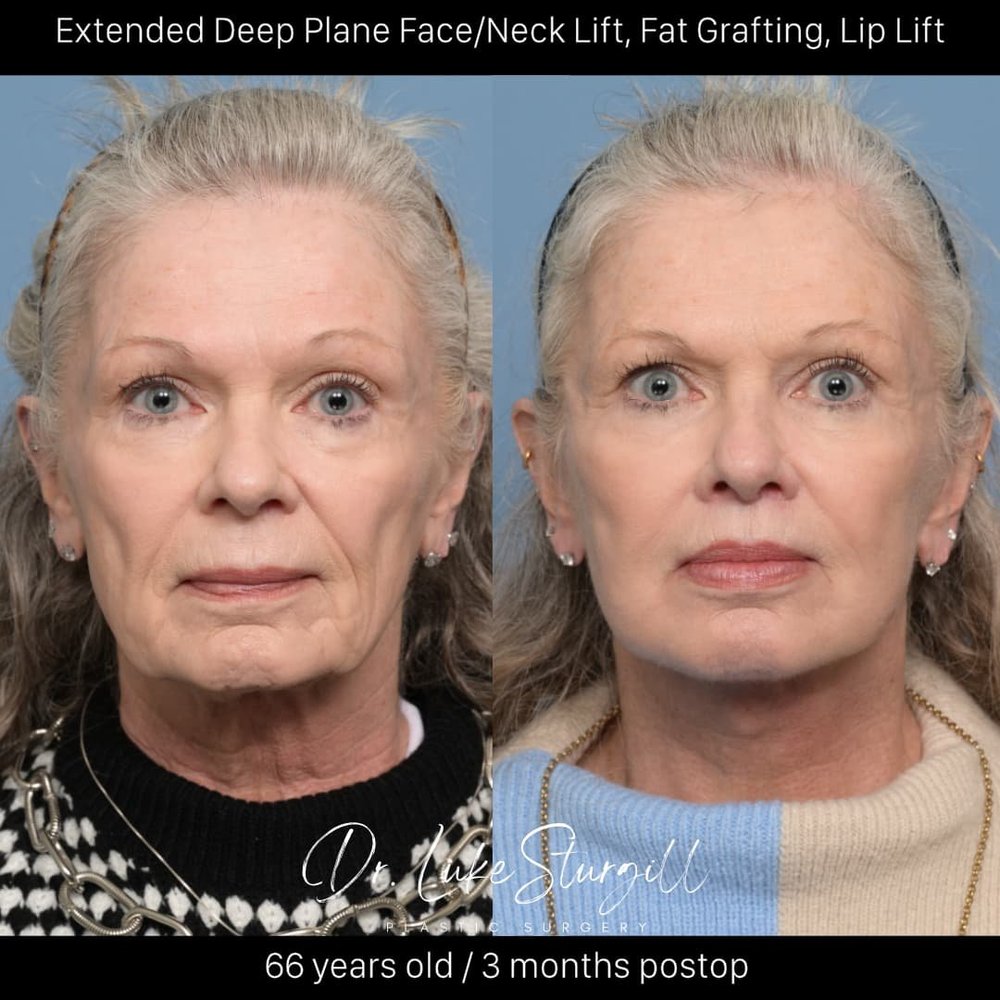
Neck & Jawline Sculpting
When the concern is isolated below the jaw—banding, fullness, or a lost cervicomental angle—a dedicated neck procedure may be the honest answer.
Learn more →Facial Fat Grafting
A lift corrects descent; it cannot replace lost volume. Fat grafting restores hollowed temples, midface, and under-eye areas with your own tissue.
Learn more →Skin Resurfacing
Texture, fine lines, and sun damage live in the skin itself—the one layer a facelift doesn’t change. Resurfacing completes the surface.
Learn more →Brow Lift
Heaviness above the eyes is upper-face territory a facelift doesn’t reach. Often combined during the same anesthetic.
Learn more →Eyelid Surgery
Hooded upper lids and under-eye bags read as tired even in a well-rested face—and are addressed at the eyelids, not the jawline.
Learn more →Before & After Gallery
Unretouched patients, standardized clinical photography, no angles, no tricks. The most honest page on this site.
View results →Why This Page Exists
The word means very different things
Two patients can both say they had “a facelift” and have had almost nothing in common. One may have had skin tightened and re-draped. Another may have had the deep structural layer of the face released and moved as a unit. Both carry the same name in conversation—but they are not the same operation, they don’t last the same length of time, and they don’t look the same at year five.
Before comparing surgeons, it helps to understand what you’re actually comparing. Then, when you sit down for a consultation, you can ask better questions and recognize a real answer when you hear one.
Dr. Sturgill’s answer for most patients with true facial descent is the Extended Deep Plane Face & Neck Lift—and just as importantly, he’ll tell you when it isn’t.
Understanding Facial Aging
It isn’t just loose skin
Every facelift technique is really an answer to a question: what has actually changed in this face? Three forces matter most, and they don’t respond to the same treatment.
Descent
Deep tissues shift downward as retaining ligaments loosen. The cheek falls away from the eye, the midface slides toward the jawline creating jowls, and the neck muscles separate and band. This is structural migration. Skin tightening alone does not correct it.
Deflation
Facial fat pads thin and shift, leaving hollows where fullness once was. The face reads drawn rather than lifted. Lifting alone won’t replace what’s gone; that requires fat grafting.
Damage
Intrinsic aging, sun exposure, and collagen loss thin the skin and roughen its texture. This is the most visible layer and the least structural. That is why skin resurfacing addresses it while a lift does not.
A facelift is the correct answer to descent. It is the wrong answer to deflation and damage. The honest plan is usually a combination—and the first job of a consultation is figuring out which forces are actually driving what you see.
Side by Side
Comparing the four approaches
Each of these has a legitimate place. The question is not which is best in the abstract, but which matches your anatomy, your goals, and how long you want the result to hold.
| Dr. Sturgill’s ApproachExtended Deep Plane Face & Neck Lift | Traditional / SMAS Facelift | Mini Lift & Short-Scar Lift | Non-Surgical Treatments | |
|---|---|---|---|---|
| What it does | Releases the deep retaining ligaments and repositions the SMAS-platysma complex, the deep muscular layer, as one continuous unit. | Tightens or folds the SMAS layer and re-drapes the skin over it. Works above the deep ligaments rather than releasing them. | A shorter-incision version of a limited lift, typically addressing the jawline only. | Energy devices, biostimulators, threads, and filler that tighten skin modestly or add volume. |
| Area addressed | Midface, jowls, jawline, and neck treated as one connected system. | Primarily lower face and jawline; midface correction is limited. | Lower face and jawline only. | Surface and volume only; no repositioning of deep structure. |
| How long it holds | 10–15 years or more, aging from a younger structural baseline. | Roughly 3–7 years, depending on technique and tissue quality. | Often 2–5 years; relapse is common when descent was the real problem. | Months to about two years; requires ongoing maintenance. |
| Social downtime | Most patients are comfortable being seen at 10–14 days. | Broadly similar: 10–14 days for most patients. | Around one week. | Minimal to none, varying by treatment. |
| Anesthesia & setting | General anesthesia with a board-certified anesthesiologist; one night in a private suite at an accredited surgical facility. | General anesthesia or IV sedation, depending on the surgeon and facility. | Often local anesthesia with sedation. | Office-based, typically topical or no anesthesia. |
| Best suited to | Patients with genuine descent—jowling, a blunted jawline, midface heaviness, and neck laxity—who want one definitive correction that lasts. | Patients with mild to moderate lower-face laxity and limited midface change. | Early jawline softening in younger patients with good skin quality and minimal neck involvement. | Early changes, skin quality, and volume, as well as maintenance between and after surgical results. |
| Honest limitation | It corrects descent only. Volume loss and skin damage need fat grafting and resurfacing to complete the result. | Because deep structures stay displaced, results can read tight rather than restored, and tend not to hold as long. | When descent is the underlying problem, a smaller operation tends to relapse, and revision is harder than doing it once, correctly. | Once tissue has descended far enough, camouflage stops working. Continued filler can distort anatomy rather than improve it. |
Timeframes describe typical outcomes reported in the facial plastic surgery literature and in Dr. Sturgill’s practice. Individual results depend on anatomy, skin quality, genetics, and healing. This comparison describes techniques, not other surgeons—many of whom perform these operations excellently for the right patient.
Real Patient Results
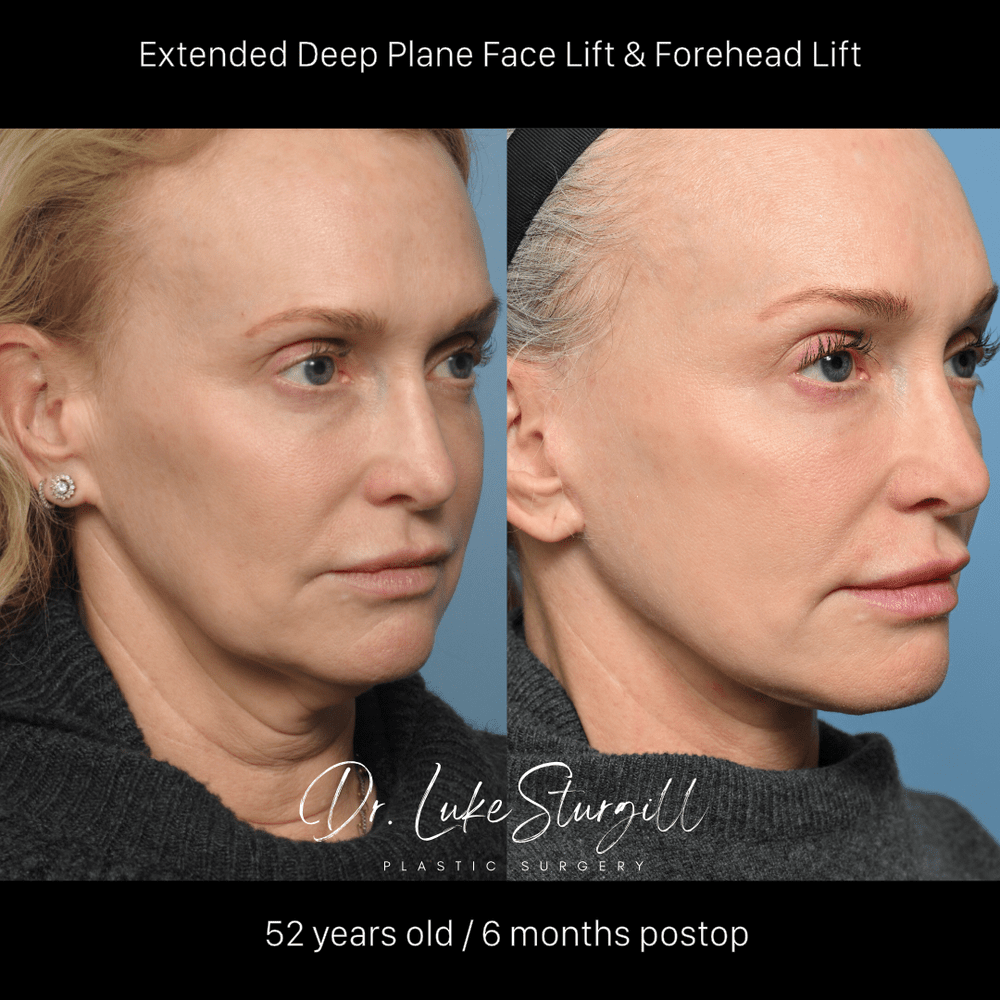
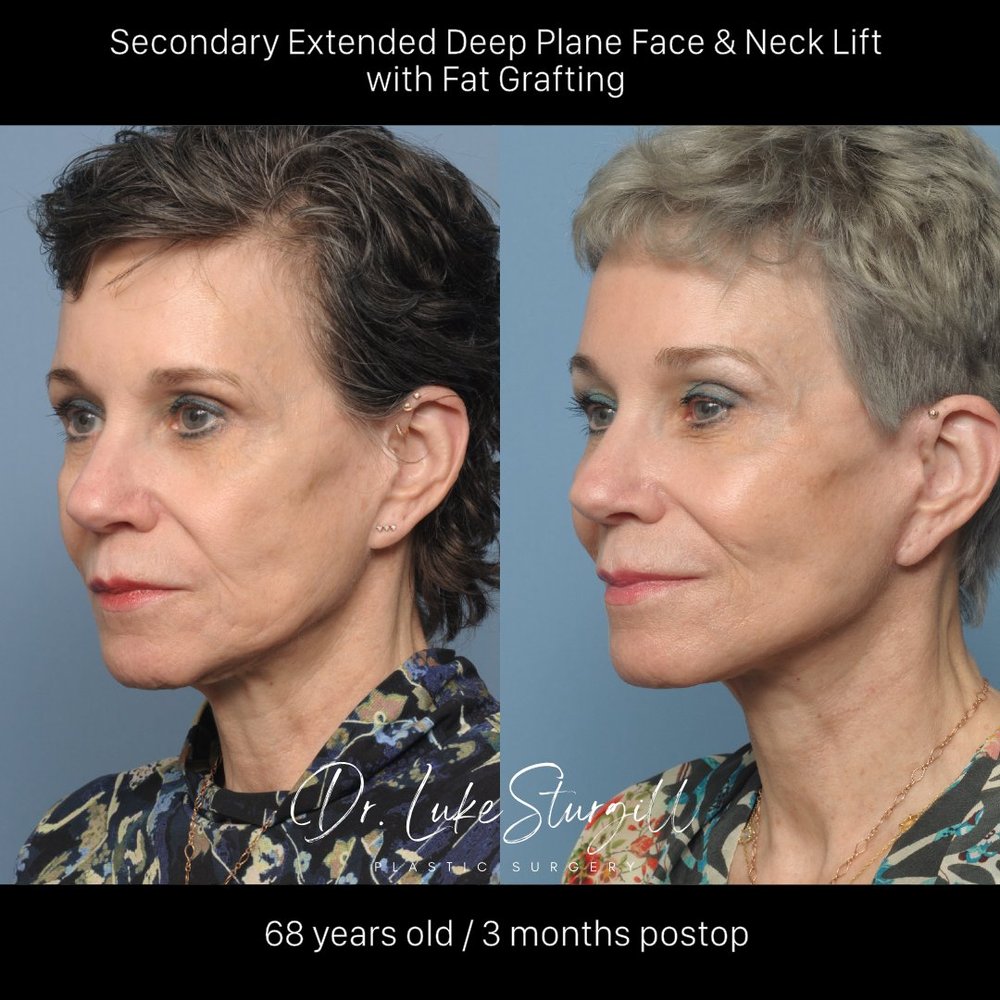
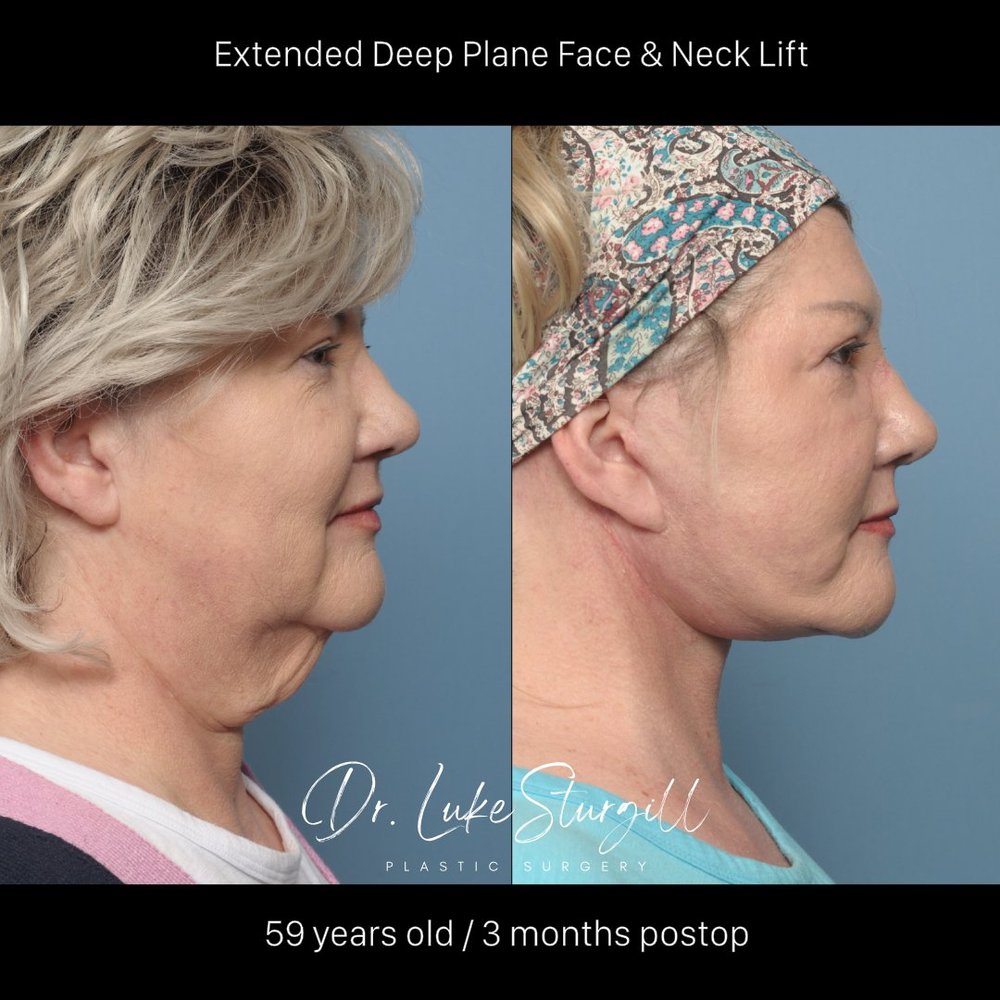
Judge the technique by the photographs
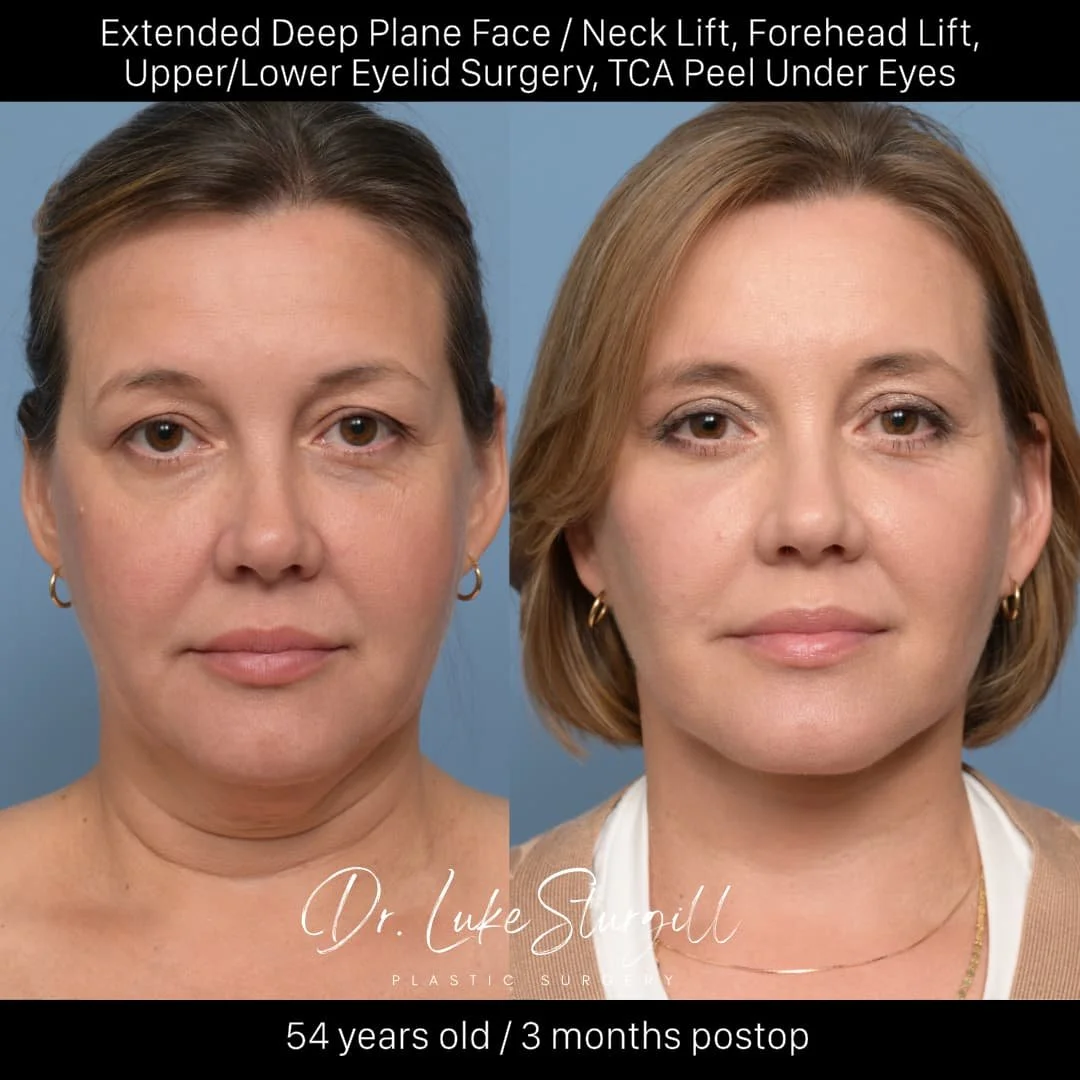
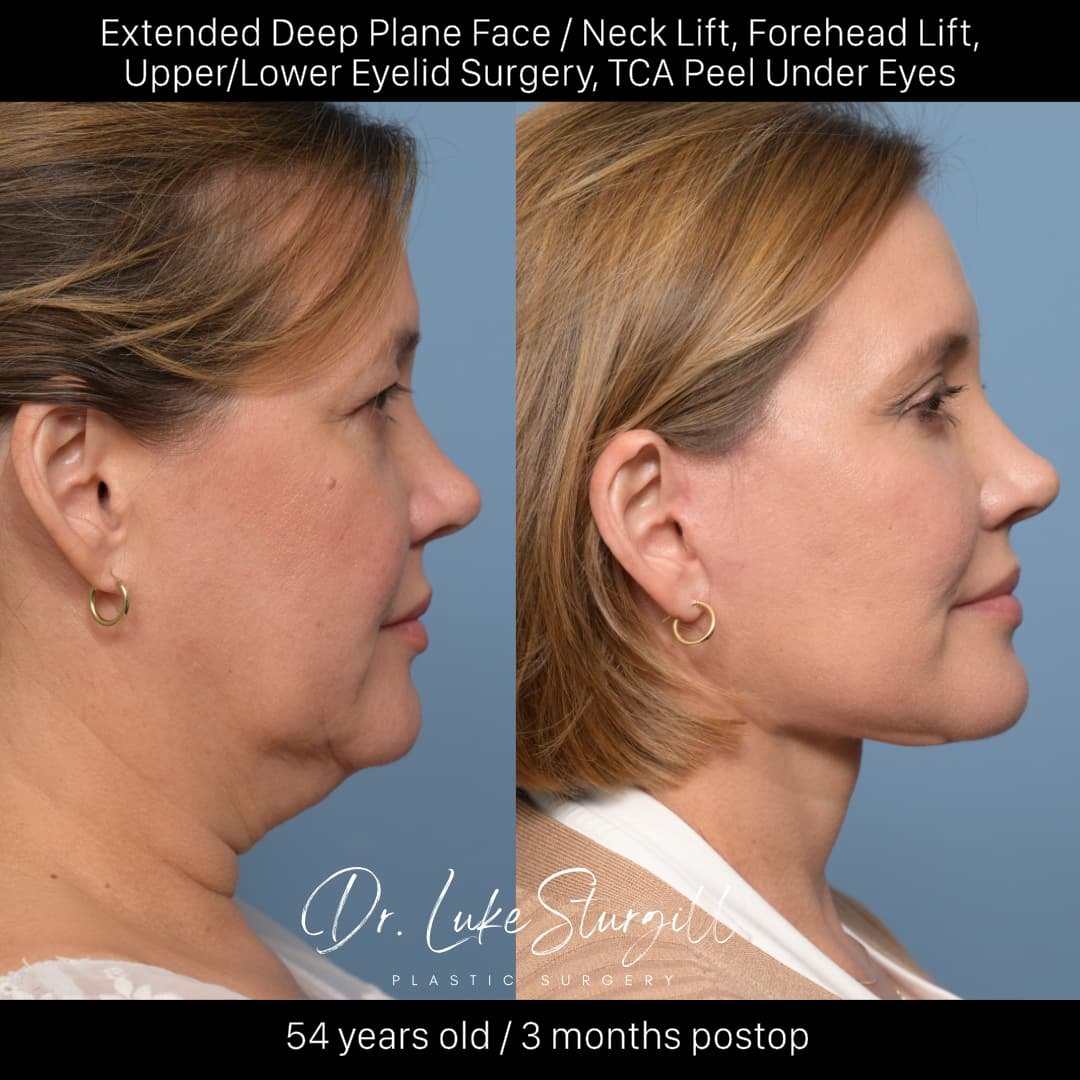
The goal is never to look tighter. It’s to look like yourself—refreshed, rested, and undeniably natural. What patients notice first isn’t any single change; it’s that everything looks right again.
What to look for in any surgeon’s gallery
- Restored midface volume and cheekbone definition—not just a tighter jawline
- Complete resolution of jowling, with a continuous contour from chin to ear
- A clean cervicomental angle—the sharp chin-to-neck transition seen in profile
- Natural expression preserved—no windswept pull or frozen smile
- Well-concealed incisions, with earlobes in their natural position
- Identical lighting, angle, and distance between the before and after frames
A note on photographs. All images on this site are unretouched patients of Dr. Sturgill, photographed under standardized clinical lighting with a 100mm macro lens and consistent positioning. No angles, no tricks. Results vary with anatomy, skin quality, and healing.
She searched the entire country for the right surgeon—and flew from Miami to Carmel for the procedure that changed everything, just in time for her daughter’s wedding.
Tina · Extended Deep Plane Face & Neck Lift Patient
The Question Everyone Is Asking
“What is the new facelift everyone is getting?”
The honest answer is the deep plane facelift. It isn’t new.
The technique was described decades ago. What changed recently is adoption: as more surgeons trained in it and long-term results became visible, patients began noticing that certain results looked restored rather than tightened—and asked what those patients had done.
What is genuinely new is the marketing around it. “Deep plane” now appears on a great many practice websites, and it doesn’t always describe the same operation. Some use it for a full ligament release and structural repositioning. Others use it for a modified or partial dissection.
So the useful question in a consultation isn’t whether a surgeon offers a deep plane facelift. It’s which retaining ligaments they release, how far the dissection extends, and how often they perform it. Those answers separate the technique from the terminology.
A note on terminology
“Deep plane” describes an anatomic plane of dissection, not a brand. Branded procedure names—weekend lifts, thread lifts, lunchtime lifts—usually describe marketing, not anatomy.
Be equally skeptical of any name you can’t define. Ask what plane the surgeon works in and what is physically moved. A real technique survives that question. So does a real surgeon.
Curious how Dr. Sturgill performs it? The complete operation is described on the Extended Deep Plane Face & Neck Lift page.
The Perkins Legacy
Documented, not asserted
Patients researching facelift surgery in Indianapolis encounter competing claims about who brought the deep plane technique to Indiana. The record is public. Over a 41-year career in Indianapolis, Dr. Stephen W. Perkins developed, published, and taught the deep plane face and neck lift—a published record spanning four decades. In December 2024, the peer-reviewed journal Facial Plastic Surgery devoted an entire theme issue to the operation, with Dr. Perkins as its Guest Editor.
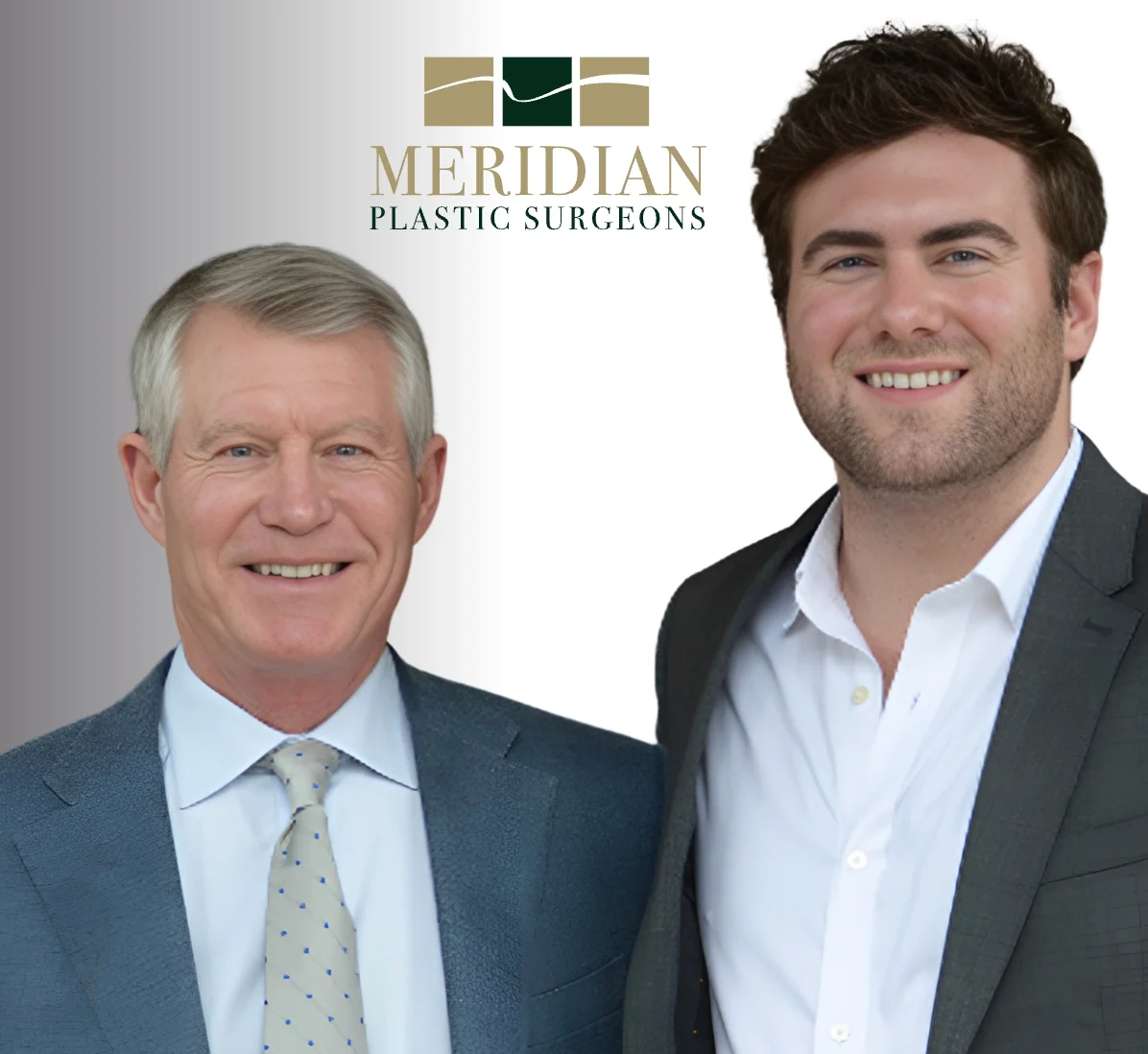
Dr. Sturgill completed his fellowship under Dr. Perkins, co-authored with him in Facial Plastic Surgery in 2024, and was hand-selected as his successor. He now performs the operation Dr. Perkins spent forty years refining—in the same surgical center, on the same patients’ families.
- Guest Editor, “The Deep Plane Face and Neck Lift,” Facial Plastic Surgery, Vol. 40, Issue 6, December 2024
- “The Evolution of My Extended SMAS-Biplanar Deep Plane Facelift to a Composite Tissue Deep Plane Face and Neck Lift,” Facial Plastic Surgery, 2024;40(6):741–749
- “Advances in Face-lift Techniques, 2013–2018: A Systematic Review,” JAMA Facial Plastic Surgery, 2019;21(3):252–259
Evaluating Surgeons
How to choose a facelift surgeon
No one should tell you who the best facelift surgeon is—including a facelift surgeon. What can be offered is the set of questions that separate a documented practice from a well-marketed one. Ask these of Dr. Sturgill, and ask them of everyone else you consult.
- Which retaining ligaments do you release, and how far does the dissection extend?
- How many of these do you personally perform each year—and how many revisions?
- May I see unretouched photographs at six to 12 months, of patients with anatomy like mine?
- What are your own rates of hematoma, temporary and permanent nerve weakness, and revision?
- Who administers anesthesia, and is the surgical facility accredited?
- Why this technique for my face, rather than the alternatives?
A surgeon who answers these specifically—with numbers, with photographs, and with a reason particular to your anatomy—is giving you real information. A surgeon who answers with adjectives is giving you marketing.
Candidacy
What is the best age?
Anatomy matters far more than the number on your driver’s license. Most patients are somewhere between their late forties and their seventies—but that range describes a pattern, not a rule. Signs that point toward surgery:
- Jowling that blurs a previously defined jawline
- Heaviness through the lower face and cheeks
- Loss of the cervicomental angle—the crisp transition from chin to neck
- Platysmal banding, the vertical cords visible in the neck
- Nasolabial folds and marionette lines driven by tissue descent
- Filler or biostimulators no longer producing meaningful improvement
That last one matters. Many patients arrive at surgery after realizing non-surgical treatments have stopped correcting the problem. And not every patient who asks about a facelift needs one—when the issue is volume, skin quality, the neck alone, or the upper face, Dr. Sturgill will say so directly and point you to the right procedure instead.
Longevity
What happens 10 years later?
Ten years after an Extended Deep Plane Face & Neck Lift, most patients still look better than they did the day before surgery. Not unchanged—better. Aging continues, but it continues from a repositioned structural baseline rather than a descended one.
That happens because the deep tissue layer was physically moved and secured rather than the skin being placed under tension. Tension relaxes. Repositioned structure holds.
The comparison patients find most useful isn’t surgery versus staying the same. It’s surgery versus another decade of continued descent—and compared against years of maintenance treatments that never fully address descent, a single structural correction is a different kind of decision. Not inexpensive, but definitive.
Investment
How much does a facelift cost?
Figures published online are frequently misleading—not because practices are dishonest, but because a single number rarely describes the same thing twice. A complete estimate has three parts: the surgeon’s fee, the surgical facility fee, and anesthesia. A range quoted online may include all three—or only the first.
The range moves with the scope of the operation, whether the neck requires deep work, whether procedures such as fat grafting, eyelid surgery, or resurfacing are combined, and whether the case is a revision. Dr. Sturgill builds the operative plan around your anatomy, so the figure follows the plan—and every patient leaves the consultation with a written, itemized estimate covering all three components.
Teresa, the practice’s patient coordinator with more than 30 years of experience, reviews financing options with every patient who wants them. Nothing about the process is designed to pressure a decision.
What to Expect
Recovery, honestly described
Every patient heals differently, but the arc is predictable. Here is what most patients experience after an Extended Deep Plane Face & Neck Lift.
The “down” time
Swelling and tightness peak. Rest with the head elevated, ice regularly, minimal activity. Sutures typically come out around days three and seven. Most describe it as uncomfortable rather than painful.
Restaurant ready
The milestone most patients ask about. Not fully healed, but presentable enough for dinner, errands, and light social activity. Tissues may still feel firm.
Big event ready
Roughly 90% of swelling has resolved and tissues have softened. The benchmark for a wedding or reunion. Most people simply say you look well-rested.
Long-term
Because the result rests on structural repositioning rather than skin tension, it holds for years. You keep aging—from a more youthful set point.
Every patient receives detailed written guidance at each stage. For a full walkthrough, see the practice’s post-operative care resources—and if you’re traveling to Carmel for surgery, the out-of-town patient guide covers timing, lodging, and when Dr. Sturgill clears travel home. Surgery takes place at the practice’s own accredited surgery center with a private overnight suite.
Your Surgeon Matters
Why patients choose Dr. Sturgill
Patients travel from across the country for a surgeon who combines deep anatomical expertise with an uncompromising standard for natural results—and the honesty to recommend only what will genuinely make a difference.
The face is the whole practice
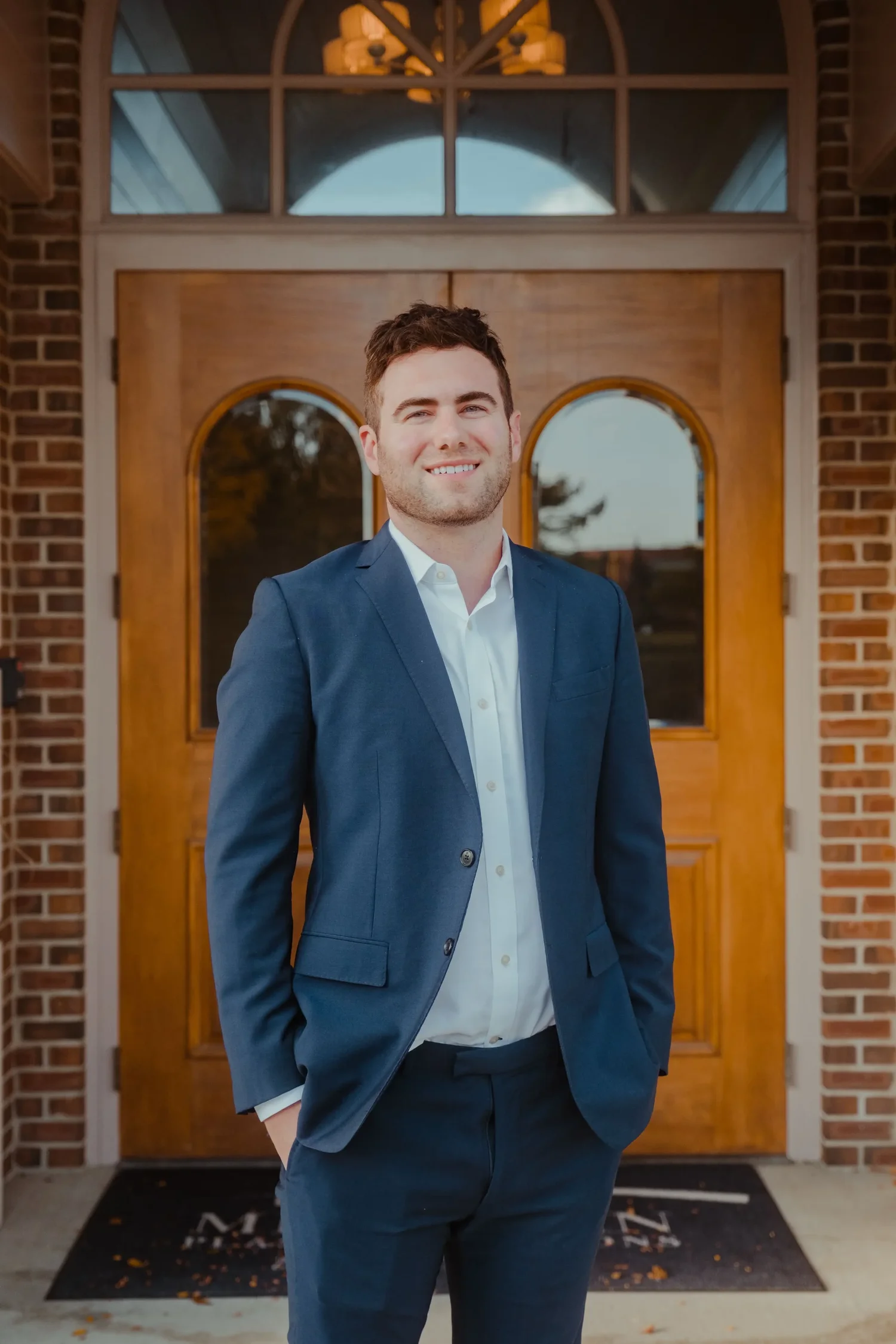
Dr. Sturgill is a double board-certified facial plastic surgeon who operates exclusively on the face and neck. The Extended Deep Plane technique is his primary operation, performed multiple times per week—including complex revisions other surgeons refer to him. Roughly half his practice is revision and secondary facelift work.
Trained by the surgeon he succeeded
He completed fellowship training under Dr. Stephen W. Perkins and was hand-selected as his successor—continuing one of the most established facial plastic surgery practices in the Midwest. He is also an invited member of Aesthetic Experts, a peer-nominated group.
Purpose-built, accredited facility
Surgery is performed at Meridian Plastic Surgery Center in Carmel—AAAHC-accredited, Medicare-certified, and licensed by the Indiana State Department of Health—under a board-certified anesthesiologist, with a private overnight suite and one-on-one nursing.
Common Questions
Frequently asked questions
Honest, detailed answers about facelift surgery in Indianapolis and Carmel—from choosing a technique through long-term results.
Choosing a Technique
What is the difference between a deep plane facelift and a traditional facelift?+
A traditional facelift tightens the skin and the superficial SMAS layer, then re-drapes the skin over it. A deep plane facelift works underneath those layers—releasing the retaining ligaments that tether the face in its aged position and repositioning the SMAS-platysma complex as one continuous unit.
Think of it this way: a superficial lift pulls the carpet tighter across the floor. A deep plane lift fixes what’s underneath the carpet so the surface lies flat on its own. Because the deep layer carries the load, the skin closes without tension—which is what produces a natural result, the finest possible scars, and longevity measured in decades rather than years.
Is a mini facelift a good option?+
For the right patient, yes. A short-scar lift can suit someone with early jawline softening, good skin quality, and minimal neck involvement—typically a younger patient whose deep structures haven’t descended much.
The difficulty arises when a smaller operation is applied to a problem that is genuinely structural. If the deep tissues have descended and only the skin is addressed, the result tends to relapse within a few years. A meaningful share of Dr. Sturgill’s revision practice involves patients who had a limited lift first and returned once it relaxed. Revising is harder than doing it correctly the first time, which is why he would rather tell you honestly which category you fall into.
Can non-surgical treatments replace a facelift?+
They can delay one, and they can complement one, but they can’t replicate it. Energy devices, biostimulators, threads, and filler act on skin quality and volume. None of them release retaining ligaments or reposition descended tissue—which is the actual mechanism of a facelift.
Used early and thoughtfully, these treatments are genuinely valuable. The problem is continuing them past the point of usefulness: once tissue has descended far enough, adding volume to camouflage it can distort the face rather than restore it. Dr. Sturgill will tell you which side of that line you’re on.
What is a “Cinderella facelift”?+
A marketing name, not a surgical technique. The term is most often attached to thread lifts or other minimal-downtime treatments promoted around a big event—a temporary tightening effect, with results measured in months rather than years.
Branded names change; anatomy doesn’t. Whatever a procedure is called, the useful questions are the same: what plane does the surgeon work in, what tissue is physically repositioned, and how long do results last in patients like you. A name that can’t be defined anatomically is describing marketing, not surgery.
Cost & Planning
How much does a facelift cost in Indianapolis?+
A complete estimate has three components: the surgeon’s fee, the surgical facility fee, and anesthesia. Published ranges vary widely between practices in part because some quote all three and others quote only the surgeon’s fee—so two figures that look comparable often aren’t.
Within any practice, the range is driven by the scope of the operation, whether the neck requires deep work, whether procedures such as fat grafting, eyelid surgery, or resurfacing are combined, and whether the case is a revision. Dr. Sturgill builds the surgical plan around your anatomy first, then quotes it, so every patient leaves the consultation with a written, itemized estimate covering all three components. Financing options are reviewed with anyone who wants them.
What happens at the consultation?+
Your consultation is a planning session—not a sales pitch. It lasts about 45 minutes. Dr. Sturgill reviews your concerns and goals in detail, performs a facial analysis, and gives you an honest assessment of what surgery can and cannot achieve for your anatomy.
You’ll see before-and-after photographs of patients whose anatomy resembles yours, receive a personalized surgical plan and written estimate, and have your questions answered directly. You will leave knowing whether this procedure is right for you—including, sometimes, that it isn’t. Virtual consultations are available for out-of-town patients.
Who is the best facial plastic surgeon in Indianapolis?+
No surgeon should answer that question about themselves, and any who does is selling rather than advising. Indianapolis has several genuinely excellent facial plastic surgeons, and the right one for you depends on your anatomy, your goals, and whose results look like what you want.
What can be verified objectively: board certification through the American Board of Facial Plastic and Reconstructive Surgery, whether the practice is limited to the face and neck, how often the surgeon performs your specific operation, whether they publish and teach it, and whether their unretouched before-and-after photographs show patients who resemble you. Consult two or three surgeons and compare those answers directly—that comparison will tell you more than any list.
Who brought the deep plane facelift to Indiana?+
Several Indianapolis practices describe themselves as having introduced the technique locally. Rather than compete over that, here is the documented record: Dr. Stephen W. Perkins published on the extended SMAS and deep plane approach beginning in the 1980s, practiced in Indianapolis for 41 years, and in December 2024 served as Guest Editor of the Facial Plastic Surgery theme issue devoted entirely to The Deep Plane Face and Neck Lift, writing its preface and its comprehensive technique article.
Dr. Sturgill completed his fellowship under Dr. Perkins, co-authored with him in Facial Plastic Surgery in 2024, and was hand-selected as his successor. Readers are encouraged to verify all of this independently through PubMed or the journal itself rather than take any practice’s word for it—including ours.
Do you treat patients traveling from out of state?+
Regularly. Patients travel to Carmel from across the country for Dr. Sturgill’s technique. The practice provides virtual consultations, coordinated scheduling, lodging guidance, and a structured follow-up plan for patients who aren’t local. Travel home is typically cleared at two weeks post-op. The out-of-town patient guide covers the logistics in detail.
Recovery & Results
How long is recovery, and when can I return to work?+
Most patients return to desk work in 10 to 14 days, depending on how public-facing the role is and how quickly bruising fades. For patients frequently on camera or in meetings, two to three weeks is a more comfortable target.
Swelling and tightness peak in the first week. Rapid improvement follows through weeks two and three, major swelling largely resolves by weeks four to six, and the neck and jawline continue settling over three to six months. Light walking is encouraged from day one, with a structured return to vigorous exercise over several weeks.
Will the result look pulled or windswept?+
That appearance comes from skin tension, one-directional lateral pull, and incomplete deep correction—precisely what the Extended Deep Plane technique is built to avoid. Because the deep structural layer carries the entire load of the lift, the skin is re-draped without tension, and each zone of the face is repositioned along its own vector rather than swept in a single direction.
The goal is a face that looks structurally younger and less heavy, with your expression and identity intact. You should look like you—not like a procedure.
Can I use nicotine before or after surgery?+
No. This one is non-negotiable.
Nicotine in any form—cigarettes, vaping, patches, pouches, gum—causes vasoconstriction that directly compromises blood flow to the elevated skin flaps. The consequences can include tissue necrosis, wound breakdown, and severe scarring.
Patients must stop all nicotine products at least four weeks before surgery and remain nicotine-free for at least four weeks afterward. Dr. Sturgill will not operate on a patient who cannot commit to this. It protects the result, and more importantly, it protects the patient.
What if I’ve had a facelift before?+
Revision and secondary cases can be excellent candidates, though they require more planning because of scar tissue and altered anatomy. Roughly half of Dr. Sturgill’s practice is revision and secondary facelift work—one of the higher-volume revision practices in the Midwest.
Deep plane technique has a specific advantage here. Prior procedures create scarring in the superficial plane, which is the exact layer most surgeons work within. Operating beneath the SMAS often provides access to less-scarred tissue, allowing full ligament release and repositioning without relying on skin tension—so the revision can look more natural and last longer than the original lift.
Schedule Your Consultation
Your face. Your anatomy. Your plan.
If something on this page matched what you see in the mirror, the next step is a conversation—about your goals, your anatomy, and what’s realistically possible. Dr. Sturgill will tell you honestly which approach fits, including when the answer is something smaller than you expected.