
Clinical-strength skincare, prescribed to your skin.
Drugstore shelves can't do what your skin actually needs. These formulas can — because Dr. Sturgill writes them for you, not for a retail aisle.
Most skincare you can buy isn't strong enough to matter.
There's a reason the most effective skincare ingredients are regulated as drugs. Active concentrations — the ones that actually remodel pigment, clear acne, or rebuild collagen — require a prescription. What you find on a drugstore shelf, or even at most medical spas, is a diluted version of what your skin needs.
Prescription skincare closes that gap. It uses the same active molecules a clinical study uses — tretinoin, hydroquinone, tranexamic acid, azelaic acid — at concentrations that actually do something, combined in a single vehicle formulated for your specific skin.
Over-the-Counter
Designed for a shelf, not a face.
- Capped at cosmetic-grade concentrations by law.
- Single ingredients sold separately — you stack them yourself.
- Designed for the widest possible audience, not your skin.
- Marketing-driven formulas, often with fragrance and fillers.
- Limited evidence of pigment correction at drugstore strengths.
Prescription-Grade
Formulated for your skin, by a physician.
- Clinical-strength actives at therapeutic concentrations.
- Multiple compounds combined in one vehicle for compliance.
- Chosen based on your skin type, condition, and tolerance.
- Adjusted over time as your skin responds.
- Dispensed by a compounding pharmacy, not a retailer.
The compounds that actually move the needle.
These are the molecules with the strongest evidence behind them. Dr. Sturgill combines them based on what your skin needs — and what it can tolerate.
Tretinoin
Retinoid
The most studied topical in dermatology. Accelerates cell turnover, smooths fine lines, clears pores, and fades pigment over time.
Hydroquinone
Pigment Inhibitor
The gold standard for melasma and post-inflammatory hyperpigmentation. Cycled carefully to avoid tolerance and rebound.
Tranexamic Acid
Pigment Regulator
Targets the vascular and inflammatory drivers of melasma — a smart pair with hydroquinone, especially for stubborn pigment.
Azelaic Acid
Multi-Target
Works on acne, rosacea, and pigment simultaneously. Well-tolerated in sensitive skin and safe in pregnancy.
Kojic Acid
Pigment Support
A complementary lightening agent that stacks well inside a brightening formula without increasing irritation.
Oxymetazoline
Vasoconstrictor
Constricts the dilated vessels that drive flushing and persistent facial redness — the topical answer for the erythema-dominant rosacea pattern.
Clindamycin
Antimicrobial
Topical antibiotic used against inflammatory acne — paired carefully to avoid resistance.
Estriol
Topical Estrogen
A bioidentical topical estrogen that rebuilds dermal collagen and thickness in post-menopausal skin — without the systemic exposure of oral hormone therapy.
Ivermectin
Rosacea Specialist
Targets the inflammatory and mite-driven components of papulopustular rosacea that other topicals miss.
Find the formula that fits your skin.
Answer two questions. You'll see the categories of actives Dr. Sturgill typically considers for your pattern, the factors he weighs before writing a prescription, and what a realistic plan looks like — a starting point for conversation, not a prescription.
What's your primary skin concern?
Which pattern fits you best?
This tool reflects how Dr. Sturgill thinks about prescription skincare decisions. It does not replace a clinical evaluation. Prescriptions are only written after an in-person consultation.
Three steps from consultation to your door.
Dr. Sturgill evaluates your skin, writes the prescription, and our compounding partner handles the rest. You don't pick up anything at a pharmacy. It arrives at your house.
01 — Evaluation
Your prescription
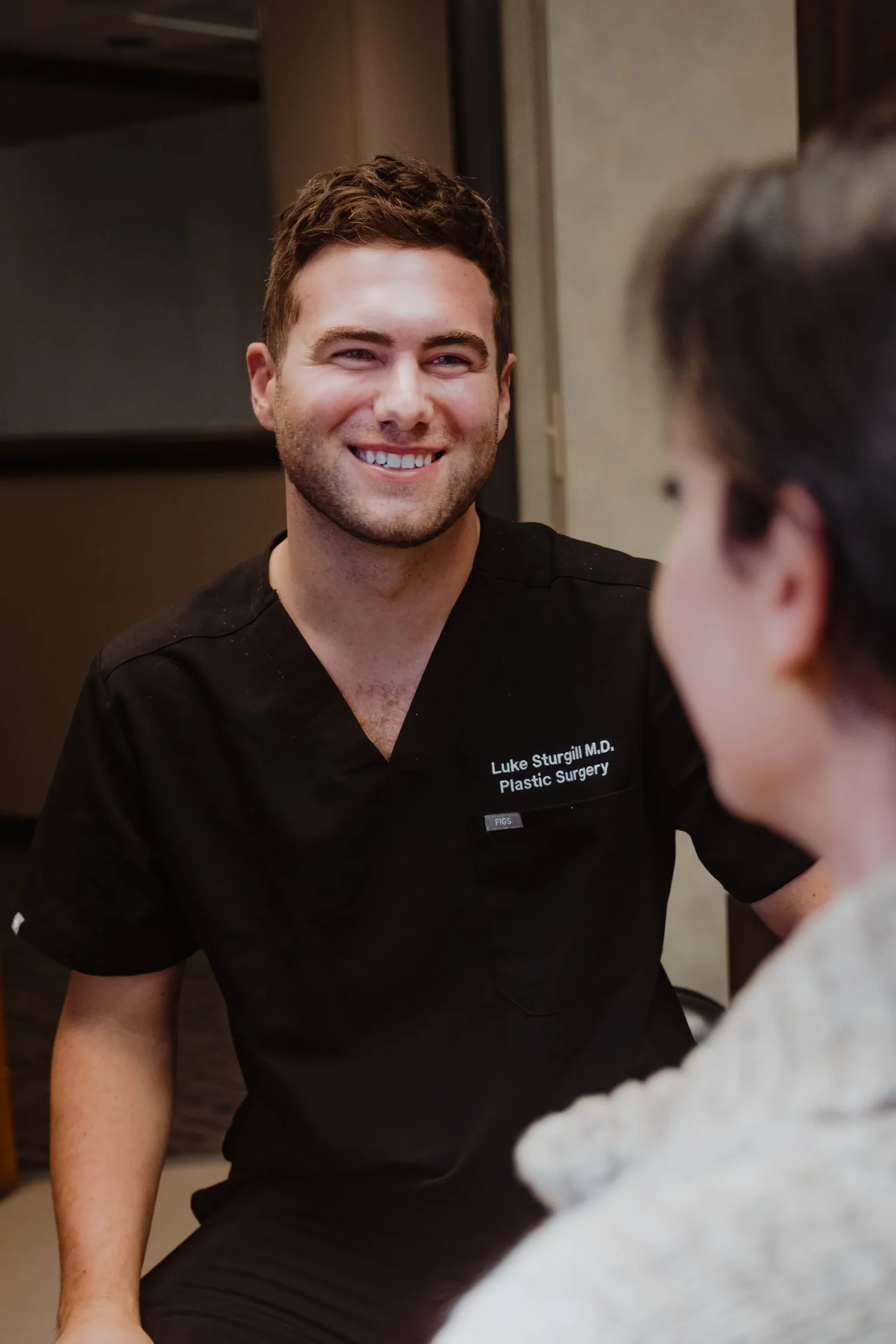
In person or during a procedure follow-up, Dr. Sturgill evaluates your skin — pigment, texture, inflammation, barrier status, goals. If a compounded prescription is the right tool, he writes it for you and sends it directly to Skin Medicinals, our compounding pharmacy partner.
02 — Verification
Your verification
Skin Medicinals reaches out to you directly by text or email to confirm billing and shipping. You review the prescription, the price, and the ingredients before anything is compounded. No guesswork.
03 — Delivery
Your medication
Your custom formulation is compounded to order and shipped to your door. Typical arrival is a few days after you verify. Refills are a tap away — and Dr. Sturgill adjusts the formula at follow-up as your skin responds.
The honest limits of prescription skincare.
A good skincare plan earns its place by knowing what it can't fix. A few things to be upfront about:
What it does well
Quality of the skin surface.
Prescription skincare changes the things that live inside the skin — pigment, inflammation, cell turnover, barrier function, fine surface lines. Used consistently, it makes the skin look healthier, more even, and more refined over months.
It also extends the result of surgical and resurfacing procedures. A primed surface ages more slowly and holds a result longer.
What it can't do
Anything structural.
It will not lift a jowl, re-drape a neck, raise a brow, open an eyelid, or replace lost facial volume. Etched-in wrinkles that live beneath the surface of the skin are remodeled by resurfacing, not topicals. Descent is remodeled by a facelift, not a cream.
When a topical is being sold as a substitute for a procedure, that's marketing — not medicine.
A prescription makes sense when your skin needs more than a shelf can offer.
A few signals Dr. Sturgill is watching for:
Questions patients ask before their first prescription.
How is this different from what a medical spa sells?
Most medical-spa skincare is cosmeceutical — stronger than drugstore, but still limited by the FDA cap on over-the-counter ingredients. Prescription skincare uses actual prescription-strength compounds, at concentrations you cannot legally buy over the counter, combined in a single compounded vehicle.
Do I need to be an existing patient to get a prescription?
Yes. Dr. Sturgill prescribes skincare as part of a clinical relationship — typically during a consultation, an in-office visit, or a post-operative follow-up. This is not a direct-to-consumer service. Your skin is evaluated before anything is written.
What does prescription skincare cost?
Pricing is set by Skin Medicinals, our compounding pharmacy partner, and varies by the compounds in your formulation. Costs are typically in line with mid-to-high-end medical skincare — but the concentrations are far higher than anything on a retail shelf. You review the exact price during the verification step before anything is compounded.
Can I use this with other products I already own?
Sometimes, sometimes not. A well-written prescription is already doing the heavy lifting. Layering retinol serums, strong acids, or competing pigment products on top can overdo it and irritate the skin. Dr. Sturgill will tell you what to keep, what to pause, and what to retire from your routine.
How long until I see results?
Pigment and texture changes usually begin at six to eight weeks, with fuller results around three to six months. Acne responds sooner — a few weeks — though it can flare before it clears. Rosacea typically calms within the first month. Consistency matters more than anything else.
Can I use prescription skincare during or after surgery?
Yes — timing matters. Certain formulations are paused in the weeks immediately around surgery and restarted at a specific point in recovery. If you're planning a facelift, eyelid procedure, or resurfacing treatment, Dr. Sturgill integrates your prescription skincare into the surgical plan.
What if my skin reacts to the formula?
Some initial purging, mild peeling, or tingling is normal — especially when a retinoid is in the mix. True irritation is a signal to adjust. Dr. Sturgill will modify the concentration, the frequency, or the compounds based on what your skin tells us. Prescription skincare is a moving target, not a fixed protocol.